

in the past month, could yet derail the
negotiations. The Conservative and
Reform movements insist on main-
taining the option of their own con-
versions and marriages — outside the
emerging framework of common stan-
dards and jurisdiction — even if these
still will not be recognized by the
state. The Orthodox reject this out of
hand.
"Trying to preserve an organization-
al bailiwick outside the unified
approach is bound to undermine the
whole thing," Rabinovitch contends at
his National Religious yeshiva in the
West Bank town of Ma'aleh Adumim.
The key to Ne'eman's efforts was to
separate Halachah, Jewish law, from
power and money. The commission
has focused on issues of personal sta-
tus, not the politics of Israel or the
Jewish world.
own marriage ceremonies, but local
Orthodox councils would send two
witnesses. If the witnesses were satis-
fied, the marriage would be registered
by the state. At present, progressive
rabbis do perform marriages in Israel,
but they are not officially recognized.
Both formulas will stand or fall by
the liberalism and goodwill of the
Orthodox courts, not exactly
renowned for either. "The proof of the
pudding," says Gideon Meir, the for-
eign minister's adviser on world Jewish
affairs, "will be in the number of con-
versions and marriages."
Hillel will have to prevail over
Shammai. The Ne'eman Commission,
it is already being suggested, may have
to soldier on to see fair play.
For their part, the Orthodox mem-
bers of the Neeman Commission are
convinced they will be able to sell this
understanding to their constituents.
One of their negotiators, Simcha
Miron, is a former administrator of
the rabbinical supreme court; another,
Eliyahu Ben-Dahan, is the present
administrator. "These people are not
outside the Chief Rabbinate establish-
ment," Rabinovitch maintains. "They
help make the policy of the Chief
Rabbinate."
To help make it all happen, despite
the demands of his day job at the
Finance Ministry, Ne'eman has been
paying almost nightly calls on influen-
tial Orthodox sages. So, to a lesser
degree, has Bobby Brown.
"Ya'acov Ne'eman has spoken to
130-140 rabbis and religious leaders,"
the prime minister's adviser reports.
"I've spoken to 38. I haven't spoken to
one who said stop the discussions.
Some question the direction it's going,
but none of them question the jour-
ney itself."
As the Orthodox see it, the
Conservative and Reform demand to
There is a truce,
but not a
reconciliation.The
walls of Jericho
have not fallen.
"What we're trying to accomplish,"
says Bobby Brown, "is to create a stan-
dard based on Halachah, and to look
on that Halachah through the eyes of
Beit Hillel, not Beit Shammai."
Two thousand years ago, Rabbis
Hillel and Shammai presided jointly
over the Sanhedrin, the supreme
Jewish religious council. The School
of Hillel personified flexibility in
adapting the Torah to changing condi-
tions. Shammai was unbending.
BY ALL ACCOUNTS, AGREE-
MENT is extremely close on the fun-
damental questions. Candidates for
conversion would study for a year in a
joint Orthodox-Conservative-Reform
"Institute of Jewish Knowledge."
When they were ready, they would
appear before an Orthodox Beit Din
(rabbinical court), which would apply
its halachic seal to the process. The
convert would have studied under the
rabbi of his or her choice, but would
have been converted by an Orthodox
court. He or she would then be fully
recognized as a Jew in Israel.
At the same time, Conservative and
Reform rabbis would perform their
1/9
1998
58
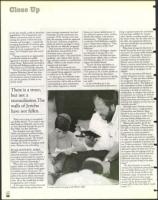
A man and his son pray at the Western Wall.
keep a separate system for conversion
and marriage available for "special
cases" throws a monkey wrench into
the whole works. On the other side of
the table, the progressives don't see
why they should give up something
they already enjoy.
What kind of cases do they have in
mind? Essentially, those that would
not receive the stamp of the Orthodo* —\
rabbinate. A marriage, for instance,
between a Cohen and a divorcee; a
marriage between an Israeli and a
Reform convert from the United
States; a convert turned down by the
Orthodox beit din because, let's say, he
wouldn't walk to synagogue on the
sabbath.
"Even the conversion bill doesn't
exclude alternative services," argues
Uri Regev. "It only says they wouldn't
be recognized. We are going to be
worse off than before. The ability of
the commission to reach a desirable
solution will depend on whether we
are going to be able to work out a
compromise, or whether there will be
an insistence on crushing the Reform
and Conservative rabbinates and dis-
abling them from providing even the
spiritual and religious services they can
currently provide."
Although some Orthodox leaders
have tried to drive a wedge between
Conservative and Reform, Ehud
Bandel is just as determined. "If the
Orthodox are trying to make us, by
our own hands, delegitimize our-
selves," he says, "we cannot go on."
—\
Rabinovitch smells a device for
putting off a decision. "If they retain
the right to function independently,"
he asks, "why should we admit them
as partners in a joint procedure?
Where will the unity element come
in? We want to go as far as is possible
in order to create a certain unity based
on common standards of personal sta-
tus. If they are sincere, I don't under-r—/
stand why they want to maintain an
alternative system of their own. If two
of us agree that we're going to live in
one house, we have to have one lock
and the same key. If one wants an
additional lock with a separate key,
we're not partners living in the same
house."
The best incentive to succeed
remains the cataclysmic price of fail-
ure. As Bobby Brown puts "Ten
percent of the Jewish world in the
Orthodox camp, 10 percent in the
Reform and Conservative camp,
would like Ne'eman to fail. Eighty
percent of the Jewish people are
scared stiff of what that failure would
mean." ❑