
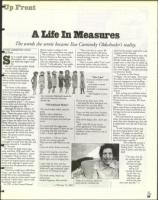

A Life In Measures
The words she wrote became Eva Caminsky Oldscheeler's reality.
LYNNE MEREDITH COHN
,-ta
Writer
S
he is a small, slight woman
who smiles a lot — so fragile,
you think she might crum-
ble.
But that's just the outside. Inside,
it's another story. Or poem.
Eva Caminsky Oldscheeler
lives in a shared room at the
unto nursing care facility.
The framed pictures on the
shelves of the shared bookcase
mostly belong -to her room-
mate.
The boxes in the corner
contain the packed belongings
of her late husband, Joe, who
died at Thanksgiving. Her
great-niece, Rhonda, brings a folder
filed with yellowed papers and
mimeographed sheets — the poems,
stories, plays and drawings Eva has
written throughout her life.
Although she had no children of
her own, Eva's words became her chil-
dren. There's the poem called "Old-
Fashioned Mother" about a mother
waiting for her daughter to get home
from a date; the letters from the late
i-fiilip Slomovitz, managing editor of
the Detroit Jewish Chronicle and pub-
lisher of The Jewish News, accepting
her work for publication; and the
sheets of music for which Eva wrote
lyrics. The poetry started coming
when she was 11.
"I enjoyed reading something, and
I thought if I could write like that and
someone enjoyed it, I would like
'ildat," Eva says.
She wrote her high school class
song, and from 1934 until 1947, her
poems appeared in Reflections, a poet-
17 magazine. There is a box in her
niece's basement filled with hundreds
of copies of original poems and scrap-
books with clippings of poems and
cartoons that she penned for various
\-,- ;blications.
"I lived in a small town called East
Tawas," says Eva, 88. "I had decided I
would like to be a schoolteacher,
taught one year in a [one-room] coun-
try school. I didn't drive, had to walk.
Sometimes I got a ride."
In 1927, at the Central Normal
/ -/ -
\-
School teacher's college in Mt.
Pleasant, Eva earned what was called
a "life certificate." Her sister Pearl
lived in Detroit, so Eva came to the
big city, worked as a typist. Then
came the Depression, and she was
laid off. "I did odd jobs," Eva recalls,
including bookkeeping for the IRS.
"Then I met Joe at a party. We
were standing around at the party,
looking at each other. After that, Joe
started coming to see me." The two
married in 1935.
There is a poem called "Lost Loves"
about her brother who was institu-
tionalized for mental illness; another
"Like A Jew"
Eva Caminsky Oldscheeler made this
pencil and watercolor drawing
decades ago.
"Old-Fashioned Mother"
The clock strikes twelve, and I'm
alone
Beside a silent telephone;
The movie ended at eleven,
And she's been gone since half past
seven.
I've waited half the night away,
And when she comes I'll have my say:
A scolding that she won't forget;
I plan, I worry, sigh and fret.
If you can weather words
of scorn,
And smile at taunts
and sneers;
And hide a countenance
forlorn
`Mid laughter in your
tears.
If you can go about your work,
And keep the faith God gave you;
And never sin, nor duty shirk,
And say `I am glad I am a Jew.'
If you can bear your heavy burdens
With strength and courage like a
Jew,
And still be happy, then you're per-
fect,
And I take off my hat to you.
(This appeared in "The Children's
Corner" of the Detroit Jewish
Chronicle, written when Eva was in
high school.)
An accident!— Oh, no, I pray,
At least not serious, anyway!
Why can't she call? Where can she
be?
I pace the room, frown nervously.
I haunt the windows, wet of eye,
As minutes endlessly creep by;
I hear a car — at last, she's here!
Relief wipes out my stinging fear.
I open wide the door and face
A goodnight kiss, a fond embrace;
Youth and a gay enchanted night
Assure me ev'rything's all right.
The harsh words, which my
smiles deny,
Unsaid, forgotten, fade and die!
Today, Eva reminisces about her
poetry and her husband, Joe.
about Jewish people, inspired by read-
ing issues of the Forward.
"My parents weren't born here. My
father went to New York; he didn't
like the inside work. A lot of Jewish
people went to Bay City; he ended up
in East Tawas," says Eva, the fourth of
five children. "My father read Jewish
first, then English." But that's all she'll
say about her family.
"I was born in East Tawas,
Michigan," she says again. These days,
Eva slides in and out of lucidity. The
diamond engagement and wedding
rings slide up and down her knobby
fingers. But behind her big eyes, her
mind catapults forward a mile a
minute.
Eva's writing was published when
people still paid for poetry and songs.
She won a piece of property in
Florida from one contest, $25 from
another.
"When I won that first $25, my
father came home, waving the check.
He was never much interested in my
writing, but he was so excited about
that," she says.
Eva's conversation is scattered; at
times, she becomes the child she was
more th.an seven decades ago; then she
is melancholic over the loss of her hus-
band.
"I wish I had been able to stop
him from dying before I did," she
laments. "I thought we should die
within a short time of each other. It
makes me feel sad. I wish we could
have lived longer together."
Eva composed a poem a
long time ago called "The
Passing Years," but did not
write it down until after Joe
died:
"The days, they fly,
the months pass by
and in the sky
the birds on high
sing merrily
and as I lie
among the flowers
to me they cry,
`Wake wake up,'
and then I sigh
and see the years
that come and die." O
— February 19, 1968
1/9
1998
19