

which had been romanticized in
Leonard Bernstein's hit musical, West
/-
Side Story.
Yet, while many New Yorkers were
appalled and incensed by Agron's
deadly deed and lack of contrition,
Simon was not among them.
"No, I wasn't," the veteran musi-
cian said. "I was too young; I didn't
realize how terrible it was. I was a
teen-ager, and it was like a movie.
"I don't think teen-agers understand;
you have to be older to understand that
a terrible thing happened and lives
were ruined. It was a tragedy. But to see
the event on the cover of the newspa-
per, it was almost the same as a James
Dean/Sal Mineo movie, which I- think
is how Salvador Agron saw it."
Simon was also struck at the time
by Agron's appearance, which he now
likens to that of "a rock 'n' roll hood-
lum" who embodied the 1950s.
"There was something about his
image," recalled Simon, who at the time
of the Agron murders was an 18-year-
old student at Queens College. "The
way he looked, the attitude and the
teen-age gang thing, which I was sort of
flirting with myself, (by) just hanging
around gangs, you know, fighting. But
after I got hit with a belt a couple of
times, I started to think, 'You know
what? I better stay with the guitar.'"
But Agron's story stayed with
Simon. Arid in 1989, while working
on his The Rhythm of the Saints
album, he began preliminary work on
what would become The Capeman.
"The idea hit me in a completed
form that was so clear, a vision that
came out of nowhere," Simon said. "I
knew it was a good idea. I didn't know
if it would pan out, and it probably
wouldn't have if it hadn't been for my
collaborators. They, particularly
Derek, made it stay afloat when I was
ready to abandon it on more than one
occasion."
Simon candidly acknowledged the
reasons why he considered abandon-
ing The Capeman. They included not
knowing how to write or structure a
play, as well as having no experience
writing characters from a play into
songs.
"I know how now," Simon said.
"And I went through a lot of changes.
I thought: 'I don't like this guy
(Agron). What if this were my 16-
year-old?' But you just stay with it.
And fortunately, my co-writer also
understood it was our journey and we
would find 'it.'"
What Simon and Walcott eventual-
ly found was a provocative tale of sin
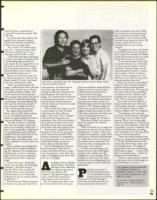
Paul Simon, second from left, with "Capeman"poformers Ruben Blades, Ednita
Nazario and Marc Anthony.
and atonement, of violence and its
invariably tragic but sometimes
redemptive aftermath. Peppered with
Spanish phrases and often raw lan-
guage, The Capeman doesn't hold back
in painting a grim picture, or in rais-
ing hope that a person's humanity,
however buried, can help him triumph
over his misdeeds.
"When Derek and I began to work
on this together in 1993, we didn't
really know the theme. We just
began," Simon said. "But it emerged.
The question of atonement and
redemption, first of all, and whether it
was a relevant question at the end of
the 20th century, since most people
don't believe that they're going to hell.
"And then the complexity of the
question is: How do you reach atone-
ment? Is atonement possible? Who
decides if atonement is completed? Is
it a societal question, or is it the indi-
vidual? How deeply can you ever
know what an individual feels?
"And if individuals don't feel terri-
ble remorse, even if they admit [a
crime], and if they still have an argu-
ment that goes on in their brain, then
what is the judgment they have? And
who are we to judge?"
A
ccording to Simon, Salvador
Agron's mother, Esmeralda,
and sister, Aurea, welcomed
him when he approached
them about his plans for The
Capeman. They granted lengthy inter-
views, as did former associates of
Agron both in and out of prison.
But The Capeman has drawn criti-
cism from relatives of the teen-agers
who were stabbed to death and from
Hispanic activists concerned that it
will perpetuate stereotypes about
Latino criminals and gangs.
Simon's also been criticized by Fred
Newman, the Manhattan psychothera-
pist and youth violence expert who
befriended Agron after his release from
prison in 1979. Newman alleges the
name of the play alone "projects this
negative image about people of color."
(The name comes from the black cape
with a red lining Agron wore as a
member of his gang, The Vampires.)
What about Simon? Is he nervous
about the response The Capeman
might receive?
"Well, it's hard for me to judge how
nervous I am, because I'm not used to
being nervous," he said. "I don't even
recognize the symptoms. I guess I have
some anxiety. But here's what alleviates
it: I think that as far as the vision of
the creative team is concerned, we'll
come very close to realizing that cre-
ative vision, if not realize it.
"So that's very reassuring to me.
Then, of course, that could happen
and the result could be met with
indifference or even hostility. That's
possible, in which case I'd be disap-
pointed, but not as disappointed as if
I put out a piece of work I didn't feel
good about."
p
aul Simon was only 16
when he and musical part-
ner Art Garfunkel scored a
national Top 50 hit with the
Simon-penned "Hey Schoolgirl,"
which they recorded under the car-
toon-inspired name Tom & Jerry.
After re-teaming in the early 1960s,
the Jewish duo earned international
fame as Simon & Garfunkel. They
disbanded in 1970, but have briefly
reunited several times since then. Old
Friends, a three-CD Simon &
Garfunkel box set, was recently
released.
Throughout his tenure with Simon
& Garfunkel, Simon wrote all of the
duo's songs. His teaming with Walcott
marks the first time he has ever collab-
orated with anyone to write lyrics.
"It was a bit awkward at first until
we got the rhythm of it, which really
in a sense was my rhythm," Simon
explained. "Because Derek's way of
approaching this would be to write a
poem and say: 'Can we set this to
music?' And my response was: `No.
We have to start from the sound and
then go backward from that.'"
Simon said he'd feel comfortable if
Songs From the Capeman included a
parental advisory warning sticker
about its explicit lyrics. "So many peo-
ple used to tell me they would play
my albums for their children, and I
wouldn't want to surprise them," he
said. "This is a grown-up album."
But he did not find it difficult to
sing the obscenities and ethnic and
racial epithets that give a visceral jolt
to such Capeman songs as "Satin
Summer Nights" and "The Vampires."
"I'm speaking in the voice of a
character," Simon stressed, "[although]
it's not like I never use these words
anyway. When I was writing songs
that were expressing what I had on my
mind, my inner landscape, I didn't feel
compelled to use that vocabulary. And
I didn't feel inhibited by not using
that vocabulary. But in the case of this
story, it's entirely appropriate.
"There's. the artistic pleasure of wan-
dering in a strange place and describing
it," he said. "And the pleasure of the
culture, the Puerto Rican culture, and
its incredible music. The delight of
going back to doo-wop and analyzing
and living in it again — a chance to be
back in my adolescence — and to col-
laborate with Derek Walcott.
"There's so much pleasure involved
in this process that it could sustain us,
and did sustain us, for years." 0
The Capernan is being perfOrme
at the Marquis Theatre on
Broadway- at 46th St. in New 'York
City. For ticket information, call
(800) 755-4000.
For a rezi.iew of "Songs From the
Capemati, see "Mixed Media' on
page 76.
1/2
1998
71