

`The
Capeman'
Cometh
Amid controversy, Paul Simon's new
musical is set to open on Broadway.
CAPEMAN
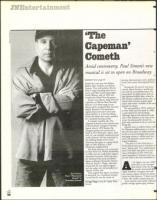
Paul Simon:
From "Homeward
Bound" to
Broadway bound.
1/2
1998
70
from page 69
headed by Latin-pop stars Ruben
Blades, Marc Anthony and Ednita
Nazario. They will perform 38 new
Simon songs, featuring lyrics he co-
wrote with West Indian playwright
Derek Walcott, who in 1992 was
awarded the Nobel Prize for poetry.
Simon's new album, Songs From the
Capeman, on Warner Bros. Records,
features 13 of those songs (a cast
album will be produced after the show
opens). Because of its sometimes
explicit lyrics and use of racial and
ethnic epithets, it is the first album
Simon has made that nearly qualified
for a parental warning sticker.
A complex morality tale, The
Capeman is based on the real-life story
of Puerto Rican immigrant Salvador
Agron, who in 1959 became the
youngest person ever sentenced to
death in New York state. Agron, then
only 16, was virtually uneducated and
nearly destitute. He was convicted in
-
the stabbing deaths of two Irish-
American teen-agers in a gang-related
fight in Hell's Kitchen, a mid-
Manhattan neighborhood.
His death sentence was commuted
by New York Gov. Nelson Rockefeller
in 1962, just one week before Agron's
scheduled execution, following pleas
for clemency from such prominent
figures as Eleanor Roosevelt; District
Attorney Frank S. Hogan, who had
prosecuted the case against Agron;
and the judge who had presided over
Agron's murder trial.
They argued that Agron was severe-
ly disturbed, not a hardened murder-
er, and that he was the victim of
George Varga writes for Copley News
Service.
poverty, discrimination and a dysfunc-
tional (and nearly disintegrated) fami-
ly.
During the 20 years he was incar-
cerated, Agron became a model pris-
oner and an accomplished poet. He
earned both his high school and col-
lege diplomas behind bars, where he
also became a jailhouse lawyer who
helped other inmates prepare legal
papers and wrote a number of his own
appeals for release.
He was paroled in 1979, and lived
in New.York until his death in 1986,
a week before his 43rd birthday.
Although Agron had admitted to his
role in the murders at the time of his
arrest, he subsequently denied his
guilt and continued to do so until hi_
dying day.
Agron's story, as told by Simon and
his Capeman collaborators, is a time-
less one that takes on added resonance
in this era of increasingly fatal youth
and gang violence, volatile racial ten-
sions and persistent social and eco-
nomic inequities.
"The story is a New York story, a
Puerto Rican story and an American ---
story," Simon said. "It's a multicultural
story. This didn't take place in a vacu-
um; it took place in New York City,
and I remember it. Everyone who was
in New York at the time remembers it."
A
t 16, Agron was just a little
more than a year younger
than Simon when his arrest ,
for murder dominated Big —`
Apple headlines. Arrogant and with-
out remorse, Agron created an uproar
when he told reporters: "I don't care if
I burn. My mother could watch me."
Such remarks only further inflamed
public outrage against gang violence,