

The BIG Story
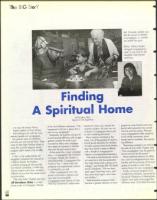
Left: Consider whether you
like the sound of children
at synagogue, or whether
you prefer the quiet.
Below: Nancy Kaplan
changed congregations
when it was time for her
daughter's bat-mitzvah
ceremony.
Finding
A Spiritual Home
dill Davidson Sklar
Special to The AppleTree
n a way, the reason Nancy
Kaplan settled on B'nai Moshe
had nothing to do with the main
reasons people join synagogues.
Her parents were not members,
and she was not married there. There
were no free High Holiday tickets to
sway her, and the religious school
program didn't make a lick of differ-
ence.
In fact, in the weeks before her
daughter's scheduled bat mitzvah at
a Reform temple, the Kaplans
switched synagogues because the
bat mitzvah candidate, a Hillel Day
School student at the time, wanted a
different service than the temple could
accommodate.
"We were lucky," Kaplan says now
Jill Davidson Sklar is a free-
lance writer in Huntington Woods.
1/2
1998
50
of her shul affiliation adventure. "We
happened to fall into a place that is
now on my wavelength."
Nationally, the Kaplans are part of
a trend toward affiliating with congre-
gations. Locally, the trend is pro-
nounced as many area congrega-
tions report an increase in member-
ship over the past several years.
At the same time, newer congrega-
tions — Congregation Bet Chaverim
in Canton, Temple Shir Shalom in
West Bloomfield, Congregation Shir
Tikvah in Troy — have come into
existence and experienced a boom
in membership, as well.
Other congregations not in the
Jewish northwestern migration pat-
terns also have benefited.
Congregation Beth Shalom in Oak
Park has maintained a stable mem-
bership for years and, despite the
migratory pattern, this year saw an
increase in congregants due in part
to new marketing techniques.
Many reasons contribute to the
trend, one of the: greatest of which is
formal Jewish education for children.
As baby boomers have had children,
they have found a need to affiliate
with a temple or synagogue for
Hebrew or nursery-school education.
"We tend to lose the Jewish individ-
ual when he or she has graduated
from high school and is going on to
college," said Temple Beth El's Rabbi
David Castiglione. "We see them
back again when they marry, and
they come back again when there
are children."
Adult education programs have
become a greater attraction at syna-
gogues as more formal community
Jewish adult education has waned
over the past few years. Although
many congregations offer programs
to the whole community, tuition
breaks are for members, thus promot-
ing affiliation.
"Becoming involved is not only for
the sake of your child," Kaplan said.
"One congregation may be great for
the kid and not for. the parent."
More traditional reasons for affilia-
tion, such as multi-generational mem-
bership and the proximity of the syna-
gogue or temple to one home,
remain factors for new congregants. ,'
Finally, communal programs such
as Rekindling Shabbat, sponsored by
the Jewish Federation of Metropolitan
Detroit, have subtly encouraged the
affiliation trend. To facilitate the move-