

•
ters or his members. They draw their
strength from him and from one
another. It's a strength that has
enabled this congregation to grow in
about 15 years from a handful of
member families to over 250 fami-
lies.
Shir Tikvah, which means "Song
of Hope," is building a shul in the
woods at Wattles and Northfield
Parkway. The shul will be surround-
ed by some five acres of trees, nature
trails and places where meditation,
prayer and spirituality will be possi-
ble.
For some of its members, those
words were not possible west of
Woodward. It wasn't a case of wor-
in West Bloomfield or
ly
Southfield, many found that living
with addresses in Troy or Rochester
was just more suitable. The majority
of Shir Tikvah members live in the
area. Yet, they find their Jewishness
affirmed in a circle of friends outside
of what would be considered the
mainline Jewish neighborhood.
The "neighborhood" by Shir
aTikvah is changing. While the
majority of its member families have
two Jewish spouses, the congregation
is accepting of intermarried families
as well. Indeed, non-Jewish spouses
can serve on the board and help the
Jewish members in many ways.
While the jury is out on the level of
acceptance of homosexual Jews in
many other congregations, there are
I a number of gays and lesbians who
find themselves davening there regu-
larly. Where is there? Currently, Shir
Tikvah uses the Noithminster
Presbyterian Church in Troy for ser-
vices. The congregation, though, has
held services in churches all over the
area, hanging a banner over the cru-
cifix in most cases.
The symbolism of the growth of
Shir Tikvah is possibly best depicted
if one gets to know the spiritual
leader many know simply as Rabbi
Arnie.
His grandparents came to
Michigan, barely escaping the
Holocaust. Their fear of what they
left behind was transmitted to their
children and grandchildren. Arnie
was not to talk about his Jewishness
outside of the house. His mom and
dad ran their clothing store, largely
of farm-type apparel for the commu-
nity. They attended church dinners.
There was no menorah in the win-
dow during Chanukah. It was a
secret he'd keep hidden. Over the
years, though, his family would go
on to join the synagogue in Jackson.
Sleutelberg would attend Albion
College. He looked for a profession
that would include teaching, coun-
seling, speaking and public relations.
"I had developed a love for
Judaism," he said. "I was teaching
religious school in Jackson."
He would attend the Hebrew
Union College with time spent in
Israel and in Cincinnati. It was the
first time he'd be emersed in a Jewish
environment. What he learned there
would shape him in many ways.
Sometimes, leaders learn how not to
lead as well.
"I remember the ivory tower cold-
ness of the faculty by and large," he
would say. "There was a rejection of
individuality and diversity.
"I was looking for Shir Tikvah,"
he said. "There's a tremendous
amount of pressure to be an assistant
rabbi at a large congregation, and I
knew it wasn't. for me."
What was for Rabbi Sleutelberg
would get its start in the parking lot
of Bemis Elementary School in Troy.
There, Phyllis Wenig and Pam
Spitzer talked about the need to
form a congregation. Bemis was the
location of a United Hebrew Schools
afternoon religious school for the
area children. An organizational
meeting drew 18 families. A month
later, some 70 families came.
"My husband and I met Arnie
*
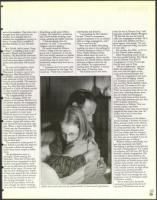
Rabbi Arnie's work with teens has produced leaders in ewish youth organizations.
when he was in Traverse City," said
- long-time member Marsha Wengrow.
"We felt that this was the kind of
rabbi our congregation needed. He is
very good with children and has a
great rapport with people. Oh, and
the most important thing, my moth-
er loves him."
Her mother, Ann Peltz, at 94-1/2
is Shir Tikvah's oldest member.
Rabbi Sleutelberg would divide
his time equally between Shir Tikvah
and the Traverse City Beth El
Congregation. It was 10 years ago
that he came over to Troy.
"We do it differently," was how
Rabbi Sleutelberg put it. "What I
hear over and over again is how
warm and welcomed people feel."
What the congregation also hears
is a great deal of singing. Indeed,
new members are given a cassette
tape and Shir Tikvah Shabbat siddur
for services. The music is all a cap-
pella, so there are no distractions.
There are members from all over the
metro area, including former mem-
bers of temples and synagogues
located much closer to their homes.
Many shul members said that they
didn't consider themselves
Conservative or Reform. They just
wanted a place, says Rabbi
Sleutelberg, where they weren't being
judged for the money they had, the
clothes they wore or even their
Jewish backgrounds.
"The key element of the Reform
Jewish theology is freedom of choice.
We're serving a niche in the Detroit
Jewish community that seems not to
be served anywhere else. We serve
people from great distances, and
we've just always had this inclusive
nature about us. When you walk in
the door, you are accepted if you are
intermarried, gay or lesbian."
Without saying it specifically, one
gets the impression that Rabbi
Sleutelberg is perhaps concerned that
his shul is being typecast. It is a place
of inclusion, he'll tell you. But this is
basically a family congregation. The
word family is about diversity. Yet
the overwhelming majority of family
memberships are Jewish parents with
children born Jewish. And, the Shir
Tikvah religious school is bursting
with constant activity. Its high school
students have produced leaders
among the National Federation of
Temple Youth even though the con-
gregation is one of Michigan's small-
est Reform temples.
"For so many years, the Jewish
community considered that Jews liv-
ing east of Woodward were on the
12/26
1997
73