
and owners of businesses. Because of a
common Eastern European origin,
class distinctions are not sharp."
Through his research in local his-
torical societies, libraries and court-
houses, and interviews with neighbors,
friends — including "all the surviving
members of Dylan's high school rock
band" — and classmates, author Engel
weaves the story of young Bob Dylan
through historical and cultural mark-
ers in the life of the North Country.
The collage-like book includes sto-
ries of Dylan's supportive, extended
not of the shofar but of the electric
guitar is what set Dylan on the track
of his muse.
The book ends at the time Dylan,
like the freight trains carrying iron
ore, rolls out of Hibbing. Following
his 1959 high school graduation, he
enrolled at the University of
Minnesota. He briefly hung around
Sigma Alpha Mu, the Jewish fraternity
on campus.
"His parents hoped he would study
something useful, but, during his one
school year plus a quarter, his main
preoccupation was learning to
play folk music, meanwhile
assuming a new identity," Engel
writes.
gospel singer Odetta — over and over
Much has been made of Dylan's
again until most of the fraternity broth-
penchant for re-creating his
ers had vacated the premises out of des-
identity. (One of the numerous
peration — and the most raspy singing
Dylan comments peppered
voice you'd ever want to hear, the young
through Engel's book is a
Zimmerman was a likable fellow and
remark quoted in Anthony
proved to be an accommodating room-
Scaduto's Bob Dylan: An
mate.
Intimate Biography: "Did I ever
One night my father and his new
tell ya I got my nose
friend were sit-
from the Indian blood
F. v;
ting around try-
in my veins? Well, that's
ing to determine
o.s. the truth, hey. Got an
a good date for
uncle who's a Sioux.")
my dad. "Short
Certainly, Dylan has
and Jewish" were
emerged in different
the two main cri-
incarnations through his
teria.
35-year musical career.
My mother
His 1978 public profes-
had been a camp
sion of Christianity
buddy of
made him, in the words
Zimmerman's
of one observer, "per-
during their final
haps the most famous
days at Herzl
Jewish apostate in
Camp in
American history." ❑
Webster, Wis.,
and was then a
Bob Zimmerman in
freshman at the
his 1959 high school
"The Kennedy Center
University of
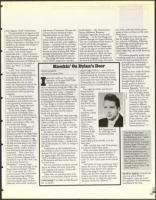
graduation picture.
Honors: A Celebration of
Minnesota. She
the Performing Arts," which
came highly rec-
this year salutes Lauren
ommended and fit the bill, or so the
Bacall, Bob Dylan, Charlton
story goes.
Heston, Jessye Norman and
After a double date with Zimmerman,
Edward Villela in recogni-
my parents took it from there.
tion of their contributions to
Some years later, Bob Dylan had gone
America's
performing arts,
on to become the anointed prophet of
will
be
broadcast
9-11 p.m.
his generation; my mother and father
tonight on CBS-Channel 62.
had moved on to a two-story walk-up in
Just Like Bob Zimmerman's
scenic St. Paul. Their paths never crossed
Blues: Dylan in Minnesota is
again.
available at bookstores or
And while the three months my father
through Amherst Press. Call
shared the room at the Sigma Alpha Mu
(800) 333-8122.
fraternity house doesn't even register a
blip on the singer's cosmic scale of
things, and has been relegated to minor
Mordecai Spektor writes for the
trivia in my father's mind, for my sister,
American Jewish World in
brother and me, it's made for great cock-
Minneapolis, where this article
tail party chatter for a lifetime. ❑
first appeared. Gail Zimmerman
Jewish family — the Zimmermans,
Stones, Edelstein, Rutsteins,
Deutsches, Agranoffs, Divines and
Goldbergs — on the Iron Range and
scattered through the Upper Midwest.
The text is interspersed with dozens of
archival and family photographs.
Engel evokes the Iron Range land-
scape on the edge of northern wilder-
ness and sketches a portrait of the
artist as a young Jew. While the close-
knit Jewish communal life revolved
around the synagogue, Hadassah and
the local B'nai B'rith lodge, the sound
Knockin' On Dylan's Door
LESLIE JOSEPH
Special to The Jewish News
I guess you could say I'm a quasi-
byproduct of the great Bob Dylan
himself, quite literally.
Now anyone who grew up in the
state of Minnesota during the 1940s, '50s
and '60s seems to have a "I knew Bobby
Zimmerman when" story — whether it
was hanging out at the Five O'Clock
Scholar on the University of Minnesota
campus, where Zimmerman used to sing,
or attending bar mitzvahs together up on
the Iron Range in northern Minnesota.
I like to think of mine as somewhat
unique since I may not have even been
here had it not been for this indirect
brush with greatness.
I first heard this story many years ago,
long before I even had a vague notion of
who this purported poet supreme of the
1960s actually was. As I grew older, it
became apparent to me that my origins
really were kind of a novelty — in a "bit
part to the stars" sort of way.
My father, a native of New York, who
had the classic New Yorker's view of the
country — the Brooklyn Bridge is just
east of the Grand Canyon, which is just
east of the Pacific Ocean — landed him-
self in Minneapolis in 1959, an ensign in
the Navy.
A newcomer to this landlocked tun-
dra, he had no place to stay or names to
look up. He met a group of men from
the Sigma Alpha Mu fraternity house
while scrounging around the University
of Minnesota, and they invited him to
live with them.
His new roommate would be, accord-
ing to my father, this kind of peculiar
but outgoing and popular 18-year-old
named Bob Zimmerman.
Other than an annoying habit of lis-
tening to one particular song by the late
Leslie Joseph is an editor at Gale Research
Inc. in Detroit.
Photo fro m "Just Like Bo b Zimmerma
ther, Zigman "Zisel" Zimmerman.
The grandchild of immigrants who
got out of anti-Semitic Lithuania and-
Ukraine when the getting was good,
Dylan was raised in Hibbing, his
mother's hometown, a thriving city of
18,000 on the Mesabi Iron Range in
northern Minnesota.
Actually, the economic boon of
iron ore — the world's largest
exploitable lode — was so immense
that, beginning in 1919 and continu-
ing into the 1940s, the commercial
buildings and houses of Hibbing were
literally moved to a site south of
town, the "New" or "South"
Hibbing.
In the "New" Hibbing, writes
Dave Engel, the Zimmerman
uncles Maurice and Paul had been
running Micka (pronounced
Mike-ah) Electric, an electrical
contracting firm, for six years
when Abe Zimmerman moved his
family from Duluth to Hibbing
and joined his brothers as secre-
tary-treasurer of the prospering
company.
The Zimmerman brothers'
electrical contracting firm later
expanded to deal in both new and
used appliances and furniture,
becoming the "largest electrical
supplies outlet in Hibbing."
In the book, Engel, a history
writer based in Rudolph,. Wis.,
sets the early life of Bob Dylan in
the context of 20th-century life in
the adjacent cities of Duluth,
Minn., and Superior, Wis., and
the nearby Iron Range.
It is into this melting pot of
Eastern European immigrants
that Great-Grandpa Boruch
Edelstein landed in his flight from
Kovno, Lithuania. Another Dylan
forebear, Zisel Zimmerman, age
31, left Odessa, Ukraine, in 1906.
He did not look back at the "anti-
Semitic mobs ... student protests,
peasant revolts, worker strikes, a
war with Japan and attempts at
revolution ... With a few thou-
sand of the millions ()flews to
come to America, Zigman finds
himself, by way of New York City,
on the frosty frontier of
Minnesota," recounts Engel.
The Jews took advantage of the
boom times in Duluth, "Zenith
City" it was called. By 1941, a
survey counted "877 Jewish fami-
ly units comprising 2,633 per-
sons; 903 foreign born, 79 per-
cent from Russia and Lithuania.
Most are 'white collar' employees
•
contributed to this story.
Scanned image of the page. Keyboard directions: use + to zoom in, - to zoom out, arrow keys to pan inside the viewer.
December 26, 1997 - Image 115
- Resource type:
- Text
- Publication:
- The Detroit Jewish News, 1997-12-26
Disclaimer: Computer generated plain text may have errors. Read more about this.