

•r
Girt
•
4.-
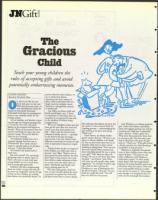
The
Gracious
Child
Teach your young children the
rules of accepting gifis and avoid
potentially embarrassing moments.
ELAINE HADDEN
Special to The Jewish News
O
h, this is just like the one
Aunt Judy gave me last year."
With this pronouncement, 6-
year-old Adrianne hastily dis-
misses the beautifully illustrated
Chanukah book that her grandparents
have so very carefully chosen for her
holiday present.
It's her birthday, and Martha is plow-
ing through her wrapped packages like
a- crazed-urre7-She-Tears- each-open;
glances at the contents and begins on
another. When all the presents from her
parents and family are open, she runs
upstairs crying. The toy she had her
heart set on is missing.
The babysitter brings your son a
wrapped package from her trip to
Disneyworld. Your "pride and joy"
opens it, casually tosses it on the floor
and says, "I don't like Simba."
You look for the nearest hole to
climb into.
But steel yourself. The upcoming
gift-giving season is almost upon us.
Now is the time to work with your
young children to try to teach them
how to accept gifts graciously.
' Children's television programming
slams our tender young ones with ads
for every toy imaginable; and by the age
of three or four, children are making
their desires very specifically known. As
12/19
1997
80
parents who love their: children, we
try to satisfy their desires.
Sometimes the sheer,volume of
gifts a child is presented with on a
single occasion precludes sincere
thanks for a thoughtfully selected
or modest gift.
Gay Haley, an Atlanta child and
family psychologist, says, "I think
it's important to remember there are
situations in our general life that add
to the problem of children being
unappreciative.
We-are.airin
-7diilgent societya—d
n chit
dren get far more than they need and
much more than their parents ever
did." Add to that the trend toward
elaborate birthday parties — especially
in the three-to-six-year-old range —
and its easy to see why children have
difficulty connecting the receipt of a gift
with an appropriate expression of grati-
tude.
"Much of what we do is in excess of
what children can really cope with or
process," says Haley. "Parents want to
have parties for their children; but they
don't want to leave anyone out or ask
their child to make exclusionary choic-
es, so they invite the whole class to a
party." Add family and friends, and
you're ordering pizza for 20.
With that many guests, there's no
time to open the gifts during the party,
so presents are opened later when the
gift givers aren't there to receive thanks.
Not only does this deprive the giver, but
the receiver is then removed from the
thanking process — acknowledging the
gift, looking at the giver and saying
"thank you."
Karen Pinson, an Atlanta kinder-
garten teacher observes, "We have a ten-
dency to tell our children to be thank-
ful, but we don't teach them how to be
thankful. Help them in their critical
thinking by asking them "How can you
show your thanks wheil someone has
done something special for you or given
you a gift?" Their ideas are often sur-
prising. "Be sure to tell them their ideas
are good, " says Pinson, "and if they
can't come up with specific ideas, make
suggestions." An example would be urg-
ing a child to draw a picture for
Grandma as a way of thanking her for
the gift of sneakers. Then ask, "Do you
think she would like that?" This will
draw the child into the process.
_ Judy Wohlman, an Atlanta psycholo T
gist, works with children and adoles-
cents and suggests starting very early by
teaching your child how to physically
open a present. "Make a game of it.
Wrap some boxes and show them how
to unwrap a gift. Tell them they must
look at the person who gives the gift
and say "Thank you." If the gift is from
a family member, the child should get
up and kiss or hug the giver."
Wohlman is emphatic that parents
must let their children know what they
expect of them. "The place we can
make a difference with children is
`antecedent control.' In other words,
think ahead. Talk about appropriate
behavior for being thankful, and be spe-
cific about what you expect. Don't wait
until unacceptable behavior is under
way and try to correct it." Most impor-
tant, though, is to emphasize that it is
really not the actual gift that matters,