

c)
Cigars And Shofars
Three young Detroiters spent a few days in Cuba to see how
the Jewish community lives.
JULIE EDGAR
News Editor
p
oor, yes. Miserable, no.
That sums up life for
Cuba's 1,200 to 1,800 Jews,
according to the leader of
Havana's Jewish community.
And that was the assessment of a
group of Detroit Jews that traveled to
Havana last week as part of a UJA
Young Leadership Cabinet mission.
"The Jews we met didn't want to
emigrate. Most of them were com-
munists. They could've emigrated in
1960
— a million-plus people left.
.,..-
,
i these people stayed because they
believed there had to be a better sys-
tern and they were open to trying
communism. They love Cuba; it's
their country," said Rob Orley, a co-
leader of the mission and one of three
Detroiters who flew to the island
from the Bahamas on an Air Cubana
prop plane.
a "The Jews in Cuba feel no anti-
Semitism. We asked them about it.
The non-Jews were thrilled we were
there to help the Jewish community
because, they said, 'You're helping
Cubans,'" Orley continued.
The 39-member group visited
Havana's three synagogues, its Jewish
center (the Patronato), cemetery and
kosher butcher and hung out with a
group of young Sunday school teach-
ers and youth counselors, or
madrachim. They were treated to
Israeli dancing and Hebrew songs and
a skit by youth groups at the
Patronato. They squeezed in a visit to
a cigar factory, too. Throughout the
five days, they heard from Dr. Jose
Miller, the "president" of Havana's
Jewish community whose parents emi-
grated to Cuba from Lithuania and
Poland. "Everyone we met was open
and warm and wanted to hear about
our lives and tell us about theirs,"
Orley said. "'We have poverty but we
have no misery,' Dr. Miller told us.
While they were very poor they were
proud."
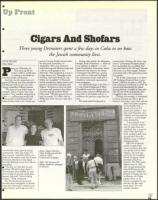
Above: Eugene Sherizen,
Heidi Fischgrund and Rob
Orley in Cuba's
Conservative synagogue.
Right: The doorway of a
defunct Sephardic synagogue
in Havana.
Among other goods, the delegation
brought loads of medicine — much of
it as ordinary as Tylenol — to the
Joint Distribution Committee, which
distributed the items to the Jewish
community. The JDC has -a perma-
nent office in Cuba and has helped
the community sustain itself and to
rebuild its communal organizations
and synagogues.
In a journal she kept of the Dec. 7-
11 trip, Heidi Fischgrund of West
Bloomfield noted that despite their
fears, Cuban customs officials did not
stop them at the border and try to
confiscate the precious cargo they car-
ried.
The week jolted Fischgrund in
myriad ways. Havana, she wrote, was
once a "picturesque European jewel,"
but its grandeur has crumbled. The
cars date back to the '40s and '50s and
electricity is in short supply. Families
extending back a few generations share
tiny spaces.
The Jewish community is no better
off. Fischgrund learned that it num-
bered 15,000 at its peak in 1952. By
the communist revolution in 1959, 90
percent had abandoned the island,
leaving behind a handful of Jews who,
like the rest of the population, have
struggled to eke out an existence.
Chicken, for example, is considered
a luxury Families are able to get it
three or four times a year. Jews can use
their food ration coupons
to buy kosher beef—
there's a limit of 3/4
pound per month — but
they must find their own
chickens and take them to
a shochet, or ritual slaugh-
terer, themselves.
"I was amazed to see
there is a Jewish commu-
nity 90 miles from the
mainland that is impover-
ished. They don't have
food, medicine and cloth-
ing and don't have the
freedom to go to Israel,"
Fischgrund said.
After the revolution,
which brought Fidel
Castro to power, Jews did
not openly practice their
religion, but were sup-
ported by the Canadian
Jewish Congress, which
provided matzah on
Passover. The JDC estab-
lished a base in 1992,
after the government lift-
ed prohibitions on reli-
gious practice. While 80
percent of Cuba's Jews live
in Havana, the Cuban
capital, there are 20
Jewish congregations out-
side the city that each
boast about 10 to 30
member families.
12/19
1997
19