

These two seemingly contradictory
movements, says Fine, actually are
working together to create a more
individualistic wedding ceremony that
has real meaning to the bride and
groom.
"Our goal was to highlight aspects
friendship and love — what our
marriage is really about," says
Southfield native Debbie Goodfriend
Kennedy, who got married three
months ago. Her husband Scott
Kennedy is not Jewish. The couple was
married under a chuppah in Madison,
Wis., by a Reform rabbi, but they
wrote their own ceremony and had the
seven traditional wedding blessings read
it English.
Yet, true to Fine's account of the
breaking with and returning to tradi-
tion that appears to be happening all at
once, Goodfriend and Kennedy chose
to incorporate a very old Jewish custom
into their wedding.
The bride and groom signed their
ketubah during the ceremony, which
is not a common practice by today's
tkandards. Since the ketubah is what
makes the marriage official, the couple
decided to highlight the signing, for
all their friends and relatives to wit-
ness.
Another historic wedding practice
making a comeback is circling — '90s
style. Traditionally, the bride circled the
groom seven times. Reasons for this
iractice vary from symbolizing a magi-
cal form of protection to indicating
that the man has become the center of
the bride's world.
These days, many Jewish couples
take from that tradition and circle each
other, to emphasize their mutual corn-
mitment and bond.
Such modern-day modifications on
the Jewish wedding can actually add a
,s.ense of religion to the ceremony, says
rine.
Take the example of an inter-cultur-
al wedding where the bride and groom
wanted to incorporate the Native
American tradition of the talking stick,
which gives the person holding it the
right to speak in a group. Since the
stick has no place in the Jewish wed-
ding, Fine suggested a compromise.
substituted the yad, a pointer used
in Torah reading, for an actual talking
stick. The yad was passed around, giv-
ing each guest the chance to say a bless-
ing over the bride and groom.
"It was really beautiful," Fine says.
'And many of the older women in the
group told me they had never actually
held a yad. It had been a symbol of a
lot of oppression for them, and this
experience allowed them to reclaim
that tradition."
Modifying tradition — both Jewish
and secular — is not confined to the
ceremony. Rather than get pelted with
customary rice, guests at the
Goodfriend-Kennedy nuptials received
bottles of bubbles as they left the sanc-
tuary, which were blown at the bride
and groom as they emerged from the
synagogue.
Gabe Levitt of West Bloomfield and
his new wife Kai did away with tossing
the bouquet and garter belt at their
recent reception. The groom's mom
Phyllis Levitt said they just didn't want
to interrupt the dancing and revelry.
Also, party favors, which West
Bloomfield wedding consultant
Andrea Solomon says used to be
a strict no-no at Jewish wed-
dings, are starting to appear with
frequency. At one recent Jewish
wedding, key chains engraved
with names of the bride and
groom were passed out when
guests retrieved their cars from
valets, Solomon says. Other
Jewish couples are giving away
etched wine bottles.
"People like giving something to
remember the occasion," Solomon
explains. "Christian people have always
done it."
Christian, Jewish — we all pick up
and adapt wedding customs from each
other, says Rabbi Schwartz. Take for
example the wedding program, which
has become commonplace at Jewish
ceremonies. Printing up a program is
not particularly Jewish, says Solomon,
but it's a nice keepsake — and it serves
the practical purpose of telling guests
who is in the wedding party.
Nowadays, with an increase in the
number of Jewish young adults becom-
ing more observant, a program can
help guide less observant or gentile
guests in understanding the customs
and rituals of the ceremony.
The possibilities, it seems, are end-
less. But at least after all this planning,
praying and partying, couples know
they can relax on an indulgent honey-
moon.
Or not.
Says Nevins, the honeymoon also is
less than Jewish.
"Traditionally, the newlyweds would
stay around for seven days to attend
parties," says the rabbi; the parties,
called sheva brachot (seven blessings),
are hosted each day after the wedding,
in honor of the bridal couple.
But, after all, rules sometimes are
made to be broken. ❑
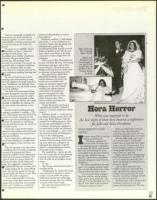
Right: Matt and
Jodi Friedman,
before the
Below: Jodi
_Friedman's cast
ran the length of
her leg for three
months after she
fell from a hoist-
ed chair during
the Hora.
What was supposed to be
the best night of their lives became a nightmare
for Jodi and Matt Friedman.
LYNNE MEREDITH COHN
Staff Writer
t almost seemed like it was hap-
I pening to someone else.
The dream wedding that
Jodi and Matt Friedman spent
a year planning became a nightmare
as the bride slid off the chair, hoisted
above the crowd during the Flora,
and crashed to the ground, breaking
her right leg. Instead of waving
farewell to guests from a limousine,
the bride and groom rushed into an
ambulance.
Now, three months later, they just
want to be a regular married couple.
Oh, and take the honeymoon to San
Francisco that they had to cancel.
"A lot of people think as long as
they have someone strong holding
them, they're going to be safe," says
Jodi, 26. "No one did drop me. I just
slid off. Even Matt in his tux wasn't
100 percent secure in the air."
Jodi's satin dress had no traction
with the chair; when the bride
reached for the chair's arms, she was
horrified to find that there were none.
And she didn't really want to go
up in the first place. "I had made
myself clear to everybody that I didn't
want to do this Everyone said, Its a
Jewish wedding tradition, you'll have
strong people holding you It just
takes a firm no," says Jodi.
Rabbi Steven Weil of Young Israel
Oak Park says listen to the bride. If
it's not a simcha for the bride, then
there's no mitzvah [in raising the cou-
ple up on chairs]."
Laid up since September and
unable to drive since she broke her
right leg, Jodi's been doing research,
trying to find a reason for the tradi-
tion that ruined her wedding. She has
come up with nothing solid.
She found one reason based on the
Orthodox tradition of men and
women dancing separately. The theo-
12/12
1997
71