

Up Front
-1
LONNY GOLDSMITH
StaffWriter
1V1
Photo courtesy of Marty Glickman
arty Glickman still
sometimes can't sleep at
night.
Sixty-one years ago,
Gliclunan's dream of sprinting to a
gold medal was halted by Hitler. His
offense: he was a Jew.
Starting today, and running
through March 15, the Public Muse-
um of Grand Rapids' Van Andel
Museum Center is hosting an exhibit
devoted to one of the darker periods
in the Olympics' history.
"The Nazi Olympics: Berlin 1936"
will make the west Michigan city its
only stop in the state, and the initial
stop on an international tour. The dis-
play, from the United States Holo-
caust Memorial Museum in Washing-
ton, D.C., will end its journey in Syd-
ney, Australia, in the summer of 2000
for the Olympics.
On Sunday, Glickman will be the
keynote speaker at the opening event.
He'll be joined by
Walter Reich, the
director of the
Washington, D.C.
museum.
In 1936, Glick-
man was scheduled
to run on the U.S.
400-meter relay
team in Berlin.
'Abe Stoller and
I were the only two
Jews on the track
team," said Glick-
man, a Hall of
Fame sportscaster.
"We weren't
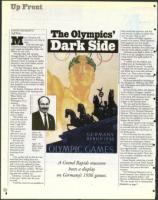
Above: An
allowed to run on
80-year-old
the team because
Marty Glick-
we were Jewish."
man.
But their reli-
gion wasn't the
Ri ht: The
stated reason for
official poster
their last-minute
of the 1936
dismissal on the
Olympics.
morning of the
race.
"Our coaches told us that the Ger-
mans had been hiding their best
sprinters for the race, and that Abe
and I were to be replaced by Jesse
Owens and Ralph Metcalf," the 80-
year-old Glickman recalled. "We had
been in Berlin for two weeks practic-
ing, and now couldn't race."
Glickman, "a brash 18-year-old
at the time," didn't take the news
too well.
"I told the coach it's not possible to
12/12
1997
6
A Grand Rapids museum
hosts a display
on Germany's 1936 games.
hide world-class sprinters, and that
we'd win by 15 yards no matter who
ran," he said. 'And we did."
The rumors of hidden sprinters
proved to be untrue. What Glickman
feels happened was that Joseph
Goebbels told American Olympic
Committee President Avery Brundage
that the Jewish athletes courdn't run.
Glickman went back to Berlin in •
1985 to set up a program commemo-
rating Owens' four gold medals 50
years earlier.
"I walked into the stadium and
walked onto the backstretch of the
track I should've run on," he recalls.
"I looked into the stands and saw the
seat Hitler sat in every day, and saw
where I sat. Then a wave of anger
came over me, and I began screaming
It was a catharsis."
Glickman planned on returning to
the Olympics. in 1940, but the 1940
and 1944 games were called off due to
World War II.
Another Jewish athlete who figures
in the exhibit is Margaret Lambert
who, in 1937 (named Gretel Bergman
at the time), left Germany for the
•
U.S. after being noted as a high
jumper on the German team.
"She was used by the Nazis to
deceive the world of anti-Semitism,"
said Susan Bachrach, the exhibition his-
torian at the U.S. National Holocaust
Museum. "She received a letter the day
the Americans began their trip to Ger-
many that she wouldn't be on the team
because she was Jewish."
The exhibit opened at the museum
in Washington, D.C., in July of 1996,
to coincide with the Olympics in
Atlanta and the 60th anniversary of
the Berlin games.
One of the areas that the exhibit
uncovers
the attempted boycott
efforts by
by the Amateur Athletic Union
and American newspapers, despite
promises to treat Jewish athletes fairly.
"There is a large amount of discus-
sion regarding that," said Bachrach.
"The effort to boycott was very seri-
ous and almost successful. There also
were a number of athletes who boy-
cotted individually."
Grand Rapids, which has a Jewish
community of around 2,000, hosted
an exhibit titled "The Rescuers of the
Holocaust" last year at the same •
museum.
"The Holocaust Museum is not a
Jewish museum, but a federal one that
caters to the general public," said
Director of Exhibitions Steve Goodell.
"We want to get out to communities
OLYMPICS on page 9