

ditorials
Tis The Season
Tis the season for synagogues and Jewish
groups to field telephone calls, provide speak-
ers and meet with public school principals. It's
part of the annual effort to ensure that
Chanukah and Christmas aren't lumped into
that amorphously bland concept
of "the winter holidays."
Bad news; it's all true.
Chanukah and Christmas are
indeed winter holidays. The fact
that they have nothing to do
with one another, regardless of
Madison Avenue marketing
gurus, is irrelevant to most
Americans. And this year, the
olood pressure of some Jews is
about to soar. That's because
Chanukah begins at sundown on
Dec. 23, only one day before the
world celebrates the 1,997th
birthday of that rebellious Jew from the Galilee
who went on to international acclaim.
To provide distance from Christmas, some
Jews will discourage the concept of gift-giving.
Influenced by the tradition of doing so on
Christmas, Jewish gift-giving exploded about
150 years ago in central Europe. The concept
of just gaining a little Belt, or small sums of
money, has long ago fallen to the overwhelm-
ing parade of toys, clothes and household
items bombarding the modern consumer.
Jews who frown on gift-giving are wasting
their time. The vast majority of Judah
Maccabee's descendants are much more
focused on Fisher Price and Nintendo's latest
offerings than learning why Israel's ancient
northeastern neighbor was called
Assyria. In fact, many of the
most religiously observant
among us give gifts. They are far
deeper enmeshed in general
American society than they
would readily admit.
The challenge for all, howev-
er, comes in injecting a height-
ened Jewish flavor into gift-giv-
ing. Fortunately, the American
Jewish world is flush with cre-
ative opportunities. In addition
to the time-honored practice of
honoring someone with a dona-
tion, consider these options: instead of
clothes, a colorful tallit; instead of a Tigers'
hat, a Tigers' kippah; instead of a cheap
thrills novel, a New York Times best-seller on
a Jewish topic; and so on. Check it all out on
the Internet, in Jewish newspapers (such as
your favorite local one) and area Judaica and
synagogue shops.
So give those gifts — just make them
Jewish ones that last far longer than the batter-
ies in toys from years past.
Since you're
giving gifts
anyway,
make them
Jewish.
Amistad 's' N essage
Slavery has been called "the American
Holocaust." One could argue against the
appropriateness of invoking (and thus compar-
ing) the Nazi genocide of European Jewry to
describe the systematic destruction and degra-
dation of another people. But there's no deny-
ing that the U.S. policy of capturing and
enslaving Africans to labor in the "New
World" stands as an affront to the principles
on which this country was established, as well
as to every virtue and tenet of Jewish law and
tradition.
That's why the release of Steven Spielberg's
new film Amistad is a major event, not only in
the annals of filmmaking but in the recesses of
the American historical and cultural psyche.
Amistad comes at a time when a national dia-
Togue on slavery and racism can take place in
an intelligent and coherent manner free of the
vitriolic and race-baiting rhetoric that has
plagued prior discussions.
It's fitting that Amistad is Mr. Spielberg's first
directorial outing since the Academy Award-
winning Schindlers List. Amistad revisits an
obscure passage in American history in 1839 in
which 53 Mendes tribesmen from Sierra Leone
were abducted by Portuguese slavetraders,
shipped to Havana, and purchased by two
12/12
1997
28
Spanish planters who placed them on a Spanish
coastal schooner called La Amistad, which was
bound for a Caribbean plantation.
The Africans rebelled, killed two crew
members and seized the ship off the Cuban
coast. After 63 days of zigzagging northward,
they anchored off Long Island's Culloden
Point. The Amistad was eventually towed by
the U.S. Navy to New Haven, Conn., where
the Africans were imprisoned and charged with
murder and mutiny. Three years later, they
were successfully represented before the U.S.
Supreme Court by former President John
Quincy Adams and gained their freedom.
Amistads overriding message is that the
Middle Passage is a harrowing chapter of histo-
ry that must be owned up to by Americans. As
a people committed to the preservation of
memory, as demonstrated by the Passover
seder's recounting of the bondage of the
ancient Israelites in Egypt and their subsequent
exodus to freedom, Jews can easily identify
with the movement spearheaded by the mak-
ing of Amistad in helping Americans come to
grips with the travesty that continues to
impede our nation's moral progress.
In that sense, Mr. Spielberg has truly made
a Jewish film.
'
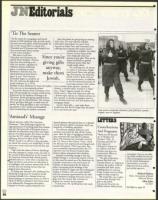
Iraqi women commando volunteers, part of the first women's
brigade, train in Baghdad.
LETTERS
Contributions
Aid Programs
Thank you for the arti-
cle "A Window Of
Freedom" (Dec. 5),
focusing upon the ter-
rible impact of
Alzheimer's disease on
its sufferers and their
families and upon our
community's efforts to
address the issue.
The gifts of generous
donors like Peter and
Dorothy Brown are helping to
enhance the quality of life of
countless frail older adults,
enabling them to continue
living at home and providing
respite to their caregivers.
We would like your readers
to know that through their
gifts to the Jewish
Community Trust for the
Elderly and the Allied Jewish
Campaign, they too are help-
ing make possible the fine ser-
vices and programs provided
by the Jewish Federation's
Commission on Jewish
Eldercare Services and its
partnership agencies.
Michael Perlman
Chair, Commission of Jewish
Eldercare Services
Ellen Lab es
Co-chair
LETTERS
on page 30