
tINGifd
SUSAN R. POLLACK
Special to The Jewish News
E
Land of 30,000
wilts (temples),
disappearing bahts
(money)
and thousand-watt
smiles.
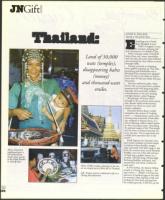
Above: Dressed in
traditional garb, a
hill tribeswoman
hawks silver jewel?),
at the Night Market
in Chiang Mai.
Above: Golden temples, gleaming in the sun,
are an integral part of daily life in Thailand.
Left: Artisans practice traditional crafts in a
Chiang Mai showroom.
verything you've heard
about Bangkok is true.
Traffic is tangled in near-
ly constant, daylong grid-
lock reminiscent of a Rubik's Cube.
Police wear gas masks to fend off
fumes from cars, buses, motorbikes
and tuk-tuks, the noisy, three-wheeled
cabs tolerated for their ability to weave
through traffic.
Tourists succumb to shopping
fever, giddily snapping up Thai silks,
gemstones and handicrafts with a
devalued Thai currency that plunged
from 25 baht to the dollar in July to
more than 40 baht-per-dollar this past
November.
And post-adolescent girls, either
barely-clad or just plain bare, perform
amazing tricks with ping pong balls,
dog-tags, darts and other unlikely
accoutrements in the city's pulsing
red-light district, called Patpong.
But glimpses of beauty shine
through in this southeast Asian nation
that, despite rapid modernization,
remains very much in touch with
ancient traditions.
Detroiter Marcia Baum vividly
remembers the custom of "making
merit" — waiting along a path in the
morning mist to present a food offer-
ing, wrapped in banana leaves, to a
trio of chanting, saffron-robed monks
on their morning rounds. Describing
the spiritual nature of the Thai people
and the sense of balance between cul-
tures, she says: "It's an experience you
couldn't have anywhere else in the
world."
Amid fragrant joss (incense), tran-
quil monks meditate in lavish temple
complexes before Buddha images,
large and small. The idols range in size
from the nation's most sacred Emerald
Buddha, just over 2-feet tall and seat-
ed high atop a golden throne, to a
colossal, 140-foot-long, 50-foot-high
Reclining Buddha, with gold, leaf-
coated body and inlaid, mother-of-
pearl soles.
At Doi Suthep, the dreamy hilltop
temple in Chiang Mai, farang — for-
eign visitors — delight in buying rice
sparrows in bamboo cages at the cable
car entrance, then making a wish and
sending the little birds soaring from
the temple grounds, 3,500 feet up the
12/12
1997
124
,,,Iwaisimiliii.100101111Awaimer*summillosummir,
Scanned image of the page. Keyboard directions: use + to zoom in, - to zoom out, arrow keys to pan inside the viewer.
December 12, 1997 - Image 106
- Resource type:
- Text
- Publication:
- The Detroit Jewish News, 1997-12-12
Disclaimer: Computer generated plain text may have errors. Read more about this.