
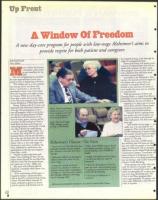

A Window Of Freedom
A new day-care program for people with late-stage Alzheimer's aims to
provide respite for both patient and caregiver.
JULIE EDGAR
News Editor
IN
orrie Dubin has become
a laundress, cook, dress-
er and chauffeur for his
wife.
He's not complaining; he considers
his new responsibilities trivial corn-
pared to what is happening to Donna.
"The hardest part is to see someone
you love go down and down and
down," said Dubin, a 76-year-old
optometrist whose work is his solace
from the long days and nights caring
for Donna. While he's at his office
three days a week, she is at the Club
in the Plaza day program at the Fleis-
chman Residence in West Bloomfield.
Donna, Dubin's wife of 21 years, was
diagnosed with Alzheimer's disease two
years ago. Her participation in the 7-
year-old program, which is run by Jew-
ish Home and Aging Services (JHAS),
provides her with stimulation in the
form of music, games, exercise and the
company of others and gives Dubin a
break from the heart-wrenching and
exhausting business of caring for a loved
one who is slowly but surely fading.
For 75-year-old Peggy Miller, it's a
bit better. But while her 81-year-old
husband Harry still has the old twin-
kle in his eye, she finds that she needs
the outlet of work for her own sanity.
Harry, who is in the early stages of
Alzheimer's and whose condition has
been stabilized by medication, also
participates in the day care program
three days a week.
"It gives us space away from each
other. I do everything for him. He can
take a shower himself, he can shave him-
self, but I don't like the way he shaves,
so I stand next to him," Miller said.
She types and performs clerical
work for a company while Harry is at
Fleischman.
"If he wasn't funny all the time, it
would be harder," admitted Miller,
who is herself in remission from breast
cancer. She and Harry, married 50
years, continue to go out to dinner
and the movies with friends, but he
12/5
1997
8
ory lo
rrn roll
of judgment;
-ality change; difficult in learn
loss of language skills.
,Infbrmation provided by Alzheimer's Association-Detroit Area Chapter.
has stopped driving. And although he
reads, he comprehends little.
Donna and Harry still possess some
measure of independence and still rec-
. ognize their spouses. As their condi-
tions progress, however, they will pass
into a .darkness that will leave them
and their spouses helpless.
According to the Alzheimer's Asso
ciation, the second and third stages of
the disease take a person from an
inability to recognize family and
friends to the total loss of control of
one's bodily functions and an inability
to communicate.
With the generosity of Peter and
Dorothy Brown, a couple from Bloom-
field Hills, the year-old Commission es
Jewish Eldercare Services (COJES) is
stepping in to plug a gap in services
that is .more critical as home-based
medical care becomes the philo-
sophical and financial standard.
Dorothy Brown explained that
her mother devoted herself to car-
ing for her father as he declined
from Alzheimer's. He died some 40
•
years ago.
"My mother was an angel — she
really was. It is very hard for the
caregivers. They can't do anything.
It's like taking care of a grown baby.
My mother wouldn't put my father
in a nursing home. I've never for-
gotten it," she said.
By late next year, a 5,000-square-
foot building that will house an adult
day care center for people in the later*
stages of Alzheimer's will sit alongside
Fleischman on the Maple/Drake Jewish
Community Campus. Consultants will
assist architects in designing an envi-
ronment that is "not overly stimulating,
but not boring," said COJES Executive
Director Linda Blumberg.
Focus groups run earlier this year
with 50 relatives of people with
Alzheimer's, showed the center coud
easily accommodate 35 or more peo-
ple every day, Blumberg said. The
Club in the Plaza program daily
serves approximately 18 people with
early-stage Alzheimer's and will con-
tinue to operate.