

•
Close Up
needed to complete the work.
Already, the social hall and restrooms
have been renovated and the shul has
a newly-designed foyer and facade.
The 14-classroom educational
center is expected to open next fall,
starting classes for children ages 2, 3
and 4 (Beth Shalom operates an
afternoon Hebrew school for grades
kindergarten and up, holding most
classes in nearby Avery Elementary
School).
"There was a lot of resis-
tance at the beginning: Beth
Shalom had never gone out
and solicited our members. We
do not have an endowment
fund. There were people who
resisted and said, 'How are we
ever going to raise $2 million?'
We have raised $1.8 million so
far," says Schubiner, the
administrative chairperson of
the capital campaign. -
"I'd like to say we've raised
[the funds] a nickel at a time.
Since we've had such wide-
spread participation, everybody
feels they've been a part of the
renovations, and I think that's
part of our success. We're a
very inclusive synagogue to
begin with," she adds.
The Nelsons, who are
also about to celebrate
the marriage of their
eldest child, Harry, call
this a "golden age" for
Beth Shalom. The new
school will enable them
to attract and keep
younger families and to
continue to take advan-
tage of Beth Shalom's
geographic accessibility
and its position as the
o
Conservative syna-
gogue in Oak Park. They note that
the same factors that once paralyzed
the synagogue — the fear that 1-696
would be the death knell for the
Jewish community in southeast
Oakland County and pessimism over
the synagogue's ability to build a
nursery school — are now contribut-
ing to its renaissance.
"For years, we suffered from a lack
of confidence," Rabbi Nelson says.
"We didn't think we could raise the
money. We suffered from a 'second-
tier' syndrome." Almost until the
capital campaign was launched two
years ago, there were doubts about
Beth Shalom's ability to grow. Today,
12/5 the synagogue boasts 625-650 mem-
1997 ber families and another 140 "friend-
68
ship" members — families who are
taking advantage of a free one-year
trial membership.
Nelson, 57, has faced down plenty
of skepticism during this tenure. In
1972, he willingly walked into a con-
gregation still reeling from the shock
of the suicide of his predecessor. He
also ignored the doubts of a mentor
who wondered openly if Oak Park
would remain vital even into the
1980s.
allow women to fully participate in
the service, and it suffered the wrath
of the Vaad Harobonim, the Council
of Orthodox Rabbis of Greater
Detroit, which publicly lambasted
the synagogue.
"It was the morally correct posi-
tion," Nelson says. "I do believe
Torah was given to everyone — men,
women and children. I didn't want
to thwart the religious aspirations of
”
women.
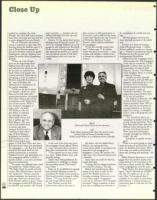
Above:
Alicia and David Nelson in the sanctuary.
Le:
Rabbi Henry Sosland oft e New City Jewish Center
in New York will honor his brother-in-law,
Rabbi David Nelson, at a celebratory dinner Saturday.
At the end of his first two years,
the synagogue board offered Nelson
a 1-year extension of his contract, a
plan that continued for a few years.
"They wanted me to stay a week
at a time," Rabbi Nelson says, only
partially joking.
Rather than feeling defeated, he
considered it a challenge to change
the prevailing mood. That wasn't
easy, either.
Early on, he established an agenda
that included allowing women to
read from the Torah in the sanctuary.
One board member resigned, telling
Nelson, "I'll come back when you
get the broads off the bimah."
Beth Shalom was the first
Conservative shul in the area to
His father, the late Rabbi Harry
Nelson, was among the first
Conservative rabbis to introduce bat
mitzvahs in his synagogue in
Bridgeport, Conn. His mother, the
rabbi says, was a learned woman and
a feminist.
Alicia takes no credit for her hus-
band's feminism.
"I always felt the religious policies
were David's scenario," she says.
Nelson has introduced an infor-
mality to the shul, as well. At the
end of the Shabbat service on
Saturday mornings (there are no ser-
vices Friday night), congregants
stand up to announce their "simchah
moments," happy occasions in their
lives like a wedding, bar mitzvah or
the acceptance of a child into col-
lege.
"We have people who live for
these simchah moments," the rabbi
says.
Perhaps as a result of raising a
child with special needs — Debra
Nelson suffered a stroke at a young
age — Nelson is considering regular
Shabbat services for people with
developmental disabilities.
"Debra loves the synagogue more
than anyone else. The synagogue
looks out for everybody. I'd like
a: people to know they can find a
community of souls at Beth
Shalom," he says. The Nelsons'
1- other daughter, Reva, is a social
worker in Chicago.
Shabbat services typically
draw between 250 and 300 con-
gregants, and situated as it is in
the heart of the Orthodox
Jewish community, Beth Shalom
has attracted a corps of
Orthodox members. The syna-
gogue also counts Reform Jews
in its mix of members.
Dr. Barbara Goldsmith, who
served as Beth Shalom's first
woman president from 1981 to
1983, says the involvement of
younger members at the syna-
gogue is creating a "synergistic
action" that is buoying the con-
gregation.
"I'm excited by where the
synagogue is headed and by the
strong, young leadership. There
have been good times and more
difficult times during the 30 or
so years we've been involved.
We've survived and becdme
stronger through the difficult
times," she says.
Schubiner is equally encour-
aged.
"There is so much going on there
today in terms of activities for chil-
dren, for families, for seniors. There
isn't a day you walk in there when
there isn't hustling and bustling," she
says.
Rabbi Nelson's devotion to a syna-
gogue that has stood at many cross-
roads during its 41-year history has
led him to reject several job offers at
other congregations over the years.
"Beth Shalom has always given me
space. They've allowed me to fulfill
the role of a rabbi as I see it," he
says. Plus, "I determined that I
wouldn't be the rabbi to close down
Beth Shalom. I wanted to leave an
institution that is vital into the 21st
century."
❑