

EDITORS NOTEBOOK
ALAN H ITS KY
Interim Editor
No one is ambivalent
about Coleman A.
Young.
The late mayor of
Detroit, whose funer-
al was held this
morning at the for-
mer Ahavas Achim
(now greatly expand-
ed as Greater Grace
Temple at Schaefer and Seven Mile),
is cherished in the black community
and often reviled in the white com-
munity for the same pronounce-
ments.
So it was interesting this week to
hear the views of former officials and
the public in the wake of Mr.
Young's death last Saturday after
many months of battling illness at
DMC-Sinai Hospital.
It made me think that maybe old
Coleman wasn't as bad as I thought.
Coleman Young wasn't responsible
for the racism in Detroit. He just made
'it clear that it existed. In many ways he
laid the groundwork for the renaissance
that is starting to take shape today. But
we didn't realize it at the time because
of the wall of rhetoric that seemed to
build up, rather than tear down, the
barriers between white and black in
this community.
It was refreshing to me when
Dennis Archer was elected. He
breathed new life into the city —
our city — and tore down some of
COMMUNITY
VIEWS
,Be A Blessing
By Being There
CO
ne of the most quoted biblical
phrases is both an enigma and
catchy. It is two Hebrew
words: heyeh b'rachah — be a
blessing. This phrase appears in the Book
of Genesis as a commandment which
God gives to Abram. These words have
been set to music by Debbie Friedman
and so many of us use them regularly.
How does one fulfill these words?
One can give a blessing; one can pro-
Herbert A. Yoskowitz is rabbi of
Congregation Beth Achim.
those walls. He created a climate, at
least in the white community, that
fostered new development and an
atmosphere more positive about
Detroit's future.
But, like his predecessor Coleman
Young, Archer has not been able to
overcome city department inefficien-
cies, high unemployment and deteri-
orating neighborhoods.
Maybe this week we have been
hearing revisionism. Or maybe we
are finally getting a dose of reality.
Leon Cohan, former president of
the Jewish Community Council, has
known Coleman Young since the
1960s when Mr. Young was a state
senator from Detroit and Cohan was
state deputy attorney general. Cohan
calls the former mayor "one of the
brightest, genuine, hard-working
people I have ever known. You could
always count on his word. He was a
mentsh. You could argue with him
and disagree with him."
Cohan invited Mayor Young in
1986 to address the JCCouncil's
annual meeting and, Cohan recalls,
Mr. Young "didn't pull any punches.
He talked the way he really is."
Young told his suburban Jewish
audience that blacks and Jews are
"natural allies" in the fight against
racism and bigotry and "Detroit can't
be a great and stable city without the
cooperation of its suburban neigh-
bors. And the suburbs can't progress
with a dying central city."
White suburbanites remember
other, negative pronouncements and
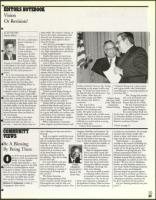
Photo by Bob McKeown
Vision
Or Revision?
Cohan attributes those to Mr. Young
"Coleman.Young was a great mayor
remaining in the mayor's office too
and a great leader who contributed
long. "It would have been better if
tremendously to restoring equality to
he had left after his third term," says
American life."
Mr. Cohan. After that, the
Mr. Young had another
anti-white image and defen-
role with the Jewish corn-
Coleman Young
sive posture were hard to
and Leon Cohan munity during his state
overcome.
at the 1986 Jewish Senate days in the 1960s.
But, says Cohan,
He was instrumental in
Community
Coleman Young was a "real
Council meeting.
helping Sen. Jack Faxon
person with no phony atti-
push through a change in
tudes. He spoke truths and
the state's kosher food law.
fought hard, but had a terrific sense
At the time, the office of the Council
of humor." Much of what he became
of Orthodox Rabbis of Greater
was shaped by the discrimination he
Detroit was located on Seven Mile
suffered as a youth and as a young
Road in northwest Detroit.
man, Cohan says.
VISION on page 31
Cohan's final assessment:
vide a blessing, but how can one be a
daughter, Michelle, had leukemia. Try
blessing?
as the Carews and her physicians did,
Look at a negative model from scrip-
Michelle's disease could not be arrested
ture. Job's friends meant well, but they
and she died while in her teen-age
did not understand that they were a
years. In the final chapter of her life, her
blessing to Job just by being
father stayed at her bedside, as
with him at a time of over-
did other family members,
whelming grief. Rather than
often in silence.
continue to sit in silence, each
After his daughter's death,
of the three friends tried to
Rod Carew often visited chil-
provide a rationale to Job for
dren hospitalized with leukemia
his suffering. They did not help
and indicated by his presence,
him by their talk.
sometimes silent, sometimes
At a time of grief, one's pres-
verbal, that he was with them
ence is often more comforting
during their difficult moment
RABBI
than one's words. Each of us
of challenge. His being with
HERBERT
can be a blessing to a person in YOSKOWITZ them was a blessing.
mourning just by being with
Not only in death is passivi-
Special to The
the mourner.
ty
a
blessing. Often when we
Jewish News
The former American
are stressed, we need someone
League batting champion Rod
to listen to us. No, we do not
Carew married a Jewish woman from
always want solutions or examples of
Minneapolis and, with his wife, was
the problems of others. Often we know
raising their two daughters as Jews. One
that the person to whom we speak can-
not help our circumstance. Yet we need
someone with whom to talk, with
whom to share, with whom to sit, to
help us by his or her presence.
Heyeh brachah — be a blessing
reminds us that sources of blessings are
both the good we do and the kind of
people we are. Be giving and be nice.
Abraham was giving and nice. The
biblical commentator Rabbi Tzvi
Elimelech Hertzberg writes that when
Abraham learned that his nephew Lot
was kidnapped, he called Lot achiv "his
brother." But Lot was not Abraham's
brother, nor did Abraham admire Lot
very much. Rabbi Hertzberg comments
that when a man was kidnapped,
Abraham forgot his grievance against
him, saw him as a brother and went to
rescue him. The patriarch Abraham was
a blessing to humanity, sometimes by
his deed, sometimes by his presence.
Are we a blessing merely by our pres-
ence?
❑
12/5
1997
27