
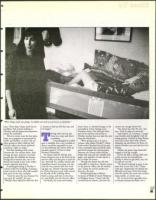

When Chaya Leah was young, "we didn't even look at a person in a wheelchair:"
says. These days, Chaya Leah has no
problem with anyone looking at
Hershy, and she appreciates questions
about his condition.
Twice in recent years she has taken
him, on a program co-sponsored by
JARC and Keshet, to meet with stu-
dent groups at Akiva Hebrew Day
School, where she found children's
questions "right on target."
She likes speaking with youth
because she can educate them. Start
young, she says, and you can teach
people that the disabled are human
beings like everyone else, not to be
feared and stared at but to be under-
stood, respected and loved.
If prolonged staring at Hershy is
Chaya Leah's first loathing, running a
close second is those who talk around,
but never to her son, and pity.
"Don't be sorry for me, because I'm
not sorry for myself," she says.
"Would I have asked for this? No. But
I choose to lead my life this way, and
I'm happy "
.
T
he big silver van has just
come to a stop, and there's
a problem.
A handicapped-accessible
spot is available, but a car is parked so
close it would be impossible to put
out the hydraulic lift, whose silver lip
extends a good 3 1/2 feet to hold
Hershey's wheelchair.
So Chaya Leah lets Hershy and
Nurse Simmons out at the front of the
doctor's office and she goes to park the
van. And still it's a schlep, because the
wheelchair doesn't just jump over the
curb the way anyone with two work-
ing legs can. Instead of going straight
in, Nurse Simmons must walk around
to the side of the building where
there's a ramp, and then to the eleva-
tor, and finally into the doctor's office.
As Hershy, his nurse and mother
enter, there is a decided change in the
atmosphere of the waiting room.
Everyone looks. One little girl whis-
pers to' her mother and points at
Hershy; another does not take her eyes
from his wheelchair.
"We're going to go in in just a
minute, okey dokes, Hershy?" Chaya
Leah strokes Hershy's face as his eyes
roam unsteadily back and forth, back
and forth around the waiting room.
Between the Disney video and the
bright fish tank and the colorful wall-
paper with splashes of color there's a
lot to shake the senses.
Though the disease has left him
vulnerable to infections, Hershy comes
to the doctors' office only for routine
care. Today, he and his mother are
here for a flu shot.
Hershy's physician is Martin
Levinson of Medical Center Pediatrics
in Bingham Farms. Chaya Leah dis-
covered him by chance, and now she
cannot say enough about him.
"He always has time for me," she
says. "And he takes me seriously."
And indeed, Dr. Levinson is outgo-
ing, friendly and thoughtful with his
young patient. Garbed in Bugs Bunny
socks and a blue shirt with cartoon
characters up and down the front, he
checks Hershy's ears and asks how he's
feeling.
Hershy, his quiet, limp hand still
cupped in his lap, coughs.
Down the hall, a young child sobs
as she receives her inoculations.
Hershy is about to get shots, too, but
he will not cry out.
"He doesn't respond to pain in the
same way as you and I do," Chaya
Leah says. Apparently, the disease has
affected every pore of his little body,
even the nerves that cause one to feel a
sharp needle, or tender arms.
Dr. Levinson feels especially close
to Hershy because his father was a
11/28
1997
81