

that his care does, in fact, consume a
large part of her life. On the contrary,
she is honored.
"Children just don't come into fam-
ilies for no reason," she says. "God
doesn't make mistakes. Hershy was
given to us as a gift, and it's a privilege
to see him, to live with him, to know
him. I am honored that I was chosen
to take care of him."
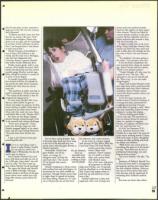
Hershy Tinman, of Southfield, is
one of about 300 children in the
world, and the only one in Michigan,
who has been diagnosed with
Canavans disease, a genetic disorder
that strikes mostly Ashkenazi Jews.
Hershy cannot speak, walk or con-
trol any of his bodily functions. Both
family and physicians say they cannot
possibly gauge Hershy's mental capa-
bility, though his mother is certain he
is aware to some degree.
It's equally impossible to predict
how long he will live. Yet already he
has beaten the odds. Most Canavans
children die when they are several
years old.
"His condition is stable, and that in
itself is miraculous," Chaya Leah says.
"The nature of this disease is that it's
progressively degenerative."
In some ways, Hershy's life is just
like any other child's: he goes to
school and makes art projects, he likes
music and has to suffer a hefty dose of
teasing from his older sisters (when
Mom asks who made the mess, Alana
and Rachel like to call, "Hershy did!").
But there are also diaper changes,
physical therapy, eating through a tube
in his stomach and constant challenges.
"You're never prepared," Chaya
Leah says, driving a large van with
Hershy, strapped tightly in his wheel-
chair, and his nurse sitting behind her.
"You only learn from the last mis-
take."
A day in the Tinman home goes
something like this:
I
is 9 a.m. and Chaya Leah is
about to wake Hershy. Usually
he's up early for school, but
today is Wednesday, his day off,
and he gets to sleep in.
Mom blankets Hershy's face and
arms with kisses and calls out one of
the 1,000-plus "okey dokes" she will
utter in a day. "It's time to get up,
okey dokes, Hershy? Good morning!"
She opens the blinds and Hershy's
room is filled with light. His large
window looks to the front of the grey
house where snow, melted into tiny,
finger-like streams, pours down the
driveway.
He has been eating all night. Bags
her bedroom, and a heart monitor.
of formula, baby food and water hang
In the corner is a dresser topped
at the foot of his bed and drip con-
with pictures of Clint Black, Billy Ray
stantly into a tube that goes directly to
Cyrus and Vince Gill (both Hershy
Hershy's stomach.
and his nurses like country
Sometimes, Chaya Leah
For Jan Simmons, music, Chaya Leah
gives Hershy a bit of ice
explains). There's a plastic
there's an
cream, or orange, or
inevitable bond
toy of a child in a wheel-
that comes with
whipped cream "to keep his
chair, and a prayer book
taste buds alive." But mostly working so closely with Hershy's name.
with the family.
it's the liquids that sustain
One of the most vital pieces
this child.
of equipment is a lift that
Hershy's bedspread is vibrant colors
helps hoist Hershy, now 74 pounds,
with smiling lions and pink hippos. At
into his wheelchair or to the shower.
the bottom sit two white stuffed-ani-
Still, Chaya Leah makes certain to
mal bears. Though Hershy moves little
pick him up and hold him at least
at night, there is a guard rail to keep
once a day.
him from falling. Nearby is a TV cam-
Hershy's bathroom is clean and
era so Chaya Leah can see him from
organized, with a row of soaps and
lotions and nine medicine bottles
lined up, like soldiers on duty, atop a
white counter. There's one liquid to
control seizures, another to ease pain,
another Hershy originally took for a
kidney infection that seemed to help
with the Canavans, too.
It takes so much time to do every-
thing. Chaya Leah slips Hershy's blue
pajama top down his arms, pure and
pale as baby skin. She changes his dia-
per, only to find it wet two minutes
later.
"No problem," she says, going to
the closet. "Let's just get a new one."
It was the finest compliment she
ever received when, about six months
ago, Alana Tinman told her mother,
"You're a very positive person."
"I hadn't thought of it that way, but
I guess it's true," she says. "My
approach is, you can sit around and
say, 'Woe is me,' or you can make
things happen."
Chaya Leah brushes Hershy's teeth,
then dabs them with a pink foam-like
disposable swab that, from a distance
resembles a flower. Hershy cannot
control his throat muscles, and so can-
not rinse alone.
In the few quiet moments, the
loudest noise is Hershy's breathing. It
is strong and deep, punctuated by
coughing and snorting ("he gets
snorky when it's going to rain," Mom
says) and sometimes a kind of sweet
sighing or cooing, like singing.
"Are you feeling good today?"
Chaya Leah asks. Her questions to
him can almost always be answered
either in a positive or negative.
Hershy, she explains, will blink once
for "yes" and twice for "no."
At 9:30, Jan Simmons, R.N.,
arrives. Simmons has been with
Hershey for a year and is his most fre-
quent nurse, working several 12-hour
shifts each week. A quiet, thoughtful
woman, she likes working with both
the elderly and children.
"With home care, you're privy to
everything that goes on in the house,"
she says. "And while you do have a
professional relationship, you can't
help but form a bond."
"Do I love Hershy?" she asks. "Yes,
I do."
Simmons, of Pediatric Special Care
in Troy, has been both in management
and practice and has seen many fami-
lies with disabled children. Most par-
ents are not bitter about their situa-
tion, she says, and do a good job of
overseeing their children's medical
care.
But some are better than others.
11/28
1997
79