

A'N
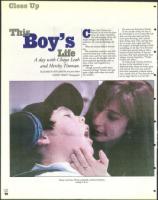
A day with Chaya Leah
and Hershy Tinman.
ELIZABETH APPLEBAUM Associate Editor
GLENN TRIEST Photographer
haya Leah Tinman has
learned to live with the ques-
tions, the bulky wheelchair,
the well-mearting advice, the
diaper changes, the daily doses of
medicine, the constant feedings, the
fear.
What she cannot abide is the star-
ing.
She remembers passitig a man who
turned his head just a little, and then
a little more, and then more and more
all the way over his shoulder until he
had completely ignored the path in
front of him and tripped- over a
garbage can.
Though normally careful about
everyone's feelings, Tinman can't sup-
press a slight smile when she recalls
the incident.
Chaya Leah loves Hershy completely,. without hesitation,
exactly as he is.
11/28
1997
78
•
The stares are directed at Hershy.
To the outside world, the boy in
the wheelchair is a 9 1/2-year-old with
dark eyes that dart back and forth,
never quite focusing, and a mouth
that's always open wide, and legs that
do not work, and a right hand that
sits cupped, as though waiting to hold
something, on his lap. He is the kind
of child most parents look at with a
mixture of pity and fear. If they do - •
not stare, they smile pathetically, then
whisper among themselves, "Thank
God he isn't mine."
To Chaya Leah Tinman, however,
the boy in the wheelchair is not a
deformed body whom she looks upon
with sorrow. He is her son, and she
loves him completely, without hesita-
tion, exactly as he is. Nor does she feel
sad or angry that he is in her life —
•