
JNGifd
J udaica Collectibles
judaica objects make
beautiful collections in
the home and are
valuable.
BARBARA B. BUCHHOLZ
Special to The Jewish News
r.
01,
it
111
any Jewish homes
abound with some
forms of Judaica, the
term that collectively
describes the objects used to celebrate
rituals and holidays — Chanukah
lamps or menorot for the festival of
lights, spice towers to usher out the
Sabbath during the Havdalah service,
mezuzot for doorposts and seder trays
to hold symbolic foods at Passover.
Jews may not have used objects
crafted specifically for the practice of
their religion from the very beginning;
but they have for centuries, according
to scenes depicted in the early illus-
trated manuscripts, says Grace Cohen
Grossman, author of Jewish Art (Hugh
Lauter Levin Associates, $75) and
curator at the Skirball Musuem in Los
Angeles.
"We see people seated at a seder
with a plate and cups in "11thcentury
Egyptian manuscripts. Important
manuscripts dating from 14th-century
Germany and 15th-century Spain and
Italy also provided information about
the objects they used," she says.
Among the earliest surviving exam-
ples of such artifacts is a 5th or 6th
century bronze oil lamp owned by the
Hebrew University in Jerusalem and
pictured in Nancy Berman's book The
Art of Hanukkah (Hugh Lauter Levin
Associates, $30). Berman is director at
the Skirball Museum.
The absence of a great number of
ancient Jewish artifacts is attributable
to several reasons, says expert dealer
Arthur Feldman of Highland Park, Ill.
"Jews always considered it a `hiddur
mitzvah' when an ordinary object was
made special so that specific Jewish
items weren't necessary. The Torah
(the Five Books of Moses) also makes
few demands on requiring specific
objects to practice Judaism," he says.
More pieces survived from the
1700s on, when a greater number of
Jewish objects were made exclusively
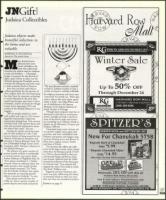
This new Baccarat menorah, available
at Jules R. Schubot Jewellers in Troy, is
certain to become a valuable collectible.
for religious functions and items were
"converted" for Jewish use. "More dec-
orative objects also were made, partic-
ularly in Italy," says Olga Weiss, cura-
tor of exhibitions at the Spertus
Museum of the Spertus Institute of
Jewish Studies in Chicago.
Though many treasures were lost or
destroyed as Jews fled to avoid perse-
cution, enough survived to reveal an
array of decorative styles and materi-
als, according to A Collector's Guide to
Judaica by Jay Weinstein (Thames and
Hudson, $29.95).
Chanukah lamps came in brass, sil-
ver, pewter, copper, stone, glass and
porcelain and were embellished with
Hebrew inscriptions and designs rang-
ing from flowing leaves and flowers to
fierce lions, elegant crowns, Torahs
and Stars of David.
The diversity also reflects the influ-
ences of the larger secular milieu. Jewish
items from the Baroque period of 1650
to 1730 are characterized by that peri-
od's favored foliage and flowers, birds
and cherubs. Material from the 1800s
showed the influence of the then-popu-
lar Oriental style. "Jews adopted and
adapted the styles of the lands in which
they lived," Feldman says.
Regional and local traditions also
came into play, influencing the choice
of materials based on what was avail-
able and what was considered aestheti-
Up To
50 %
OFF
Through December 24
HARVARD ROW MALL
21750 West 11 Mile Road • Southfield,
(248) 358-5540
EBREW BOOK and GIFT CENTER, INC.
\kv\szw.A
•
\:\\•
\mm.
JuDAicA on page 35
OPEN WEDNESDAY AND THURSDAY NIGHTS UNTIL 7:00
11/28
1997
G31
Scanned image of the page. Keyboard directions: use + to zoom in, - to zoom out, arrow keys to pan inside the viewer.
November 28, 1997 - Image 117
- Resource type:
- Text
- Publication:
- The Detroit Jewish News, 1997-11-28
Disclaimer: Computer generated plain text may have errors. Read more about this.