

F kOBERT L. PINCUS
Special to The Jewish News
he attractive blonde in the
painting tells Brad, the
emerging artist, that "soon
you'll have all of New York
clamoring for your work." She was
right, in a roundabout sort of way.
-New York clamored for Brad.
Not his work. Brad was just an artist
in a comic-strip image. But because
Roy Lichtenstein turned that image
intq one of his seminal paintings, Brad
il has become an icon of American art.
Brad's big year — and Lichtenstein's
— was 1962. The painting was, in
Lichtenstein's characteristically witty
and ironic way, called Masterpiece. And
-
-it was a watershed moment for
American art. Pop Art was on the rise
and Abstract Expressionism, while not
on the wane, was superseded as the
movement of the moment.
Lichtenstein was both celebrated and
castigated as a major progenitor of the
new movement.
After Pop's moment had passed,
sometime in the late '60s, many of its
-- artists faded from view.
Not so Lichtenstein, who was born
to a Jewish family in New York City in
1923. When he died this fall at age 73,
his images were as well-known, proba-
bly more so, than they were a quarter
century ago. His face was not as recog-
nizable as that of Andy Warhol.
Lichtenstein never sought the spotlight
as his major Pop counterpart did. But
- siiis influence on the culture was just as
vast. He borrowed from Pop culture,
and it returned the favor.
The sustaining qualities of his art
were wit and humor. Detractors said he
merely copied the comics. But the
argument was an ignorant one. He
streamlined their design, altered color
and even text, as only an artist with a
keen
eye could do.
,
Comics, in the Lichtenstein mode,
became a fresh mirror through which
to see modern life. They were funny
and serious at once — funny because
they were so melodramatic, serious
because they dealt with big subjects like
romance and war, ambition and heart-
break.
When Lichtenstein painted the first
of his Pop pictures, he didn't believe
- 'lanyone would clamor for them, much
less exhibit them. "I thought no gallery
would take this stuff," he told me in a
1995 interview, "but I liked it. It was
I
.
Robert L. Pincus writes for Copley
News Service.
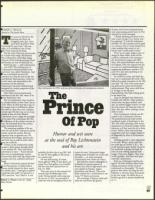
Roy Lichtenstein, in 1995, with one of his droll prints of contemporary interiors.
The
rince
Of Pop
Humor and wit were
at the soul of Roy Lichtenstein
and his art.
probably the first time in my life I did-
n't care if I had a gallery. I felt secure,
in a certain way."
He was dead wrong, of course,
about galleries. Well, at least about one
major New York gallery: Leo Castelli's.
His first solo show opened there on
Feb. 10, 1962.
That same year, he also enjoyed the
second major breakthrough in his
work. Having turned comic-strip pan-
els into art in 1961, he proceeded to
make the style he had gleaned from the
comics his own. Lichtenstein began
redoing icons of modern art in the style
of comics — or, more accurately,
Lichtenstein's own version of comics.
His bold line, almost calligraphic in
its fluidity, his precise pattern of
Benday dots and his high-keyed color
were applied to Picassos, Legers,
Beckmanns and Monets. They were
flashy versions for a world keyed to car-
toons, TV shows and movies.
His retoolings of famous works and
styles (he sometimes did generic
Picassos and German Expressionism)
were wisecracking and he knew it. Not
satirical but ironic homages.
"I found anything you drew in the
style would change it in a funny way,"
he explained. "I could do landscapes,
still lifes. If I did a pitcher and an apple
in a cartoon style, it would simply have
other qualities that weren't in art
before, and I could make it work."
There was an agile, elegant sense of
design in these works. Some of this
could be attributed to his training at
the Art Student's League and Ohio
State. (He earned bachelor's and mas-
ter's degrees.) But one suspects that his
six years as a sheetmetal designer and
engineering draftsman, between 1951
and 1957, also had so _ mething to do
with his approach.
He worked in series, and that's the
best way to understand his work. They
followed in quick succession in the '60s
and early '70s. One of the most amus-
ing and incisive series was his brush-
stroke pictures. They were a deft form
of revenge on the Abstract
Expressionists, who had nothing good
to say about Pop.
Later, he diverged into abstraction
himself, with Mirrors. These predomi-
nantly silver and gray surfaces, with
dots, do indeed suggest mirrors. So did
the oval contour he chose for many of
them. But they reflect nothing, except
shifts in color.
Once introduced, nothing was dis-
carded in the Lichtenstein universe.
The parodied gestural brush strokes
resurfaced as part of landscapes in the
'80s. His earlier paintings made return
appearances as miniature images within
interiors, as if they were the art in these
rooms. Earlier comic-strip paintings
reappeared with their images fragment-
ed diagonally by slices of Lichtenstein
mirrors.
Nothing seemed to resist adaptation
to his style. When I spoke with him
two years ago at Gemini G.E.L., the
world renowned print facility where he
had produced multiples through the
years, he was crafting Japanese-style
images. They were elegant. They were
terrific parodies. And they were quin-
tessential Lichtensteins.
Early on, Lichtenstein said he was
against "all those brilliant ideas of pre-
ceding movements which everyone
understands so thoroughly." He made
good on that claim, by using his own
brilliance to reinvent these movements
in his own image. He didn't do so to
feed his ego but to amuse himself and
us. ❑
11/21
1997
87