

to o
Drum Roll, Please
ALICE BURDICK SCHWEIGER
Special to The Jewish News
Id
ax Weinberg was in the
right place at the right
time. It was the spring of
1993 and NBC had just
announced that Conan O'Brien would
be David Letterman's replacement for
the network's late-night talk show.
While standing on a street corner on
New York City's Upper West Side wait-
ing for the light to change, Weinberg,
an accomplished drummer, seized the
moment.
"My wife and I were out for a stroll,
and I recognized Conan from a recent
television appearance on 'The Tom
Snyder Show,"' explains Weinberg. "So
I went over to him, introduced myself
and asked what he was going to do for
music. He had some very definite ideas
about what he wanted."
After a series of meetings and audi-
tions, Weinberg convinced O'Brien
that he was the right person for the
coveted job. "Everything seemed to fit
together nicely — his aspirations and
mine," says Weinberg, who named his
band the Max Weinberg Seven.
In September 1993, Weinberg began
his reign as leader of the bandstand.
The job turned out to be more than
just directing and selecting walk-on
songs for celebrity guests.
Like most talk-show band leaders
these days, Weinberg is an important
part of the on-air repertoire, often
being thrown into comedy bits.
"Thanks to Conan's and Andy's (side-
kick Andy Richter) tutelage, I have got-
ten better at that," chuckles Weinberg.
As comfortable as he looks on the
small screen, TV stardom was not in
Weinberg's dreams growing up. All he
ever wanted was to be a musician.
Born and raised in New Jersey,
music was always a part of his life. His
father, an attorney who operated a
summer camp in the Pocono
Mountains, played the violin. His
mother, a physical education teacher in
Newark, loved music and took
Weinberg to many Broadway musicals.
But he can thank his sisters for pursu-
ing the drums.
"In the fall of 1956 my sisters were
watching Elvis Presley on 'The Ed
Alice Burdick Schweiger is an Ann
Arbor-based freelance writer.
11/21
1997
84
Sullivan Show,' and I was watching it
with them," remembers Weinberg, who
was then 7 years old. "D.J. Fontana
was Elvis' original drummer, and when
he hit that drum roll on 'Hound Dog,'
I knew that was what I wanted to do."
Within a year, he was taking drum
lessons, and shortly after, he found
himself performing at a relative's bar
mitzvah.
"The bar mitzvah band leader got
such a kick out of it that he hired me
to play at his club dates, as a sort of
young novelty act. I would play three
or four songs, and he would pay me
$10, which was a lot in those days."
By the ripe old age of 10, Weinberg
formed his own band, the Epsilons,
and performed at grammar school
dances, parties and bar mitzvahs. "By
the time I was 12 or 13, I was playing
professionally most weekends," says
Weinberg, who squeezed his own bar
mitzvah between play dates.
After graduating from high school in
1969, Weinberg attended Adelphi
University for a year, until his high
school band signed a record deal with
Epic Records.
"I moved back home to continue
working with that band, and trans-
ferred to Seton Hall," says Weinberg. "I
enjoyed college, but it was a back-up."
The drummer's biggest break came
when he was a senior at Sewn Hall and
read an ad in the Village Voice. Bruce
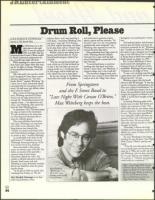
From Springsteen
and the E Street Band to
"Late Night With Conan O'Brien,"
Max Weinberg keeps the beat.
Springsteen was searching for a drum-
mer.
"His keyboard player and drummer
had just quit the band, and about 60
drummers answered the ad," Weinberg
says. "Luckily, he chose me. With just a
few classes to go, I dropped out of col ~ r
lege to tour with Bruce, but I eventual- l
ly did go back to finish those credits. I
finally earned my degree in 1990."
For 15 years, Weinberg's E Street
band toured with Springsteen, per-
forming in front of sold-out crowds
worldwide. Weinberg's favorite song?
"Darkness on the Edge of Town."
"It was a very exciting song that had
a great drum part, and it was my wife
Becky's favorite," he says.
Weinberg regrets that the band's
Moscow date fell through. "It was dur-
ing the Gorbachev administration and
there were political ramifications," he
says. "It would have meant a lot to my
family. My grandfather [and namesake]
escaped the pogroms in Russia in the
1880s. It would have brought us back
full circle."
In hearing Weinberg speak of his
Jewish roots, it's clear that family and
religion are important to him. "No
matter what you do, you always main-
tain a connection with your heritage,"
he says. "My great-great-grandfather
was a talmudic scholar, and there are
pictures of him with a flowing beard
down his chest. He was extremely
observant, and that has filtcicd down C
through my family.
"Personally, I observe the High
Holidays and love going to temple. It
affords me a sense of solace, and I love
the melodies."
For now, Weinberg is very happy
dividing his time between "Late Night
With Conan O'Brien" and his own
family.
"To be 46 years old and be able to -
see my family grow and be home each
night by 8. What else could I ask for?"
says Weinberg, who has been married
for 16 years and has two children, Ali,
10, and Jay, 7. "I think I am extraordi-
narily lucky for a musician."
❑