
Success Stories
A local conference on doing business with Israel shows o some examples.
•
ALAN ABRAMS
Special to The Jewish News
major Michigan manufac-
turer and an Israeli compa-
ny have formed an interna-
tional joint venture to pro-
duce a portable folding scooter.
Scheduled to be marketed late next
year under the brand name of
Travelmate, the
scooter can be easily
transported when
not in use by pulling
it from behind, the
method many air-
port travelers already
use for carrying lug-
gage.
The partners in
the joint venture are
Amigo Mobility
International of
Bridgeport, Mich.
(near Saginaw), and
Tzora Health Care
Industries, based on
a kibbutz about 30
minutes from Tel
4/P Aviv.
The project is
coming to fruition
thanks to seed
money provided by
the BIRD Foundation, which, by
putting up half of the equity, encour-
ages and facilitates joint ventures
between Israeli and American indus
try.
The Amigo-Tzora linkup was one
of several success stories presented at a
seminar sponsored by the American-
Israel Chamber of Commerce of
Michigan at the Oakland County
Information Technology Building in
Pontiac last week.
Amigo manufactures carts which
are used worldwide by impaired indi-
viduals. Although Amigo does busi-
ness in 40 countries globally, this is its
first international joint venture, said
company founder and chairman
Clarence Rivette.
The company has been in business
since 1968 and does an annual vol-
ume of about $25 million, according
to published reports.
'
"Tzora manufactures power-assisted
devices, and we had been exporting to
them," said Rivette, who is a member
of the board of the American-Israel
Chamber of Commerce. "They
(Tzora) take manual wheelchairs and
add a joystick to them. Their power
wheelchairs are powered by small,
high-torque-effect motors on the tire."
_ Because both Amigo and Tzora are
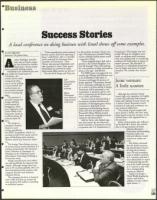
Left..
David Rubin
discussed
Israel's
economy.
Below:
Participants
were intent on
doing business
with Israel.
in the mobility business, Tzora's con-
cept of developing a portable folding
scooter utilizing motors power struck
a responsive chord.
"Tzora originally had a deal with a
partner in the United Kingdom. but
that fell through. They were looking
for a new partner, so they contacted us
about a year ago," said Rivette.
The BIRD grant was approved two
months ago. Rivette and Solomon met
at the Dusseldorf Trade Show in
Germany and began the process of
design approval. The partners already
have a prototype, although the prod-
uct is only in its first month of design.
Travelmate will be presented to the
marketplace in January, and be avail-
able to consumers by the fourth quar-
ter of 1998, said Rivette.
Another success story heralded at
the seminar involves the Brasscraft
subsidiary of Michigan's giant Masco
Corporation. Brasscraft is now
importing and distributing shower
heads that were developed in Israel.
Brasscraft's Marty Melton praised
Israeli workers for creating and devel-
oping the necessary valves.
Said Joe Savin, who helped orga-
nize the seminar for the American-
Israel Chamber of Commerce and its
co-sponsor, the U.S. Department of
Commerce, "The impact was very
useful. We put the emphasis upon
small- to medium-sized businesses
who were dealing with or considering
trading with Israel either as export or
import partners. We identified 15
companies or individuals doing busi-
ness in Israel, and about 45 people
attended. We consider that success-
ful."
Joint venture:
A little scooter.
Although the seminar stressed
Israel's high tech capacities, the highly-
touted teleconference link between
Israel and Oakland County which was
to feature Natan Sharansky, Israel's
minister of trade and commerce, ran
into technical difficulties.
The mantle of guest speaker fell
upon David J. Rubin, the New York-
based Israeli economic minister to the
United States, who appeared live at
the seminar.
Rubin told attendees that inflation
has leveled off in Israel. He credited
this to the government of Prime
Minister Binyamin
Netanyahu understanding
business needs, and
believed inflation would
remain low under con-
trols.
But Rubin cautioned
that the Israeli economy
has slowed down because
of a big rise in interest
rates. He said unemploy-
ment in Israel is currently
at 6-7 percent, and that it
was unreasonable to expect
a continued high growth
rate of the Israeli economy
at 5-7 percent a year with-
out a corresponding
increase in inflation.
Israel is no longer a
Third World developing
nation, said Rubin,
adding it is now a devel-
oped nation. ❑
11/14
1997
131
Scanned image of the page. Keyboard directions: use + to zoom in, - to zoom out, arrow keys to pan inside the viewer.
November 14, 1997 - Image 143
- Resource type:
- Text
- Publication:
- The Detroit Jewish News, 1997-11-14
Disclaimer: Computer generated plain text may have errors. Read more about this.