

King Of Comedy
On the eve of the Jewish Book Fair, comedian Alan King talks about books.
ci SUZANNE CHESSLER
Special to The Jewish News
C
()median Alan King, probably
the current king of Jewish
humor, considers his books
— all four — among his
crowning glories. The most recent,
Name Dropping, tells about the celebri-
,--, ties who have shared billings and friend-
- ships with him.
As King launches the JCC's 1997-98
Encore Series, he will entertain during
the annual book fair. His program starts
at 8 p.m. Saturday, Nov. 15.
In the midst of planning his Detroit
routine, King discussed books and book
fairs with the JN:
Q: When you entertain in Detroit, will
0 you be doing a lot of name dropping?
A: No, not really. When it comes to my
life, it is filled with people of note, but
my performances are very personal.
Q: Do you find that an all-Jewish
audience is different from audiences in
general?
A: I don't think they're different. I just
think the material has to be a bit more
pointed. When you have an older
Jewish audience, you have to talk
mamalush. If you've got a younger
Jewish audience, you set it up different-
ly. A mixed audience, of course, is what
I generally play to. People who are not
Jewish understand Jewish life because
it's so much a part of the American fab-
ric.
Q: What's the difference between
doing standup about your life and
writing a book about it?
A: When I do standup, there's instant
gratification. I'm supposed to get
laughs, and I don't have to.wait for the
reviews. My first responsibility in writ-
ing an autobiography is to tell a story,
and then the humor comes out of that.
Q: What's it like working with a co-
writer such as Chris Chase?
A: I've had four co-writers. I've written
every book with a co-writer. When I
Suzanne Chessler is a Farmington
Hills-based freelance writer.
wrote the cookbook, I wrote it with
Mimi Sheraton because she's an author-
ity and obviously a good writer. When I
wrote a biography that spans over 55
years, I had to collaborate with some-
body who knew what has taken place
socially and in the entertainment world
in the last 50 years.
Q: How did you decide to begin writ-
ing books?
A: I didn't decide. It's not like an author
with a story that he's trying to sell.
They've come to me and said, "Would
you write about so and
so?" Now, a lot of the
best-selling nonfiction
books are written by tele-
vision personalities. They
have exposure. People
know the names so they
go out and buy their
books.
Q: Have you had some
interesting comments
from the people whose
names you've dropped in
your book?
A: Quite a few, including
from Frank Sinatra.
Everybody [else] seems to
have some delight in beat-
ing up on him [in print].
They had a front-page
story in one of our major
newspapers: "Frank
Sinatra and Jacqueline
Kennedy." When I wrote
about Frank, I wrote
about 50 years of friend-
ship and fun. Frank said he was very
pleased.
them, and they only know him through
his words. They know me from televi-
sion, films, concerts. [Plus,] I'm so
Jewish, and I wear my Jewishness as a
badge of honor.
Q: What are some of the memorable
comments — unusual, funny or inter-
esting — made to you while you were
signing books.
A: If I look up and see young people —
I mean under 30 — they always say to
me, "I'm buying this for my mother or
father or my grandmother or grandfa-
o
ALAN KING
Q: What made you decide to appear at
book fairs and book signings?
A: They sell books.
Q: Are Jewish book fairs different from
book fairs in general?
A: I think the audience is a bit more
personal, a bit more aggressive. They've
known me for so many years. It's not
like another author who comes to
Q: When you're at book fairs, do you
ever buy other writers' books?
A: Not at book fairs, but I'm a vora-
cious reader. I like Caleb Carr's new -
book, Angel of Darkness. I read for
sheer pleasure and entertainment. I
don't read for education anymore.
When I was a kid, I did because I did-
n't have any education. If someone
asks, "Why don't you read a biogra-
phy?" I say, "I know how
it ended."
Q: Do you give books as
.? gifts?
A: Yes. I'm a big book
9 giver. Every time I read a
book that for one reason
• or another I find out-
LE]
• standing, I always buy a
dozen copies and send
them to different people
I think would find it par-
ticularly interesting.
t thkgc t.xviy. WM., F think n3 musk, i think at tint anatint.
`Mum I thea
when t linnk at sts.dvop S.M.:fr. f MMS c9E Ainn Xing
Q: About how many book fairs have
you been featured at?
A: A couple of dozen, probably.
bought it for somebody or it's for an
anniversary or a birthday, I'll sign it that
way.
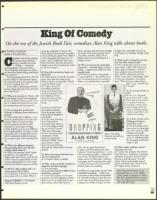
Above: Alan King:
From bar mitzvah boy
to book author.
CHASE
ther, who is a great fan of yours."
I spoke at Harvard and got the same
reaction. I had someone tell me — and
this was already an adult — that when I
was on the "Ed Sullivan Show," his
father used to sit there with a rolled-up
newspaper and hit anybody who made
a sound. You know who told me that?
Martin Short, the comedian.
Q: When you sign books, do you write
individual comments — either your
own ideas or those that are requested?
A: Generally speaking, I don't have too
much time to get that personal in the
signing. But usually, if people say they
Q: Is there a book you're
thinking of doing or
would like to do?
A: I've been asked, but I
haven't got the time right
now As I reach my 70th
birthday, everybody
wants to know how I got
to be 70. Self-help books
for the aging was the last
inquiry I got.
Q: What makes reading a special
experience for you?
A: I think that anybody who doesn't
read, fiction or nonfiction, is missing
probably the greatest form of enter-
tainment and education. The old
cliche "there's nothing like a good
book" still holds true. I find it to be
the highest form of pleasure.
Alan King will entertain 8 p.m.
Saturday, Nov. 15, at the Maple-
Drake Jewish Community Center.
$20 JCC members/$25 non-mem
bers. For tickets and information,
call (248) 661-7649.
11/7