

Focus
Kosher Gets Cleaner
Photos by Kris ta Husa
A few local kosher businesses get higher marks for cleanliness
on health inspection reports.
JILL DAVIDSON SKLAR
Special to The Jewish News
I
t was a stray coffee cup and a
misplaced thermometer that
marred the near-perfect report
Jerusalem Pizza received after its
latest health inspection.
In mid-April, an official from the
Michigan Department of Agriculture
visited the Southfield kosher eatery for
a regular inspection. The offending
cup was on an unused table in the rear
of the store and the thermometer was
not in its designated place in one of
the coolers. Both errors were corrected
while the inspector continued his tour
of the facility.
"Good job correcting both viola-
tions on site," the inspector wrote.
"Facility is very clean and organized."
In fact, health inspectors had a hard reports, health officials prodded some
time finding fault with many of the
kosher business owners to clean up
area's kosher facilities. Inspection
their places and comply with state law
scores and reports fared better since
by issuing numerous notices of unsan-
last reported in March.
itary conditions or by temporarily
It was then — following a review of closing the offending facilities.
hundreds of pages of state and
While state and local offi-
county health inspection docu-
cials have pursued compli-
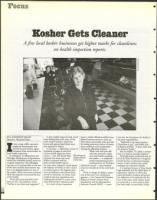
ments — that The Jewish News Rita Jer ome at
ance with health standards,
Unique Kosher
reported that some area retail
the heksher — a trademark
Carry Out
kosher businesses had less- •
symbol representing kosher
than-enviable health reports.
certification by an Orthodox
In some cases, inspectors noted repeat- rabbinical council — has remained
ed evidence of vermin or their excreta
intact in virtually all of the retail facili-
as well as lapses in the hygienic prac-
ties.
tices of employees who process food
Those in charge of rabbinic inspec-
served to customers. In others, food
tion at the state's two certification
products and raw ingredients were
agencies — the Council of Orthodox
inadequately labeled or stored, some-
Rabbis of Greater Detroit (Vaad
times beyond their expiration date.
Harabonim) and the Metropolitan
As a result of poor inspection
Kashruth Council (MKC) — main-
tain that the cleanliness of a facility is
not their responsibility.
"Kashruth is my main concern.
Cleanliness is not," said Rabbi Jack
Goldman of MKC. "I don't work with
the board of health."
But, he added, "If a place is unsani-
tary, it is hard to maintain kashrus."
Although kosher technically has lit-
tle to do with cleanliness, it is against
Jewish law for an observant business
owner to sell a product that could
endanger the customer's health.
It is perhaps because of these Jewish
legal standards and the added layer of
supervision inherent in them that
some feel kosher products go beyond
the definition of complying with the
laws of the state; many assume foods
are prepared in a more sanitary fash-
ion than treife, or non-kosher, foods.