

Six
M11110
Pop Tabs
ro
at Vance wants students to
understand the enormity
of the number six million.
A chemistry teacher,
Vance is organizing the Roeper
School's pop tab drive, and she is
attempting to use the fundraising
project as an opportunity for
_
Holocaust education as well.
For the past four years, students
at the private school in Birmingham
have collected tabs from empty soda
cans and sold them for aluminum
recycling. Money earned is then
donated for the purchase of hospital
equipment.
This year — inspired by a similar
project held in an Illinois school —
Roeper is setting a goal of six mil-
lion pop tabs, one for every Jew
killed in the Holocaust. At the end
of May, pop-tabs collected in plastic
jugs by each homeroom will be
dumped together into one pile so
that students can see what six mil-
lion looks like.
"It seemed like a good idea
because there's no way that kids can
Photo by Krista Husa
Roeper's commemoration
of the Holocaust
is potentially controversial.
JULIE WIENER
SteyfWriter
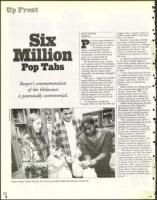
Roeper students Natalie Knazik, Abe Gurawitz and Keke Fairfax fill milk jugs with pop tabs.
10/24
1997
8
imagine what it means to have six
million people killed," said Vance,
who is not Jewish. -
However, it is unclear whether
the project is being coordinated
with adequate sensitivity. Although
the Holocaust "is part of ongoing
discussion in the school," says
Vance, no Holocaust education
component accompanies the pop-
tab drive.
In addition, student participation
in the drive is being linked to a
school-wide contest, with the home-
rooms bringing in the most pop
tabs earning an end-of-school party
in May.
"I was a little concerned that par-
ties might be offensive, but it's more
a motivational kind of thing, it's a
reward," said Vance. "They're not
having a party to celebrate the
Holocaust."
Asked whether the linking of pop
tabs to human lives might be dis-
tasteful, Vance said, "We're not
equating them in any_way. We're
trying to enable [the students] to
make a connection to realize how
horrible [the Holocaust] really was."
Rabbi Charles Rosezveig, founder
and director of the Holocaust
Memorial Center in West
Bloomfield, said he hoped the pro-
ject succeeds in raising awareness
about the Holocaust. But he was
critical of linking it to parties.
"The naming of it as a party is
something that probably, on second
thought, may not be the most
appropriate for this kind of thing,"
he said. "I would have a gathering,
but not the wording of a party.
There's nothing to celebrate."
Michigan Anti-Defamation
League Director Don Cohen, who
was familiar with the project in
Illinois, stressed the importance of
linking a Holocaust-related project
to a strong educational component.
"Obviously it needs to be done in
an appropriate way with firm educa-
tional purposes;" he said. "In the
original program, some people were
concerned that [comparing pop tabs
to human lives] was a trivialization
of the lives. That concern can be
addressed with a solid educational
focus. Short of that, people can
think it's just collecting pop tabs,
and that would be a missed oppor-
tunity." ❑
.