

k's
Mixed Media
News 6- Reviews.
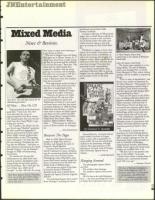
Dan Bern: 'An early Bob Dylan for the
skateboard generation."
Of Note ... New On CD
"Topical-political-poetical-sarcastic-
punk-folk." That's how New York
Letter describes the music of
singer/songwriter Dan Bern, whose
CD released earlier this year, the self-
titled Dan Bern (Sony/Work), is gar-
nering rave reviews.
No "Candle in the Wind" for this
guy. Bern's song "Marilyn" speculates
on what would have happened if
Monroe had married X-rated author
Henry Miller instead of playwright
Arthur Miller. In the CD's opening
track, "Jerusalem," he notes that "the
Jews are waiting, Christians are wait-
ing, also the Muslims." And then, to
ease everyone's anticipation, he reveals
himself, singing "I am the Messiah,"
though an oddly self-deprecating
incarnation.
No wonder the 32-year-old
Midwesterner has often been corn-
pared to Guthrie, Springsteen and a
young Dylan for his voice, politics,
and storytelling. "But I don't give the
`new Dylan' tag a whole lot of
thought," he says. After all, the young
Bern spent as much time listening to
Lenny Bruce as Dylan.
The son of refugees from the Nazis,
Bern grew up in Mount Vernon, Ia. "I
think I was aware from a really young
age that the personal and the political
are one and the same," Bern says. "My
father had his whole family shot,
except for a brother. And my mom
grew up in Germany and her family
left when she was young, in '39. So I
was living where I was as a direct
result of political events that touched
their lives personally."
With appearances under his belt at
the Ann Arbor Folk Festival and The
Ark, Bern is headed back to Ann
Arbor next week. Maybe he'll sing a
new song of his called "Lithuania."
"These are my ghor,cs: my Uncle
Emanuel/Uncle Eli and Aunt Mia/
and my grandparents, Jenny and
Tobias/none of whom I've ever met/I
saw some letters once that they wrote
my dad/in Palestine in 1940 not long
before they were all shot ... I some-
times want to dance on Hitler's grave/
and shout out (the names) Groucho
Marx, Lenny Bruce, Leonard Cohen,
Philip Roth, Bob Dylan. Albert
Einstein, Abbie Hoffman, Woody
Allen ... ." The list goes on with each
strum of Bern's acoustic six-string gui-
tar.
— Gail Zimmerman
Between The Pages
Back in 1920, Meyer Fryman
bought the Eagle Shoe Store in
Petoskey and changed the name to
Fryman's. Sound familiar?
Fryman's Shoe Store was an "Up
North" landmark for years, a frequent
stop for vacationing families who visit-
ed the store every summer. Ernest
Hemingway's sister, Marcelline, once
wrote that Ernest's mother bought his
shoes at Fryman's every fall when the
family lived on Walloon Lake.
Such stories are typical of the fami-
ly histories found in Howard V.
Epstein's book, Jews in Small Towns:
Legends and Legacies (Literary Legends,
$39.95).
The anthology features three entries
from Michigan, including the above-
mentioned excerpt from Zelda
Fryman Goldstein.
A unique collection of 140 personal
essays, Jews in Small Towns evolved out
of Epstein's interest in the oral histo-
ries of Jewish people who held a par-
ticular minority status in that they
grew up among very few Jewish fami-
lies.
Published as a legacy to Jews every-
where, the heartfelt stories depict the
life and times of the contributors, as
well as the centuries-old struggle of a
religious culture. What was life like for
small-town Jews? How did they hold
onto their heritage? How were they
perceived by their communities?
As a literary contribution, these
individual reflections offer us moving
insights into the challenges, difficulties
and triumphs of life on the back
roads.
K.,..,ei vrs of the maw in North America
Howard Epstein, a licensed clinical
social worker, was born in Logan,
Ohio, a town with a population of
about 6,000. He was the only Jewish
student in his elementary and high
schools. Now chair emeritus of the
department of social work of Georgia
State University, Epstein lives in
Atlanta.
— Linda Bachrack
Hanging Around
The photographs capture before
and after.
The artifacts show heritage.
The speakers explore future possi-
bilities.
All of it has to do with Ethiopian
Jews — the time preceding their move
to Israel, their experiences since and
A Tikal (Prayer) House lends
authenticity to the display of Ethiopian
handicrafts.
what the future could hold.
The issues come together in a trav-
eling exhibit, The Jews of Ethiopia,
which runs through Nov. 16 at the
Sloan Museum in Flint, where visiting
speakers will be available to requesting
groups.
"This is a story of assimilation," said
Steven Laux, curator of education for
the Sloan Museum. "These people were
among the poorest on earth, living in
an isolated Third World community
and then going through changes affect-
ing everything they know."
There are 140 pieces in the exhibi-
tion, including utilitarian objects and
figurines made from textiles, metal,
basket materials, wood and clay. A
Tikal (Prayer) House has been con-
structed by the museum staff to lend
an authentic atmosphere for the hand-
crafted bags, pillow covers and cere-
monial objects that will be for sale.
The exhibition is organized by the
North American Conference on
Ethiopian Jewry in cooperation with
Yeshiva University Museum and the
consulate general of Israel in New
York.
Sue Fishkoff, a writer for the
Jerusalem Post with firsthand knowl-
edge of Ethiopian Jews, will be avail-
able to speak to groups on Oct. 30.
Rachamim Elazar, radio journalist as
well as Umbrella of Ethiopian
Organizations founder, and Shlomo
Mulla, Jewish Agency for Israel social
worker, are available Nov. 4-12.
"We have had a very positive reac-
tion to this exhibit," Laux said.
"Viewers learn about a unique form of
Judaism and a community isolated
until 100 years ago."
— Suzanne Chessler