

•
s. \ ,$) •
. •
s
\\\N
•
N
*At
.\\ ' .\\
The Magic Of Maurice
Famed children's book illustrator Maurice Sendak is the set and costume
designer for the Detroit Opera House's next production,
Mozart's The Magic Flute.
SUZANNE CHESSLER
Special to The Jewish News
performance, what do you like about
them?
IV
A: I just feel that I've done the best I
could for Mozart, who is my hero and
whom I definitely would not like to
fail. I feel I have a very personal rela-
tionship with him and his music, and
that opera is my favorite.
Q: When you sit back and look at
the sets of The Magic Flute during a
Suzanne Chessler is a Farmington
Hills-based freelance writer.
10/10
1997
Q: What makes it your favorite?
Q: Have you used your family photos
as the basis for illustrations beyond
the Isaac Bashevis Singer stories?
A: The humanity and warmth, to me,
make it a very superior work. It's
touching and insightful about the
A: I have. When I [illustrated] Fly by
Night by Randall Jarrell, he had just
been killed in an accident, and it was a
A: Immensely. The most obvious exam,
ple is a Grimm fairy tale called "Dear "---\
Mili," which I illustrated some years
ago. The story was part of a letter to a
little girl who had lost a parent. It's
about a Christian girl being comforted
in Christian terms. I left her as
Christian in the book, but I gave her a
vision of what happened to children
who aren't Christian.
I'm very Holocaust obsessed. I'm a 7 '
first generation American whose par- )
ents had lost everybody in the war, and
I went through extreme suffering with
my parents, which I can never forget.
Photo by Chris Callis
hen The Magic Flute
takes the stage at the
Detroit Opera House,
audiences will see sets
and costumes designed by Maurice
Sendak, the versatile artist who has
written and illustrated children's books
for 40 years.
Perhaps best known for the book
Where the Wild Things Are, which won
a Caldecott Medal in 1964, Sendak
became the first American illustrator to
receive the international Hans
Christian Andersen Award for his
entire body of work.
Sendak often portrays the worri-
some aspects of childhood and dedi-
cates his books to children who are,
according to his terms, never satisfied
with condescending material and who
understand real emotion and feeling.
"I seem to have been blessed, or
cursed, with a vivid memory of child-
hood," said Sendak, 69, recalling him-
self as a sickly youngster. "According to
Freud, there's a valve that shuts off the
horrors of childhood to make room for
the horrors of adolescence.
"I must have a leaky valve because I
have these torrential memories. From a
career standpoint, I guess that's been a
good thing. Socially, it's been nothing
short of disaster."
Since 1980, Sendak has taken on set
and costume design, and in 1990, he`
founded The Night Kitchen, a national
theater company for children.
The Connecticut-based writer and
illustrator, who received the National
Medal of Arts from President Clinton
this year, recently talked with JN about
his designs for the Mozart opera and
the forces —including the Holocaust
— that shaped his artistry.
A: No. It's just a different scale. If it's a
book for children, it's two-dimensional,
and I don't have to worry about people
coming in and out of doors. An opera
is three-dimensional, and I do have to
worry about people coming in and out
of doors.
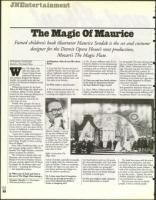
Maurice Sendak: "I remem-
ber my own childhood and
how I dwelt on terrible
thoughts. No one was there
to comfort me. Now I'd like
to be the comforter of chil-
dren in the sense that I can't
tell them the answer, but I
know that its there."
Right: A scene from The
Magic Flute.
nature of people, especially young girls,
and it [deals with] the confusion and
pain of children. Under no conditions
should it be taken as a cute opera. It's
very funny and has cute things in it,
but the subtext is profound.
Q: Is there some kind of transition
that you go through personally to
move from illustrating children's
books to designing sets?
very hard book to work on. It's nostal-
gic, about lost families, and I just made
it my lost family. On the cover is a por-
trait of my mother as a young girl,
when she first came to this country. I
frequently turn to my family although
my family is mostly gone.
Q: Has your religion made a presence
in your illustrations or stories?
The book has scenes with the actual
buildings from Auschwitz, and there
are scenes in a little French town where
the Nazis killed the Jewish children. I <
took a few incidents from the war and
put them in the visionary world of Mili
so that she could ... [know] that other
children arbitrarily suffered in the same
way and died for no reason.
My intention was not to disturb
people; it was to remind people.