

I
"But I wanted something more
meaningful and challenging," she says.
"I wanted to do something significant
in the community"
That something became a job at
Temple Emanu-El, where Goldman
worked for six years as administrator.
She moved on in 1992, taking a job as
administrator of a large Reform con-
gregation in Connecticut.
That same year, Goldman, then 36,
noticed a change in one of her nip-
ples. It appeared inverted, like a tiny,
dark pool sunken into the skin.
"I thought it was odd, but I didn't
do anything about it," she says. "Later,
I learned this is a classic sign of breast
cancer."
Several months later, she discovered
a lump.
"One morning I felt something, a
thickness that had never been there,"
she recalls. "I knew something was
wrong, and I called the doctor right
away. I said I wanted to come in that
day."
The nurse was amused. She said:
rn
10/3
1997
92
"It's going to be at least two
months before we have an open-
ing."
But with a resolve that would
come to define her entire approach
to her medical care, Goldman said
she had a lump and she needed to
speak immediately to someone.
The nurse got her in that day.
Initially, Goldman was opti-
mistic.
"I knew the situation was seri-
ous, but I didn't jump to the con-
clusion that I had cancer," she says.
"I had no family history of the dis-
ease, and I had been pretty good —
although not diligent — about
doing self-exams. The doctor said
he thought it probably was a cyst,
but he wanted me to double check
with a surgeon.
"I was new in town," Goldman
says. "So when he handed me a list
of surgeons, I told him, 'I don't know
any of these people. You choose the
best name and call him now."'
That same day, Goldman was in to
see a surgeon, who recommended a
mammogram.
"The technician said he saw some-
thing which could be nothing, but he
wanted to send it to the surgeon,"
Goldman says. "The look on his face,
though, told me this was not good."
Following the mammogram, the
surgeon made his own biopsy by
inserting a needle into the lump. Days
later, Goldman was still waiting for
the results.
"By that fourth day I was beside
myself," she says. "I wasn't sleeping,
and I was angry that this was taking so
long."
Meanwhile, "I started to put my
affairs in order. I made sure my work
and financial records, my life and
health insurance were all up to date. I
knew death was a possibility"
Among Goldman's greatest support-
ers at the time was her boyfriend,
Cliff. She phoned him soon after her
mammogram, and he urged her to
stay calm. He said he would be there
for her.
When the physician's office finally
called with the results, the news was
not good. It was cancer, and the sur-
geon wanted to perform a lumpecto-
my and follow up with radiation.
Goldman opted for a second opinion
with physicians at nearby Yale
University, who recommended a mas-
tectomy. Goldman hesitated.
"Then the head oncologist told me
something I'll never forget. She said,
`You'll have to get over your body-
Sokolowski, and her knowledge,
4ao
insight, compassion and sense of
humor was nothing short of a godsend I
to me and hundreds of other women."
Meanwhile, friends at work sent
cards and letters and flowers, which
Goldman says were essential to her
recovery. "I can't tell you what it
means to receive upbeat mail while
you're going through an experience -
like this," she says.
Goldman continued working
throughout much of her treatment.
She also read everything she could
find about breast cancer, and about ml
the chemotherapy that was just ahead.
"I was so terrified at the thought of
chemotherapy that I could hardly
bring myself to go to the doctor's
office," she says. "So I began my own 14
little course of readiness. I checked out
works by Bernie Siegel and meditation 4
tapes. As the weeks went by, I finally
made the transformation from 'I'm
too frightened and I can't do it' to
04
`chemotherapy is the good guy. It's my
ally, and it's going to kill the cancer.'
Without that change, I don't think I
could have survived."
As she listened to the tapes,
Goldman often sketched pictures of
what was in her heart. "Sometimes, I
would write, 'I'm so angry' over and
over in big letters. But sometimes I
could laugh. I would go back and
10
forth like that, from the sublime to
the ridiculous. But as time went on, I
saw less and less pages with rage and
more and more with humor."
so
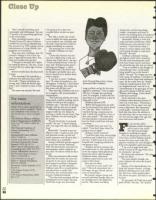
Artist Howard Munce drew a brave,
determined Ellen Goldman.
image problem and go for the most
aggressive treatment.' I was so angry
with her; I thought she was being
cruel. In retrospect, I realize that los-
ing a breast is a small price to pay for
being able to live."
Goldman phoned Cliff.
"Before the lumpectomy, he told
me he was proud of me and he loved
me," she says. "After I told him I
would be having a mastectomy, he
said, 'I think this would be a time to
date other people.'" He made some
less-than-pleasant comments about
how her body would look with just
one breast.
"I wouldn't leave you now," he
added. "I just don't know when I'm
going to see you again."
Goldman wasn't interested.
"I told him these were unacceptable
conditions and I asked him to leave,"
she says. "I didn't want to be in the
hospital bed, wondering whether he
was going to visit."
Goldman did have someone else
she could count on. Her mother flew
in for the surgery, where physicians
discovered cancer cells throughout
Goldman's breast. Afterward,
Goldman stayed with an aunt and
uncle in New Jersey.
Then she was alone.
"I cried for an entire week," she
says. "I felt such tremendous loss —
the breast, the guy I loved, and my
sense of immortality."
She joined a support group and
secured individual therapy, then met
an oncology nurse who helped her
survive. "Her name was Nancy
F
or six months, Ellen
Goldman couldn't bring her-
self to look in the mirror.
Her ally had seemingly
4110
brought her nothing but agony.
First, her fingers got terribly sore.
Then there was the shaking, and the
nausea that never went away. Her
appetite vanished; the mere thought of al
fruits and vegetables made her queasy.
"I ate a lot of angel-food cake
which, because of the egg whites, has a
lot of protein," she says.
She always felt exhausted. "My only,.. 4
1■I
escape was sleep."
The most painful, though, was
what Goldman felt when she looked
at herself.
-
Because of the chemotherapy, her
body had become bloated, a strange
thickness defining every inch of her.
Her skin bore a dull, grayish pallor.
Her breast was gone, and then so was
her hair.
"At one point, all I had was a small
patch of hair," she says. "So I picked