

Health
te
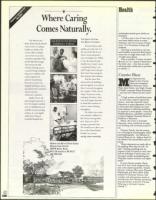
Where Caring
Comes Naturally.
The Marvin and
Betty Danto Family Health
THE QUALITY OF CARE.
LOCATED ON THE JEWISH
COMMUNITY CAMPUS.
THE QUALITY OF CARING.
Research shows that
Care Center is a unique
health care facility. The
quality, personal care is at
Center offers multiple
the top of the list of resi-
care services in an envi-
dents' needs and prefer-
ronment respectful of the
ences in health care. Which
Jewish faith and heritage.
is why the Danto Family
Our services include
Health Care Center's most
24-hour nursing care in
exceptional feature is its
a catered living setting for
staff. People who truly put
long term residents, sub-
their hearts into caring for
acute programs for
their patients and residents.
And for those first
patients transitioning
between an acute care
attracted by the building's
hospital and home, and a
physical appeal, rest assured
specialized self-contained
that it's carried throughout
unit to care for
the complex. With a lovely
Alzheimer's patients.
chapel, luxurious rooms,
mahogany furniture, brass
Quality-driven sub-
acute programs provide a
trim and elegant attention
level of complex medical
to detail that combine to
care or rehabilitation not
create a warm relaxing
available in most nursing
atmosphere.
We believe the center
centers, at a cost signifi-
cantly lower than an
is an attractive addition to
extended hospital stay.
the Detroit metropolitan
area. Stop in or call to
arrange a personal tour.
We would love to show you
how at the Danto Family
Health Care Center
caring comes naturally.
MARVIN AND BETTY DANTO FAMILY
HEALTH CARE CENTER
6800 W MAPLE ROAD
EST BLOOMFIELD, MI 48322
248-788-5300
Ftr
•'
10/3
1997
126
AokT,
•
YA
4
carbohydrate-based sports drinks are
beneficial.
• Drink a cup or two of water one to
two hours before activity to assure
hydration, and 4 to 6 ounces of water
every 15 to 20 minutes to keep well-
hydrated.
Also keep in mind that in the heat
and humidity of summer, fluid require-
ments rise to a high-water mark 10 to
16 eight-ounce glasses.
Heat or exertion, it seems, can drain
at much as 5 to 7 quarts of liquid from
the body a day - a loss that an under-
'‘
achieving thirst mechanism is powerless
to address. ❑
•
Creative Blues
ic-depression has
plagued a host of poets,
writers and composers -
ohn Berryman, Sylvia
Plath, Anne Sexton, van Gogh, Georgia
O'Keeffe, composer Robert Schumann
- and may have influenced their creativ-
ity.
"A high number of established artists
- far more than could be expected by
chance - meet the criteria for manic-
depression or major depression. In fact,
it seems that these diseases can some-
times enhance or otherwise contribute 40
to creativity in some people," wrote Kay
Redfield Jamison, a psychiatry professor
at Johns Hopkins University School of
Medicine in Baltimore.
Mania, she wrote in Scientific
American, seems conducive to origi-
nal thinking and increased productiv-
ity.
However, Frosch, who has written
on a subcategory of pathography called 10
psychopathography - the influence of
mental illness on art - believes there's lit-
tle evidence that mental illness aids cre-
ativity.
"Manic-depressives are rarely able to
do anything when they are sick," he
said. "Turning something into art
requires a kind of control in one's mate-
rial and technique; if you're crazy, you
have great trouble accomplishing any- 10
thing that requires structure and organi-
zation."
In some famous people, illness
may have been more imagined than
real, some experts speculate. Charles
Darwin, Crimean War nurse Florence
Nightingale and Mary Baker Eddy,
founder of Christian Science, had
complex and subconscious needs to
manufacture their illnesses, becoming
hypochondriacs, wrote Dr. Thomas
Pickering in his book Creative
Malady. ❑
4