

\-1
/- kind.
A few private rabbinic dialogue
groups did spring up in places such as
v--Chicago. But such events were
dwarfed by the more contentious
statements being made.
• A small group of Haredi rabbis
denounced Reform and Conservative
Judaism as "not Judaism." The episode
r received extensive media coverage.
; Mainstream Orthodox groups took
out full-page ads in newspapers
\__ around the country. They did not
/----reject the original group's claim, but
emphasized the need for Jewish unity
and respect.
In a world of electronic communi-
cation and live television news, each of
(--' -the incidents instantly became the
buzz of the community. Shabbat ser-
mons, letters to Jewish newspapers
and community programs quickly
\--Turned to issues of Jewish unity and
'religious pluralism.
Mind you, remarkable things did
continue to happen in the past year.
Community and personal celebrations
-,came and went, new syngogues and
_ schools opened, and countless individ-
uals sought to strengthen their person-
al spiritual/religious foundation. Yet,
when the day was done, we spent
-more energy pointing out our differ-
' 'ences — or lamenting our inability to
set them aside — than anything else.
In part, the religious pluralism bat-
\ mtle has gained so much attention
because it has put to rest forever the
once semi-sacred slogan of American
Jewish life — We Are One, the popu-
lar cry of UJA/Federation fund-raising
campaigns.
\ - But to say We Are One is as inac-
curate today as it was some 3,000
years ago when Moses left Egypt with
an erev rav or mixed multitude.
7 Nor were our divisions invisible
lthroughout the ensuing long march of
Jewish history. During the
Maccabbean revolt, Jews were split
between the Hellenist/secularist camp
and the religious zealots.
-- Less than a century later, the divide
took refuge in the Essenes, Pharisees
and Sadducees. On the eve of the
modern era in Western Europe, Jewish
communities to the east were rife with
competing Chasidic groups, all of
/- which fought the rigidity and elitism
of the mitnagdim, or yeshiva world.
1
\
Back in Germany, the center of the
Enlightenment, the gap between clas-
sical Reform and neo-Orthodox
Judaism seemed an immeasurable gulf.
Yet, the tensions of those times
avoided the core of today's struggle.
That's because until recently, the
answer to "Who Is A Jew?" was clear.
If your mother was Jewish, you were a
Jew, no matter what you did or did
not do. And since until this century,
few non-Jews had any desire to marry
the seed of Abraham and Sarah, the
debate was irrelevant.
But in 1983, that formally changed
as the Reform movement adopted the
doctrine of patrilineal descent. It
binding one. But an irrevocable line
had been crossed.
The Orthodox world reacted then
— and still does — with utter disdain.
The Conservative world, which has
partnered with its Reform counter-
parts in the religious pluralism battles,
is less vocal in opposition. Yet, its rab-
bis continue to abide by the "Jewish
mother" clause and to not accept
Reform conversions. (They do, how-
ever, provide a process of conversion
into Conservative Judaism for Reform
Jews-by-Choice that is easier than the
Orthodox one, which demands inten-
sive Jewish study for a long period and
then a promise of adherence to Jewish
laws and customs.)
So if these splits are
nothing new, why all the
angry confrontations of
late?
Well, in the past
decade American Jews
have increasingly
focused on the realities
behind the frightening
statistics of intermarriage
and assimilation. Many
Jewish leaders are horri-
fied that countless young
Jews — as well as them-
selves — seem far more
fluent in the philosophi-
cal language of
McDonald's than that of
Maimonides.
Recognizing this,
every Jewish group, sec-
ular and religious, has
embraced the concept of
Jewish learning.
Communities have
banded together to open
more Jewish private
schools; trips to Israel •
are now seen as manda-
tory; family education is
the rage.
As such, more and more
Jews are confronting tra-
ditional Jewish beliefs, ones that often
do not jibe with their own lifestyles.
So they either shift toward that tradi-
tion, or point to the rulings and
philosophies of rabbis who differ from
the traditional perspective. And as
they contemplate their Jewish identity,
their own ideologies become more
rigid.
"Rabbi Tarfon said,
would be very
surprised if there is
anyone in this
generation that can
accept criticism.'
Rabbi Elazar ben
Azariah responded,
`I doubt if there is
anyone in this
generation that knows
how to give criticism.'"_
Talmud Arkhin 16
declares that a child is Jewish if one of
his or her parents are Jewish and_if the
child is raised in a Jewish home and
passes through Jewish life cycle events.
While some Reform rabbis had long
abided by this, it was now official. In
some regards, it didn't matter. Reform
Judaism had always seen Halachah, or
Jewish law, as a guiding force, not a
Year Of Anger
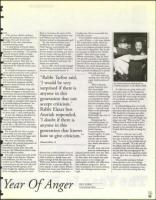
An Israeli policeman holds back an
Orthodox protestor at the Western Wall.
So where are we going with it all?
One place must be the recognition
that those of us who care about collec-
tive Jewish life must accept the limits
of our debate, meaning that widely
accepted answers will never be
reached.
In acknowledging that, we would
do well to focus more on the need for
discussion than the search for answers.
We should do so because our collec-
tive passion over religious pluralism
shows that many of us still deeply care
about not only "Who Is a Jew?" but
"What Does It Mean To Be A Jew?"
And that is very, very good. And we
should let the remarks of the sage
Tzadok HaCohen guide us along the
way.
"There is only one way to tell
whether two people are arguing for
the sake of heaven or for their own
sake," he wrote in his introduction to
Or Zarua Latzadik. "If at the end of
the debate they love each other with
complete heart and soul, then you can
be sure that they are arguing for the
sake of heaven. If the argument results
in hate, then they are arguing for their
own ego."
The powerful sentiment behind
those remarks is part of a heritage
owned by everyone whom the broader
Jewish community recognizes as one
of its own. Let's start acting that way.
NEIL RUBIN
Contributing Editor
9/26
1997
75