

Both Sides Of The Fence
LARRY DERFNER
Israel Correspondent
L
iving a mile from the north-
ern border with Lebanon, the
homes of both Rachel
Keinan and Yisrael Avakrat
are vulnerable to katyusha rockets
fired periodically in their direction by
Hezbollah terrorists. Each is also the
parent of sons who, as soldiers in elite
units of the Israeli army, go over the
border and fight the Lebanese group.
Keinan, a jewelry-maker at Kibbutz
Elon, and Avakrat, mayor of the devel-
opment town of Shlomi, live about
four miles from each other. But the
way they see the war in Lebanon is
worlds apart.
They are part of a new debate that
has broken out in Israeli society —
As their sons
go off to battle,
Israeli families
vigorously
debate the army's
presence
in Lebanon.
whether to keep Israel's soldiers in the
"security zone" in south Lebanon until
formal peace with Syria (Lebanon's de
facto ruler), or to get them out as
soon as possible.
Keinan, a 51-year-old Peace Now
supporter, managed not to think
about the war until her son, Harel,
went there to fight about two years
ago. Then the thought began growing
in her: "It's the soldiers' job to defend
civilians, yes, but you have to balance
that against the price we're paying. So
many soldiers are being killed. Why
aren't their lives as valuable as those of
civilians?" Keinan's younger son, Adi,
21, is now in uniform — and fighting
in Lebanon.
Avakrat, a Likud member, has two
sons in their mid-20s who fought in
Lebanon in recent years; they're liable
W<;..‘‘'
Olifl
21
1
2.stte0
1,0 1
D',V4- 11
ri
11.1M1 e r:1
q,a0 t.
31`7°.1 1.it•
AMMO
0.1. . •
,99.666.993559
464-0
g
•
31.74
101,114 101:24
,
to return as reserve soldiers. In family
discussions about the war, "It's clear to
them that the scales tip in favor of us \ '
staying in the security zone," Avakrat
says.
This is how they felt before the
recent spate of battle deaths in
Lebanon, he adds, and this how they -
feel now
With two soldiers killed in
Lebanon last Saturday, and 12 killed
on the previous Saturday, the call for
unilateral pullout has been spreading.
Dina Bosel, whose son, Ophir, was
among the recent war dead, said bit-
terly on television: "I don't want any-
body to tell me it was worth it,
because when you add it up, it wasn't -
worth it."
Gen. Amnon Shahak, chief of staff
of the Israeli military, said the move-
ment for withdrawal from
Lebanon was one of "the
clear signs of fatigue" among
the Israel public. This is lead-
ing many people to demand
a quick, decisive solution,
but Shahak admitted, "We
do not have such a solution."
These sorts of frank, trou-
bling statements didn't used —\
to be heard. But the 15-year
war in Lebanon, which has
often been called "Israel's
Vietnam," is driving more
and more people to speak
their hearts.
There is a growing division
of opinion about Lebanon
among the residents of the
northern border. The area is 7
dominated by two sharply
contrasting kinds of popula-
tion centers — left-wing,
mainly Ashkenazi kibbutzim
like Elon, where the move-
ment for withdrawal gets a
•'L_,:_it, frisio,40)41.*:
fairly receptive hearing, and
right-wing, Sephardi
moshavim and development
towns like Shlomi, where
opposition to withdrawal is
overwhelming.
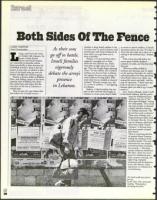
An Israeli walks past posters
put up
by the Peace Now movement
reading, "Netanyahu is
destroying the peace."
9/19
1997
30