

piece, The Man With The Movie
Camera (1929).
It will be their third visit to the
Motor City.
"I know it isn't often that you hear
people saying they like to visit Detroit,
but we do," Winokur said. "The
Detroit Film Theatre is a great place
to play, and the audiences are wonder-
ful."
When the Alloy Orchestra began its
existence in Boston's chilly weather six
years ago, fortune had it that a man in
the crowd ran a retro movie theater
and was looking for someone to pro-
vide a score for a silent film.
The group agreed to do the show,
which became a highly popular repeat
attraction. Word of the group's ability
to turn out a quality performance
traveled to Telluride, Colo., where
organizers of the city's film festival
invited the orchestra to perform for
festival goers.
From there, word of their reputa-
A Tickle In The Heart
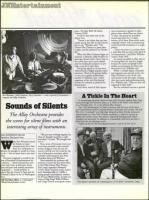
Ken Winokur, Caleb Sampson, Terry Donohue — and a myriad of instruments —
comprise the Alloy Orchestra.
The Alloy Orchestra provides
the scores for silent films with an
interesting array of instruments.
JILL DAVIDSON SKLAR
Special to The Jewish News
W
hen Ken Winokur joined
his friends to make
unusual music for a New
Year's Eve celebration in
Boston, he thought it would be a hoot
to do — but no more than a one-time
deal.
He never imagined it would be the
first of hundreds of performances his
orchestra — whose instruments corn-
prise such items as bed pans, horns,
pots and pans and normal percussion
equipment — would perform in
places like the Louvre in Paris and the
National Gallery of Art in Washington
D.C.
Jill Davidson Sklar is a Huntington
Woods-based freelance writer.
"We put tons of things together for
what we thought would be a really
cool show," he said. "We thought that
was it."
But a series of fortunate twists and
turns have provided a near-constant
stream of gigs in cities all over the
country and all over the world for the
trio of alternative musicians which
includes Caleb Sampson and Terry
Donohue along with Winokur.
Next weekend the orchestra will
perform its scores for four silent films
at the DIA's Detroit Film Theatre:
Fritz Lang's legendary Metropolis
(1925), Buster Keaton's comic master-
piece Steamboat Bill, Jr. (1928); a
young people's participatory matinee
of The Lost World (1925), an early cre-
ation of King Kong's Willis O'Brien;
and Dziga Vertov's avant-garde master-
In an amazing trip down memory lane, three brothers explore their roots
In and through their klezmer music in A Tickle in the Heart, to be shown 7
p.m. Monday, Sept. 15, at the Detroit Film Theatre.
The 1996 documentary by Stefan Schwartz tells the story of the three
surviving Epstein brothers, popular klezmer musicians now in their 70s and
80s. On a "comeback" tour that takes them from their Florida retirement
communities to a New York Chasidic wedding to a sold-out concert in
Berlin, the brothers share their stories, frequently finishing each other's
thoughts and sentences. In addition to a beautifully told story, the film is
filled with the trio's Ideziner music.
Tickets are $5.50; $4.50/students/members. Call (313) 833-2323.
hoto courtesy of Kin o In ternati
Sounds of Silents
tion continued to spread to other
places where silent films are shown.
To date, the group has provided
sound and music for 11 silent
movies, all of them films which were
originally shown with accompanying
sound from full orchestras to a single
pianist.
"There was never an occasion when
a silent film did not have some kind of
accompaniment," said Elliot Wilhelm,
curator of the DFT.
As sound was added to film, the art
of scoring films live was lost, largely
because the scores circulated by the
studios to accompany the films were
destroyed or lost, Wilhelm said.
While a veritable legion of pianists
and organists now provide scores, the
Alloy Orchestra is one of the only
such groups to ply the trade, creating
their own scores and performing them
live, Wilhelm said. "They are very well
respected in their field."
But the orchestra's success is pinned
Max Epstein entertains the remaining Jews in his father's hometown, Pinsk.