

LYNNE MEREDITH COHN
Staff Writer
hirty-four years ago,
Sherwin Wine had a vision.
Since he couldn't find an
ideology he was comfortable
with in any of the existing Jewish
movements, the young, Reform-
trained rabbi turned inward. It was
time to start a new arm of Judaism.
Nearly three and a half decades
after he conceived Humanistic
Judaism, the movement's leader and
founder sees retirement on his short-
term horizon. Does that mean the
death of his movement? Not a chance,
says Wine.
The founder of what has become
an international movement — cele-
brating Jewish culture, history, the
power of the individual and, some-
times, religion, without praying to a
deity — will step down next June.
But while he will "seriously curtail
my activities," Wine is not the type to
retire to the garden. He will keep an
office at the Birmingham Temple in
Farmington Hills.
It has yet to be decided who will
succeed Wine in a full-time role.
Born in 1928 and raised in Detroit,
Wine was trained as a Reform rabbi
"because no humanistic training" was
available to him. Raised Conservative
at Congregation Shaarey Zedek, the
Central High School graduate and
University of Michigan philosophy
major says, "It was very clear to me
that while I felt myself to be strongly
Jewish, I wasn't a Conservative Jew.
"Reform was comfortable for me,
but at U-M I had developed a pretty
strong humanistic philosophy of life
that I wanted to attach. to Jewish cul-
ture ... I wanted to be a philosopher
and counselor to Jewish people. The
closest profession to that was rabbi."
In 1951, Wine enrolled at Hebrew
Union College; he was ordained in
1956. While his humanistic ideas
were perfectly acceptable within the
framework of college," they were not
in the Reform movement, he recalls.
Wine spent two years in Korea as a
U.S. Army chaplain, followed by two
years as assistant rabbi at Detroit's
Temple Beth El. Then he organized a
Reform temple in Windsor, also called
Temple Beth El, which he led for
three years.
By 1963, Wine realized that while
"I loved being a rabbi — teaching,
counseling, celebrating Jewish culture,
serving people at important moments
in life — my belief system and the
Reform movement were not compati-
ble." And he could no longer keep his
ideas under wraps.
"I grew up in an environment
where most of the people I knew did
not solve their problems by prayer —
they talked about prayer, but were
taught to be self-reliant. That was dif-
ferent from the messages coming out
of traditional religion."
Wine knew Jews who "were fairly
secular, no matter what synagogue"
they affiliated with.
"I grew up in the era of Hitler and
"
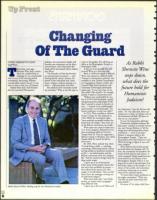
Rabbi Sherwin Wine: Making way for new Humanistic leaders.
9/12
1997
8
As Rabbi
Sherwin Wine
steps down,
what does the
future hold for
Humanistic
Judaism?
the Holocaust," says the 69-year-old
rabbi. "It's very clear that, from our
experiences as Jews, we cannot rely on
the kindnesses of faith. We have to
rely on our own power."
So says the humanistic ideology.
Humanistic Judaism eschews dei-
fied prayer. Judaism to secular human-
ists, says Tamara Kolton, is "all the
things Jews did during their whole
civilization — God is one part."
Kolton is assistant rabbi at the
Birmingham Temple. "There are
Humanistic Jews who believe in God.
We're all trying to figure it out, and
that's religion."
Wine believes the Jewish people
survived history by human will. To
him, the movement he founded cele-
brates Jewish history and culture. A
velvet-wrapped Torah stands between
book shelves in the library of the
Birmingham Temple. That it is not
placed in an ark in the sanctuary but
still finds a place in the temple is evi-
dence of the careful, and sometimes
confusing, balancing act to which
Humanistic Judaism aspires.
"It wasn't that I had a revelation in
the night somewhere," Wine says.
"My life has been consistent with
those beliefs."
He knew of "so many other Jews