
L
r p
),,
L3LIrl
c
Shakin
The Fizz
•
ALAN ABRAMS
Special to the Jewish News
R
emember root beer floats?
Frosted root beer mugs?
Papa burgers? Curb-side
service at drive-ins with
tray-toting waitresses on roller skates?
If there are such things as fast-food
memories, almost certainly they have
to be about A&W restaurants.
The old familiar A&W logo has
gone global, and you are now just as
likely to find the company's "All
American Food" in Beijing as you are
on the Wayne State University cam-
pus.
Since A&W Restaurants left the A.
Alfred Taubman umbrella in 1995, the
company has undergone a dramatic
turnaround, and is now cruising
towards its former heights. The cata-
lyst is Sidney J. Feltenstein, chairman,
president and chief executive officer of
9/12
1997
148
the Livonia-based company.
A veteran of the fast-food industry
wars, Feltenstein was formerly execu-
tive vice president of marketing for
Burger King Worldwide. Before that,
he was senior vice president at
Dunkin' Donuts for 19 years.
Feltenstein organized and led a
group of investors, mainly fast-food
executives, operating under the name
of Sagittarius Acquisitions, Inc., and
was backed by the investment compa-
ny Grotech Capital in the purchase of
A&W from Taubman.
When Feltenstein took control of
the company on New Year's Day,
1995, there were 650 stores left from
the company's peak of 2,400 stores.
On average, A&W had closed 85
stores a year over 20 years under
Taubman and previous owners, and
had sold the root beer trademark to
Cadbury Beverages (now Cadbury-
Schweppes.)
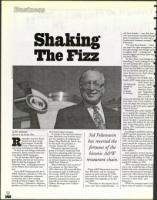
Sid Feltenstein
has reversed the
fortunes of the
historic A&W
restaurant chain.
Today, A&W Restaurants has more
than 800 stores, and the company
expects to reach and pass the 1,000-
store mark by the end of 1997, a goal
Feltenstein had originally set for the
year 2000.
"I have been in this industry for 25
years, and I have watched brands — I
call them brands — over that time
who have become tarnished through
lack of investment, but who had a
fundamental consumer strength,"
Feltenstein.
"I've seen those brands — when
you inject the right management, wit
the right strategy and enough capital
to support both — emerge and
become bigger and better than they'v)
ever been before.
"In fact, when I was looking to do
something, I wasn't looking for this
hot new concept like a nascent
Boston Chicken. I was looking for a
brand that had fallen on hard times,
but yet had been around for many
years. Because to me, that's where th
great opportunity was at.
"I looked at a lot of deals, and
finally A&W came across my desk.
And I knew that NW
Sid Feltenstein the one. A&W is
outside an
one of the great
A&W
American icons," he
prototype
said. "Regardless of
at Fairlane.
the problems it has
had, it is still a
strong and exciting and vital brand.
And when I saw it was available, an
I saw the shape the company was in
said this is one of the great opportu
nities of all time."
Feltenstein put a plan together to
try to acquire the company. His firs
meeting with the people at Taubma
was in early February of 1994. He
closed the deal 11 months later, pay
ing a mere $20 million for the corn
pang. Under Feltenstein, A&W is e
mating 1997 systemwide revenue at
$300 million.
According to published reports,
A&W reported systemwide sales of
$280 million in 1996, up 12 percen
from the $250 million it reported i
1995, the first full year Feltenstein's
group owned the company, and the
first year of net growth in 20 years.
Sales the previous year had totaled
$241 million.
Total company revenue has also
continued to grow under Feltenstei
reaching $18.9 million in 1996, a
jump from $12.7 million in 1995,
and $10.9 million in 1994.
"We're very lucky because we inh
ited a very wonderful base of franch
holders that were committed and d
icated to the business of wanting to
a great job. They believed in the co
cept — they were people who have
root beer in their veins," said
Feltenstein.
"While the company wasn't very
big in terms of number of employee
Scanned image of the page. Keyboard directions: use + to zoom in, - to zoom out, arrow keys to pan inside the viewer.
September 12, 1997 - Image 152
- Resource type:
- Text
- Publication:
- The Detroit Jewish News, 1997-09-12
Disclaimer: Computer generated plain text may have errors. Read more about this.