
Free Prostate Cancer Screenings
cient evidence of its safety. Now, if
the experts could only tell us how
much is enough.
How Much Is
Too Much?
The beneficial anti-clotting effect of
Vitamin E can be a danger for those
on blood-thinning medication.
People on anticoagulants or other
medications that may affect blood
clotting probably should not take
Vitamin E. Check with your physi-
cian.
Selenium
Supplements
Selenium, a mineral long feared
for its toxicity, is the last of 40
nutrients to be proved essential to
human health.
Identified as an essential trace
mineral for humans in the 1960s,
selenium acts as an antioxidant,
protecting red blood cells.
Recent studies suggest that a
daily 200 microgram supplement
can help prevent both heart dis-
ease and cancer. The Food and
Nutrition Board of the National
Academy of Sciences reports that
a daily intake of between 50
micrograms and 200 micrograms
is safe and adequate. Most of us
consume enough selenium in our
food to satisfy the current recom-
mendation.
At levels of about 1,000
micrograms (1 milligram), signs
of toxicity appear: loss of hair,
fingernails and gastrointestinal
problems.
Trying to get more selenium
from foods is complicated
because levels vary with the sele-
nium content of the soil in which
the foods were grown. Moreover,
food processing can remove sele-
nium from the food source. Since
Vitamin E greatly, increases the
effectiveness of selenium in the
body, if you're taking Vitamin E
you may not need selenium sup-
plements.
Selenium is found in foods
rich in protein, such as meat, fish
and shellfish, as well as cereals,
grains such as pasta, rice, and
wheat, vegetables, mushrooms,
asparagus, broccoli, cabbage, cel-
ery, Brazil nuts.
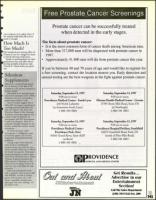
Prostate cancer can be successfully treated
when detected in the early stages.
The facts about prostate cancer:
• It is the most common form of cancer death among American men.
• More than 317,000 men will be diagnosed with prostate cancer in
1997.
• Approximately 41,400 men will die from prostate cancer this year.
If you're between 40 and 70 years of age and would like to register for
a free screening, contact the location nearest you. Early detection and
annual testing are the best weapons in the fight against prostate cancer.
Saturday, September 13, 1997
9:00 am to noon
Providence Medical Center - South Lyon
210 North Lafayette
(in downtown South Lyon)
1-800-341-0801
Saturday, September 13, 1997
9:00 am to noon
Mission Health Medical Center - Livonia
37595 Seven Mile Road, Suite 370
(at Newburgh)
1-800-341-0801
Saturday, September 13, 1997
9:00 am to noon
Providence Medical Center -
Providence Park, Novi
47601 Grand River, Suite A207
(at Beck)
1-800-341-0801
Saturday, September 13, 1997
9:00 am to noon
Providence Hospital Pavilion, Southfield
22255 Greenfield Road, Suite 351
(south of Nine Mile Road)
1-800-341-0801
ROVIDENCE
H OSPITAL AND MEDICAL CENTER
5.1 qpri
DETROIT
JEWISH NEWS
'TN
9
Get Results...
Advertise in our
Entertainment
Section!
Call The Sales Department
(248) 354-7123 DJ. 209
9/12
1997
141
Scanned image of the page. Keyboard directions: use + to zoom in, - to zoom out, arrow keys to pan inside the viewer.
September 12, 1997 - Image 145
- Resource type:
- Text
- Publication:
- The Detroit Jewish News, 1997-09-12
Disclaimer: Computer generated plain text may have errors. Read more about this.