

To family, friends, fellow entertainers and
fans — as well as people who might not be
quite asfamiliar with her humor —
Gilda Radner's memory is
a blessing.
SUZANNE CHESSLER SPECIAL TO THE JEWISH NEWS
D
etroit-bred comedian Gilda Radner, who gained TV star-
dom by making viewers laugh through "Saturday Night
Live," died May 20, 1989, but is kept in mind through
Gilda's Club, a network of support centers planned to
cheer cancer patients and their loved ones.
Radner, who succumbed to ovarian cancer at age 42, turned to
support groups for help and understood the need for home-like
places where patients and their relatives can laugh and cry, learn
and grow.
Her vision for a network of centers
was made real under the leadership
of family and friends, including her
widower, Gene Wilder, and her
therapist, Joanna. Bull. The New
York Gilda's Club has become
the model and training hub for
similar facilities.
As finishing touches are
being put on a Gilda's Club
building in Royal Oak, two
entertainment-filled fund-
raisers are scheduled to
accelerate the end-of-year
opening.
"The Lion Laughs Tonight," an evening of humor
staged Aug. 24 by the Motor City Women of Comedy,
will be at the Royal Oak Music Theatre. The Gilda's
Club Family Walk & Block Party will be led Sept. 28
by Detroit Mayor Dennis Archer at Cobo Center, where
a party filled with music and clowns follows the parade-like walk.
Radner's impact also can be experienced through books, a
play and TV and radio retrospectives that breathe life into her
memory.
U)
LLJ
Up
LLJ
CC
LU
Lll
00
Editor's Note: It was 1975. My husband, Lonny, and I were liv-
ing in an apartment in Troy, and across the hall lived a nice
guy named Michael Radner. One day he knocked on the door.
"My sister is going to be on a new TV show starting tonight. Her
name is Gilda Radner, and the show is called Saturday Night
Live.' Be sure you watch." We did. And I haven't stopped watch-
ing since.
But I prefer those old reruns of the show on Comedy Central,
where we can watch Gilda do all her great characters a con-
fused Emily Litella; the rambling, loud-mouthed newscaster
Roseanne Roseannadanna, a lisping Barbara Walters (Baba
Wawa) — the list goes on and on.
I often think of Gilda on those days when nothing seems to
go right. In the words of Roseanne Roseannaclanna: "It just
goes to show you, it's always something."
— Gail Zimmerman
A Brother's View
Michael Radner, who volunteers considerable time to estab-
lishing Gilda's Club in the area, thinks of his sister very much
in the present.
"I have to remind myself that she's gone," he said. "Although
I talked to her a lot, I didn't see her face to face because she lived
out of town. In my mind, she's still out there."
Michael Radner, born five years before his famous and only
sibling, is an investment counselor who applies his financial
skills to raising operating funds for the Gilda's Club at 3517
Rochester Road in Royal Oak, where all services will be offered
at no charge.
"When Gilda was sick, she went to a support community in
California and wished everybody could receive that kind of help,"
he recalled. "Gilda's Clubs provide a residential setting very
much like a clubhouse, where people can find social and psy-
chological support. At any time, people will be able to walk in,
have a cup of coffee and talk to somebody who has had a simi-
lar experience."
Trained therapists, lectures and special events are part of the
program that supplements medical care in a facility unlike a
hospital or treatment center.
"Gilda's Club is also about enjoying life," Michael Radner said.
"It's not all serious. Gilda loved to make people laugh, and in
dealing with her own cancer, that's what made life that much
more bearable.
"As Gilda's brother, I love that people remember how much
she made them laugh. That probably is her most important
legacy."
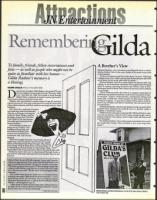
Michael Radner and Marcia Gershenson in front of the future home of Gilda's
Club in Royal Oak.