
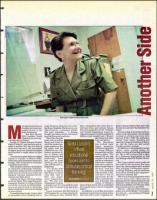

Greta Lipson: Appeal to kids on their terms.
All ost high-school dropouts
do not go on to have suc-
cessful careers in the
field of education.
But then Beverly
Hills resident Greta
Lipson is not your typ-
ical high-school dropout.
By age 17, Lipson had quit Central
High in Detroit, was married and al-
ready a mother. But once her first of
three sons was born, she had second
thoughts about her stunted education
and enrolled in night school at Cass
Tech.
A concerned teacher there encouraged
Lipson to transfer to Wayne State,
where she jump-started her career as a
teacher, then continued on to become
a professor and author.
Now professor emeritus of education
at University of Michigan-Dearborn,
Lipson- has authored and co-authored
more than 20 educational books and
teachers' resource materials for ele-
mentary and high school.
And just as Lipson is far from typical,
so are her books. They range from a con-
temporary English re-telling of Romeo
and Juliet, to a book on ethical dilem-
mas to an activity book in which stu-
dents rewrite fairy tales into the format
of news articles.
In creating these books, Lipson aims
to stimulate critical thinking and to
make literature relevant to the every- Hour. Intrigued by the poems that re-
day lives of students. She draws on a va- told fairy tales and nursery rhymes
riety of sources — newspaper articles, from the perspective of the "witches"
folk tales, anecdotes — to develop, and "wicked" stepmothers, Lipson de-
thought-provoking stories and accom- veloped a program in which students of
different ages staged trials of Hansel
panying discussion questions.
and Gretel and other
One of her favorite
fairy-tale figures.
books is the re-written
The discussions
Romeo and Juliet, in
that evolved made
which the modern lan-
Lipson appreciate
guage appears on fac-
children's capacities
ing pages with the
for seeing different
traditional text. Dis-
perspectives and dis-
cussion questions fo-
cussing ethics. "The
cus on themes and
essence of it was, stop
issues in the play that
and take a look at this
modern-day teens
and try to understand
face, such as party
what other implica-
crashing, peer pres-
tions there might be,
sure and heroism vs.
there's another side to
foolishness.
the story," says Lip-
"I've always tried
son. "As it developed
to appeal to kids on
with my books, I real-
their terms, to connect
ized that it was an
what they read to
opportunity for the
their own experi-
kids to examine their
ences," explains Lip-
JULIE WIENER STAFF WRITER
own humanity and
son. "We don't love
values, to develop a
Shakespeare because
a teacher says it's very good for your sense of their selves and an awareness
brain. But if it speaks to us, that is the that maybe there weren't immutable
truths."
key."
In addition to providing discussion
Lipson published her first book in
1973, inspired by a volume of poetry by questions, Lipson tries to create stories
Sara Henderson Hay entitled Story that "end with a hook," triggering stu-
Greta Lipson's
ofteat
educational
books aim to
stimulate critical
thinking.
dents to discuss whether they agree with
the outcome and with the characters' be-
havior. ,
It's rewarding, if not particularly lu-
crative work, says Lipson, who has been
turning out a book a year since retir-
ing from U-M in 1983. Her publishers
include Good Apple, Teaching and
Learning Company and Simon & Schus-
ter, and the books are sold mainly
through teachers' catalogs.
In addition to the education books,
Lipson enjoys writing poetry for
adults, but none of it has been published
yet. She is still trying to find a taker
for a humorous manuscript on food
and dieting called The Kishke Chroni-
cles.
But Lipson doesn't want to take all
the credit for her creations. She raves
about the other authors she's worked
with, including U-M Dearborn histori-
an Sidney Bolkosky, and she attributes
much of her success to the supportive-
ness of her husband, Bill.
"Bill was a feminist long before there
was ever such a word," Lipson says, ex-
plaining that the retired restaurant and
bookstore owner shared all the house-
hold responsibilities and child care while
she attended school in the 1950s.
The two — who met while working to-
gether at a movie theater when Lipson
was only 14 — are members of Temple
Emanu-El.