

h
ea
PHOTOS BY KRI STA HUSA
M
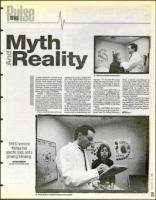
Dr. Nusbaum conducts an examination.
t's been labeled a miracle drug
and the solution to staying young.
Health food stores are barely
keeping up with the demand for
the product, and it's hard to flip,
through a fitness or health mag-
azine without reading something
about the wonders of DHEA.
DHEA — dehydroepiandros-
terone — is a steroid hormone.
A few articles in respected med-
ical journals and more frequent
articles in popular magazines and
newsletters have spurred many
to join the bandwagon that calls
DHEA the fountain of youth and
a miracle drug.
Some, however, are not so ac-
cepting of its power to restore peo-
ple to the vigor of their 20s or to
be a panacea for lupus and can-
cer. Still others report concern for
the hormone's side effects, specif-
ically in large dosages or dosages
taken over a long period of time.
The excitement began during
the last 10 years when re-
searchers studying the aging
process recognized that the rise
and fall of DHEA seemed to mir-
ror that of the body itself.
DHEA is made from cholesterol
by the adrenal glands which sit
atop each kidney and play a role
in the formation of the sex hor-
mones such as testosterone and
estrogen. For the first few years
of life, the adrenals make very lit-
tle DBEA. Around age 6, they be-
gin producing it until it peaks in
the mid-20s.
From the early 30s there's a
steady decline in DHEA produc-
tion, so that by age 60 DHEA con-
centrations in the blood are only
about two-thirds of peak levels
and by age 75 only 20 percent. In-
terestingly, at all ages, men tend
to have higher DHEA levels than
women.
"Some call DHEA the mother
of hormones and the superhor-
mone," says Dr. Jeffrey Nusbaum,
M.D., a family practitioner in
Farmington Hills. "Even with all
the recent hype about the sup-
plement, there is enough research
documented to confirm that
DHEA can be beneficial for di-
verse medical conditions such as
chronic fatigue and several auto
immune disorders.
'On the other hand, I don't pre-
scribe DHEA without first check-
ing a patient's own DHEA level
using a simple blood test. If a pa-
tient's DHEA level is low, then in-
creasing it may help that patient
MYTH page 74
DHEA hormone
therapy has
specific uses, and a
growing following.
RUTHAN BRODSKY
SPECIAL TO THE JEWISH NEWS
ti
Cr)
0")
T-
-
LC)
r -
H-
C/3
CD
Dr. Jeffrey Nusihum discusses treatment with a patient.
13]