
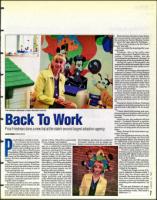

Pole Friedman's philosophy is simple: Help others if you can.
Back To Work
Pola Friedman dons a new hat at the state's second largest adoption agency.
JULIE EDGAR SENIOR WRITER
ola Friedman needed a break.
For 15 years she had served
in various capacities at Sinai
Hospital, starting out as a vol-
unteer and winding up at the
helm of the Sinai Health Care
Foundation. With the merger of Sinai
and Detroit Medical Center in Feb-
I ruary and the dissolution of the Foun-
dation, the time seemed right to take a
breather.
Then Gerald Levin of Orchards Chil-
dren's Services came calling. Friedman
told him up front she didn't want to work,
but he coaxed her into coming in and at
least hearing him out.
Two hours later she accepted the job of
vice president for development and pub-
lic relations. Her task is to raise funds for
the agency, assist the board and "put Or-
chards' name in lights."
Friedman started in her new position
at the end of June, and as it turns out, the
place is a perfect fit.
"I have a soft spot for kids who are the
most vulnerable. Every day I walk into
that office I see kids. I look at them and
wonder what dreadful thing has hap-
pened to them. [The job] is a good outlet
for my outrage," she laughed.
Orchards started out nearly 35 years
ago as a residential psychiatric
treatment program for pre-adoles-
cent boys, developed by National
Council of Jewish Women with
$48,000. Today, with an $11 million
annual budget, it's the state's sec-
ond largest adoption agency and
Michigan's largest private foster
care agency, providing permanent
placement for unwanted children,
home-based services for at-risk chil-
dren and in:home respite care for
families with sick children.
The Orchards' office on Southfield
Road is equipped with a large,
bright playroom and individual
nooks where birth families visit with
the foster families that are caring
for their children. Sesame Street
characters are pasted along the
walls and toys are set up on tables.
In the corner of another room are
rows of shoes, donations for children
who often don't own a decent pair
when they come in for placement.
For Friedman, the shoes are a symbol of
Orchards' mission and an image she
keeps in mind as she goes about her work.
Sinai had been the place where princi-
ple and paycheck intersected, but after
its purchase by Detroit Medical Center,
it wasn't the same place for Friedman.
"Sinai wasn't going to be the Sinai I
loved," she said.
But it provided the launchpad for a sec-
ond career.
Friedman, who, in her early years
taught high school English before be-
coming a full-time mother, was the
"quintessential professional volunteer" at
the beginning of her long stretch at Sinai.
During her years at the hospital, she
acquired the skills that enable her to work
just about anywhere that needs an elo-
quent spokesperson.
At Sinai, she served as administrative
assistant to former CEO Irving Shapiro
before he asked her to come on board full-
time in the early 1980s. In 1988, Fried-
man became the corporate director of
public and community relations, and in
1992 she became president of the Sinai
Health Care Foundation, which was
charged with electing the majority of
Sinai's board of trustees.
In the meantime, she helped develop
the Sinai Guild, for which she also served
as president. The Guild oversees Sinai's
volunteer program, runs the hospital's
gift shop and raises money for the hospi-
tal.
During her tenure at Sinai, Friedman
managed several fund-raising drives that
totaled close to $5 million for the hospi-
tal.
"I know about fund raising and ener-
gizing people and working with boards of
trustees. I learned from volunteering,"
she said.
Along the way, she conferred with her
family — husband Howard, a psychia-
trist, and daughters Alyssa and Lauren
— who weren't initially wild about the
idea of her not being there all the time for
them.
Today, Howard is her most ardent sup-
porter, she said.
The most significant events in her life,
aside from her marriage and the birth
of her grandson Mason, now almost 2, was
the 1989 death of her brother, Mark Sil-
verman, from AIDS. He was a producer
of three of Joel and Ethan Coen's
films, the last one Miller's Crossing.
"It had a huge impact on me,"
Friedman said, noting that without
the drug AZT, Mark would not have
lived as long. She has spoken pub-
licly on the subject.
Gerald Levin, the CEO and pres-
ident of Orchards, believes Fried-
man's sensitivity and track record
as a fund-raiser and organizer are
critical to the agency.
"I think she brings a sense of fo-
cus in response to human needs. I a
r–,
think that has always been her cn
strength. She cares about what she
does, she's mission driven, and the Lc)
mission we have at Orchards was
something she could respond to," he cr)
said.
For her part, Friedman, 55, hopes =
that when she dies at the age of 120, <
her tombstone reads, "She made a
difference." LI
7