

THE JEWISH NEWS
UP FRONT
This Week's Top Stories
City Kids
Jewish students in Detroit public schools are a minority among both
classmates and fellow Jews.
JULIE WIENER STAFF WRITER
etty Schenk likes to tell how
her son Matthew, as a stu-
dent at Cass Technical
High School in Detroit,
wrote an essay on "Why rm Proud
To Be An African-American." Al-
though white and Jewish, he got
an A.
When the essay was assigned,
he asked if he should select a dif-
ferent topic. But the teacher said
"Oh, you know what to write.
Don't worry about it."
Schenk's epxperience of tem-
porary identity loss may have
been the exception rather than the
rule. But for Jewish students at-
tending Detroit Public Schools, it
symbolizes the ongoing identity
challenges of being white and
Jewish in an environment in
which being black and Christian
is the norm.
Just as Jews are today a rarity
in the Detroit Public Schools, De-
troit Public Schools students are
a rarity in the local Jewish com-
munity, with many Jews stereo-
typing Detroit's schools as
dangerous, ovemowded and of lit-
tle educational value.
Some of those stereotypes are
grounded in fact. Like schools in
most inner-city systems, many of
Detroit's schools contend with vi-
olence and serious discipline prob-
lems. The average Dertroit Public
Schools' student ranks consider-
able lower than the average
Michigan student on achievement
tests.
However, for the few Jewish
Above:
William Goldstein's
gravesite.
Right:
oldstein,
with his sister Sheila
Weinberg, left, and
cousin Fran Shulman
at his father's grave.
Gon
Lw
argon
Families with relatives buried at B'nai Israel say
the Novi cemetery is indifferent to their complaints
about care and maintenance.
e road leading into B'nai
Israel cemetery in Novi
opens onto a pleasant vista
of rolling green hills and
, woods.
To the left, atop a gentle slope,
William and Phil Goldstein,
brothers, are buried next to each
b other.
' Get closer and you can make
out some of the words on
William's grave marker, a
bronze plaque that is flush with
the ground. Streaks of dried mud
obscure the rest of it.
Jerome Goldstein, his son, is
incensed about the condition of
the gravesite, which consists of
the marker and a rectangle of
dirt at its foot that is flecked with
,- tufts of grass. His father died two
years ago, and since then, Gold-
stein has made complaints re-
, peatedly, mainly about the lack
of grass at the site.
"I visit the grave every Sun-
day and there's still no grass," he
!-- said last week, noting that when
it rains, dirt washes onto the
grave marker. Several graves at
the cemetery are either muddied
or covered with overgrown grass.
His cousin Fran Shulman,
Phil's daughter, talks about sev-
en years' of complaining to the
cemetery proprietors about the
state of her father's grave and
the rest of the Jewish section of
the cemetery. After raising the
1
issue of empty beer and wine bot-
tles around the gravesiths, Shul-
man said she was told by
cemetery management that
"that's how Jewish people
grieve."
She said she has brought
flowers to her father's grave but
they were either stolen or not
watered.
"You need water sprinklers
here and they're not going th put
water sprinklers in," she said
Goldstein and Shulman both
bought plots for themselves and
their families before they were
advised, Goldstein said, that
B'nai Israel "is not maintained."
But, "I hate to sell mine be-
cause my father is here," he said.
B'nai Israel opened about
eight years ago as an addition to
Oakland Hills Memorial Gar-
dens near the intersection of 12
Mile and Novi roads, just north
of Twelve Oaks Mall. Last fall,
the Pennsylvania-based Lowen
Group bought the cemetery.
Goldstein did not pay for per-
petual care for his father's
gravesite because, he said, there
is no sprinkler system in the
park to keep' flowers looking
fresh.
"I called the consumer com-
plaint division of the Attorney
General's office, but because my
FORGOTTEN page 25
students who attend -- and de-
mographer Patricia Becker esti-
mates that there are fewer than
20 Jewish children currently en-
rolled in Detroit Public Schools —
the experience is often better than
their peers from the suburbs
would expect.
Jeffrey Schenk (Matthew's
younger brother) recently gradu-
ated from Cass Tech, a school of
choice and Detroit's most acade-
mically competitive high school.
(Admission to the school is based
on test scores.) Schenk is confident
the education he received has pre-
pared him for the University of
Michigan, where — along with al-
most 100 classmates from Cass
Tech — he will enroll this fall.
"My experience has been corn-
pletely the opposite of stereo-
types," he said. "I competed on the
debate team, and we always could
compete on the same level as oth-
er students throughout the state
even though debate is considered
a white, suburban activity ... it
eliminated the myths about the
failures of Detroit public educa-
tion."
KIDS page 25
Is A Rabbi Qualified?
PHOTO BY DANIEL LIPPITT
JULIE GAR SENIOR WRITER
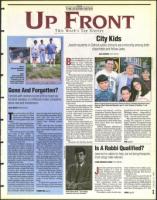
Mark and Sandy Sperling send their children to Detroit's Golightly Educational Center.
Back row: Mart, Sandy and Meredith, age 13. Front: Zachary, 9, Geoffrey, 7, and
Lindsey, 11.
Jews turn to rabbis for help, but not being therapists,
most clergy make referrals.
LYNNE MEREDITH COHN STAFF WRITER
ews have always turned to
their rabbis in a time of
need. Whether it's a simple
question of kashrut or as ex-
treme and private as marital dif-
ficulties, the rabbi could find
answers rooted in Jewish law.
But sometimes that's not
enough. When it comes to real
emotional troubles, do rabbis re-
ally have the authority, and the
know-how, to help?
Nowadays, some Jewish spir-
til
Rabbi Steven Weil: "The primary
counselor has to be a therapist."
itual leaders have taken psy-
chology courses or master's level
training in therapy. But the ma-
jority have not.
Rabbis spend a good chunk of
time counseling congregants —
sometimes as much as 50 per-
cent, according to a 1992 study of
40 Orthodox rabbis undertaken
by Aviva Tessler, a rebbetzin in
suburban Washington, D.C. The
RABBI page 28