

RABBI page 3
study formed Tessler's master's
thesis at the University of Mary-
land school of social work.
The rabbis who were surveyed
ranged from 28 to 83 years of age,
with just over half living in sub-
urban communities. More than
half had studied liberal arts, and
16.7 percent took mental health-
related classes.
In a national survey, "it was
reported that Americans used the
clergy as their primary source for
personal problems," Tessler
wrote. "It could be estimated that
the 235,000 parish clergymen in
the United States counsel ap-
proximately 6,500,000 persons
per year."
Rabbi Harold Loss of Temple
Israel in West Bloomfield says,
"Frequently the first person an
individual may be willing to come
to for help is a rabbi that they
know. It seems to be somewhat
more inviting and at times a safer
environment."
Despite this apparent need,
most local rabbis emphatically
step aside when asked to counsel
troubled congregants, referring
them instead to a qualified coun-
selor. Most of the rabbis Tessler
interviewed "did not have exten-
sive (more than two courses)
training in the area of mental
health."
Rabbi Steven Weil, spiritual
leader of Young Israel of Oak
Park, learned a little bit of psy-
chology from Dr. Irving Levitz, a
psychologist and rabbi who teach-
es at Yeshiva University.
`The first thing and last thing
he taught us is: 'You are not pro-
fessional therapists and don't
ever think that you are.' And then
he taught us a world of therapy,"
Rabbi Weil recalls.
"It's really fascinating and
wonderful, but using him as a
model, I will never counsel a cou-
ple independent of a
therapist. The pri-
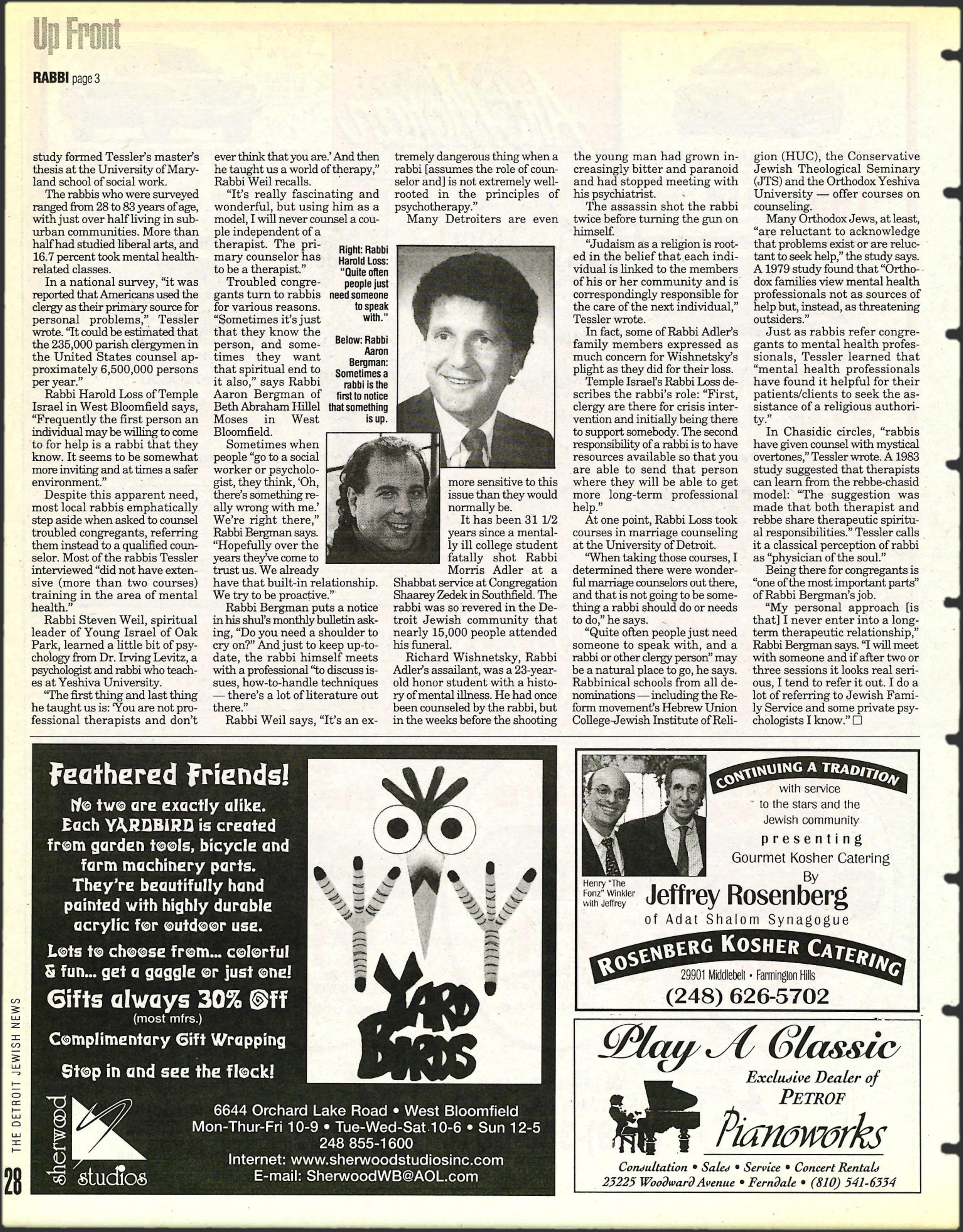
Right: Rabbi
mary counselor has
Harold Loss:
to be a therapist."
"Quite often
Troubled congre-
people just
gants turn to rabbis need someone
to speak
for various reasons.
with."
"Sometimes it's just
that they know the
person, and some- Below: Rabbi
Aaron
times they want
Bergman:
that spiritual end to Sometimes a
it also," says Rabbi
rabbi is the
Aaron Bergman of first to notice
Beth Abraham Hillel that something
is up.
Moses in West
Bloomfield.
Sometimes when
people "go to a social
worker or psycholo-
gist, they think, 'Oh,
there's something re-
ally wrong with me.'
We're right there,"
Rabbi Bergman says.
"Hopefully over the
years they've come to
trust us. We already
have that built-in relationship.
We try to be proactive."
Rabbi Bergman puts a notice
in his shul's monthly bulletin. ask-
ing, "Do you need a shoulder to
cry on?" And just to keep up-to-
date, the rabbi himself meets
with a professional "to discuss is-
sues, how-to-handle techniques
— there's a lot of literature out
there."
Rabbi Weil says, "It's an ex-
tremely dangerous thing when a
rabbi [assumes the role of coun-
selor and] is not extremely well-
rooted in the principles of
psychotherapy."
Many Detroiters are even
more sensitive to this
issue than they would
normally be.
It has been 31 1/2
years since a mental-
ly ill college student
fatally shot Rabbi
Morris Adler at a
Shabbat service at Congregation
Shaarey Zedek in Southfield. The
rabbi was so revered in the De-
troit Jewish community that
nearly 15,000 people attended
his funeral.
Richard Wishnetsky, Rabbi
Adler's assailant, was a 23-year-
old honor student with a histo-
ry of mental illness. He had once
been counseled by the rabbi, but
in the weeks before the shooting
the young man had grown in-
creasingly bitter and paranoid
and had stopped meeting with
his psychiatrist.
The assassin shot the rabbi
twice before turning the gun on
himself.
"Judaism as a religion is root-
ed in the belief that each indi-
vidual is linked to the members
of his or her community and is
correspondingly responsible for
the care of the next individual,"
Tessler wrote.
In fact, some of Rabbi Adler's
family members expressed as
much concern for Wishnetsky's
plight as they did for their loss.
Temple Israel's Rabbi Loss de-
scribes the rabbi's role: "First,
clergy are there for crisis inter-
vention and initially being there
to support somebody. The second
responsibility of a rabbi is to have
resources available so that you
are able to send that person
where they will be able to get
more long-term professional
help."
At one point, Rabbi Loss took
courses in marriage counseling
at the University of Detroit.
"When taking those courses, I
determined there were wonder-
ful marriage counselors out there,
and that is not going to be some-
thing a rabbi should do or needs
to do," he says.
"Quite often people just need
someone to speak with, and a
rabbi or other clergy person" may
be a natural place to go, he says.
Rabbinical schools from all de-
nominations — including the Re-
form movement's Hebrew Union
College-Jewish Institute of Reli-
feathered friends!
Ilo two are exactly alike.
Each YARDICIRD is created
from garden tools, bicycle and
farm machinery parts.
They're beautifully hand
painted with highly durable
acrylic for outdoor use.
Lots to choose from... colorful
fun... get a gaggle or just one!
Gifts always 30% @f1
Henry "The
Fonz" Winkler
with Jeffrey
gion (HUC), the Conservative
Jewish Theological Seminary
(JTS) and the Orthodox Yeshiva
University — offer courses on
counseling.
Many Orthodox Jews, at least,
"are reluctant to acknowledge
that problems exist or are reluc-
tant to seek help," the study says.
A 1979 study found that "Ortho-
dox families view mental health
professionals not as sources of
help but, instead, as threatening
outsiders."
Just as rabbis refer congre-
gants to mental health profes-
sionals, Tessler learned that
"mental health professionals
have found it helpful for their
patients/clients to seek the as-
sistance of a religious authori-
ty."
In Chasidic circles, "rabbis
have given counsel with mystical
overtones," Tessler wrote. A 1983
study suggested that therapists
can learn from the rebbe-chasid
model: "The suggestion was
made that both therapist and
rebbe share therapeutic spiritu-
al responsibilities." Tessler calls
it a classical perception of rabbi
as "physician of the soul."
Being there for congregants is
"one of the most important parts"
of Rabbi Bergman's job.
"My personal approach [is
that] I never enter into a long-
term therapeutic relationship,"
Rabbi Bergman says. "I will meet
with someone and if after two or
three sessions it looks real seri-
ous, I tend to refer it out. I do a
lot of referring to Jewish Fami-
ly Service and some private psy-
chologists I know." L
with service
to the stars and the
Jewish community
presenting
Gourmet Kosher Catering
By
Jeffrey Rosenberg
of Adat Shalom Synagogue
29901 Middlebelt • Farmington Hills
(248) 626-5702
(most mfrs.)
Complimentary Gift Wrapping
Step in and see the flock!
6644 Orchard Lake Road • West Bloomfield
Mon-Thur-Fri 10-9 • Tue-Wed-Sati 0-6 • Sun 12-5
248 855-1600
Internet: www.sherwoodstudiosinc.com
E-mail: SherwoodWB@AOL.com
Of, tff y 67a. s,
•
Exclusive Dealer of
PETROF
tianoworks
Consultation • Sales • Service • Concert Rentals
23225 Woodward Avenue • Ferndale • (810) 541-6334