
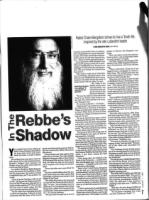

Rabbi Chaim Bergstein strives to live a Torah life,
inspired by the late Lubavitch leader.
LYNNE MEREDITH COHN STAFF WRITER
ronment of non-belief. Even in yeshiva, similar in Detroit. But Bergstein was
why I should believe was never discussed," wrong.
"Here, you had to create the interest,
he says. The Torah "sounds like antiquat-
ed lore, [but it is] a lot more than just sto- knock on doors. A lot of people didn't think
ries — there's a whole spiritual dynamic." we could succeed," he recalls.
As a Lubavitcher, Rabbi Bergstein has Until Bais Chabad of Farmington Hills
spent his life trying to reach out to unin- opened in late 1986, Bergstein led daven-
volved or unaffiliated Jews. He says it is a ing in his basement. And it has not been
challenge "to rejuvenate the next genera- easy.
"When I advertised, I found out it was
tion." But to an extent, the Lubavitchers
illegal
[to have a synagogue in a home]. I
have done it.
"They used to make fun of Lubavitch- didn't know. The zoning board came and
ers, the Orthodox, the black hatters. Now tried to close us down. It was fun — but at
there are over 100,000 ba'ale teshuvah (re- the time it didn't feel like fun."
When they were about to open the shul
turnees to the faith) all over the world. It
on Middlebelt Road in Farmington Hills,
really started with the rebbe," he says.
The rebbe in his a neighbor opposed the Lubavitch pres-
lifethhe, and by some ence. 'The woman took us to court every
Rabbi Chaim Bergstein:
since his death, was second week; the police would dismiss it.
It is a challenge "to
revered by many ob- It's sort of a miracle that we got it. The day
rejuvenate the next
servant Jews as the we got approval from the zoning board, the
generation."
Moshiach (Messiah). lady across the street put her house up for
"We have the ability to communicate the sale."
Some neighbors thought the synagogue
Torah to our friends, those we have con-
tact with. The rebbe said this is for every- would "make an unpresentable property
at the opening to the subdivision. It's a very
one," Bergstein says.
residential neighborhood; they thought we
"It's not just Lubavitch — it's Torah."
Bergstein grew up in yeshivas in Brook- would make it dumpy," he recalls.
The Bergsteins now have seven children,
lyn, followed by a brief stint at Brooklyn
College and ultimately studied in yeshiva ranging in age from 12 to 26, and five
in Israel. While there, he lived in Kfar grandchildren.
Since the rebbe's death in 1994, Berg-
Chabad, the Village of Chabad, between
stein says ithas been "lonely" — although
Lod and Tel Aviv.
He was in Israel for four years, includ- he had mininilal contact with the revered
ing during the Six-Day War. "We were get- Lubavitch leader during his lifetime —
ting letters from the State Department "just the actual smile, occasionally, was
saying they could not be responsible for sufficient to be inspired for a long time.
"All of us had to do a lot of soul-search-
our safety, get out as soon as possible," he
recalls. 'The rebbe said there was nothing ing. The messages of the rebbe, what we
dedicated our lives to, continue — in
to worry about, stay and study."
The group of about 33 young men of greater measure because we have to do it
which Bergstein was a part, all with for- on our own. You will see as time goes on
the amount of hours and intensity of aim
eign passports, remained.
"I witnessed not only the miracle of the of the rebbe to bring yiddishkeit to all Jews
Six-Day War, but was there when they will increase," Bergstein says.
"I've seen an intensity among my col-
opened the Kotel [Western Wall of the tem-
ple in Jerusalem]," Bergstein recalls. 'The leagues, no less," since his death. 'The pass-
sports fan in me [was thrilled] to be there." ing of the rebbe only intensified our
people and achieving the goals set forth by "We studied all night on Shavuos, went resolve."
"The challenge of each Jewish person
the late Lubavitcher Rebbe Menachem to the mikvah, that's when they opened
has
to be viewing himself as the last Jew-
Schneerson. [the Western Wall] for the first time to the
A framed black and white picture of the public. I was there, among the first ish person on earth, that survival depends
on him, [that he has] the power to recre-
rebbe sits on his desk. The walls of Rabbi minyanim."
A few weeks later, he trekked to the ate Jewish life."
Bergstein's basement office in Bais Chabad
He tells the story of Rabbi Mendel Futer-
of Farmington Hills are bare. Seated at his Tomb of the Patriarchs — another first.
desk, the rabbi can look out onto a green That visit, Bergstein says, "was much more fas, who left the Soviet Union a hunted
yard, complete with swing set and pine emotional — I identify much more with man because he had built secret yeshiv-
as behind the Iron Curtain. Futerfas spoke
people than with things.
trees.
•
Back
in
the
United
States,
Bergstein
very
little English, but on a trip from Lon-
the
rebbe
was
a
man
of
God,"
he
"I know
met his wife on a "standard shidduch don to New York in 1964, he sat beside an
says.
He grows excited talking about the com- [matchmaking]," and they married in 1970. English-speaking man.
The rabbi held his tefillin and tallit bag o,
puter codes that have been used to find For six years, they lived in Boston, where
C
knowledge of political and secular events he taught in a Lubavitch yeshiva. In 1977, on his lap the entire flight. The man be-
(rabbinic
ordination).
side
him
eyed
the
bag
every
so
often,
but
_
he received smicha
hidden in the Torah.
"The rabbis have told us for thousands In November of that year, Bergstein they could not communicate verbally. Fi-
of years that the Torah has all the knowl- moved his family to suburban Detroit to nally, the rabbi said, "I Jew, you Jew," =
edge," he says.`As we became more so- start up a Lubavitch presence in the sub- pointing to the other man. "I tefillin, you CD
=
phisticated, [we] challenged [that notion]. urbs. teen•"
That day, the man donned tefillin for a
"I didn't realize just how assimilated peo-
Along came a rabbi with a long beard dis-
cussing codes. Later came computer analy- ple were in the suburbs," he recalls. "I had the first time in 40 years, Bergstein says.
"If I can leave a message, it is: 'I Jew, 1
helped start a shul in Boston, was the spir-
sis — it's not just arbitrary.
'We have been brought up in an envi- itual leader there." He thought it would be you Jew, I,Torah, you Torah." 0
Rebb
y
ou wouldn't know from looking at
Rabbi Chaim Bergstein that behind
his long white beard and heavy
black coat hides a wealth of sports
trivia.
His striking blue eyes dance when he
talks about his favorite baseball player,
Brooklyn Dodgers first baseman Gil
Hodges, whom the rabbi claims deserves
to be in the Hall of Fame.
As a child in Brooklyn, Rabbi Bergman
took to the streets for punchball or stick-
ball. By sixth grade, his yeshiva erected
a basketball hoop, and "I was smitten," he
recalls.
A love of sports "has been with me all
my life." He has seen the Tigers, Lions, Pis-
tons and Red Wings play, although he no
longer watches sports on TV. Now, he uses
the tube only to watch videos, but the
sports interest remains, albeit latent.
But the rabbi's days of keeping dose tabs
on sports are long gone. Today, he is more
concerned with the future of the Jewish
•
•
"