

Branching Out
Li Rafael Guber researches family trees
j' and preserves personal histories with
artistic presentations.
SUZANNE CHESSLER SPECIAL TO THE JEWISH NEWS
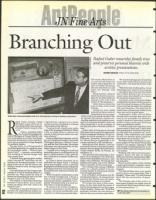
Rafael Guber creates genealogical works of art "that should be in a family for hundreds of generations."
afael Guber recently visited
Michigan to give advice on re-
searching family trees and sur-
prisingly found a branch of his
own.
Guber, speaking before
the Jewish Genealogical So-
ciety of Michigan at Temple Beth El, told
how he developed an art form that blends
historical documents, photos and heir-
looms into an ancestral montage designed
for aesthetic display.
The day before, at a Young Israel of
Southfield gathering, his constant ques-
tion to people he meets — "Where is your
family from?" — opened a conversation
that revealed he shared lineage with
some people there.
"I started doing genealogical studies
when I was past 40," said Guber, 44, who
had been an investment banker. "I was
going to play out my mid-life crisis by sat-
isfying a creative need, serving myself
and others.
"I saw genealogy and the images of ge-
nealogy as a way of reaching people in a
personal way. What makes my work ef-
fective and compelling has less to do with
me than it has to do with others.
"The subject is inherently interesting
because it's about them. It's as funda-
mental as asking, 'How did I come to be
whoever I am?'
"Yesterday, it was eerie because I met
one man who looked like he could be my
brother; we had the same facial features.
I showed him a picture of my grand-
mother and was introduced to a woman
who looked exactly like her.
"I started to tell a family story, and a
lady at the synagogue finished it. Before
I left, we made plans to continue our
search to find out more about our com-
mon relatives."
Guber studied historiography and his-
tory at Columbia University, the Jewish
Theological Seminary, Hebrew Univer-
sity and Bar Ilan University. His artistic
techniques were advanced at the Art Stu-
dents League in New York.
"I started to do a collage for myself and
showed the piece to a well-known art col-
lector," Guber recalled. "I did a piece for
him, which led to a number of other com-
missions."
As Guber's clients increased, he es-
tablished the Sepia Guild, a working
group of genealogists, artists, archivists,
biographers and historians providing both
genealogical research and creating artis-
tic presentations of personal history doc-
uments.
"When I'm given a commission to look
into a family's background, I choose a
team to work around it in terms of their
research and artistic capabilities," he ex-
plained. "Sometimes there is so much ma-
terial that we build breakfronts.
"A woman in the process of rediscov-
ering her connections to Jewish life had
a cousin who saved candlesticks once
owned by our client's great-grandmother.
The cousin offered them to
us, and we built them into
a piece with a glass door so
that on Friday afternoons
she can take them out and
make the blessing with
them."
Being hired by celebrity
clients has become common-
place for the Sepia Guild. An
example is the wife of the
creator of "The Simpsons."
Guber does not restrict his
work to those with Jewish
heritage.
Among his most visible
projects has been ancestral
artwork given by the mayor
of New York to the grand marshal of the
St. Patrick's Day parade. Another out-
standing experience was creating a mon-
tage for a prominent Swedish couple and
then presenting it in the presence of
the king and queen of Sweden at Ellis Is-
land.
Guber takes Jewish groups through
Ellis Island and re-enacts the experiences
of their immigrant forebears. He put to-
gether the fourth episode for a 10-part
PBS series, "Ancestors," showing his art,
his life and the use of genealogy to re-
connect spiritually to the Jewish past.
Although his wife, Rosalyn, does not
participate directly in the special perfor-
mances, she encourages the involvement
of their children: Rivky, 15; Yehuda, 13;
and Rayla, 11.
"The good part about genealogy is that
there are no problems with Orthodox,
Conservative and Reform factions," said
Guber, who is Orthodox. "Everybody had
bubbies and zaydes, and I work off that
theme to promote Jewish community.
"I'm working with a group of Reform
rabbis on a special project to be an-
nounced shortly. It will promote Jewish
unity through genealogy."
A lot of Guber's art projects are for
awards presentations. An unnamed auto
executive from Detroit soon will receive
his ancestral montage as a surprise.
"For people who seem to have every-
thing, we give them back the names of
their great-grandparents and the images
of their families," Guber said. "We'll find
passenger manifest lists and photos of
relatives they may not have seen before.
"We also find photographs of ancestral
towns and render them as pastels and
watercolors. I do about 95 percent of the
art.
"With little bits of information, we can
find things about relatives from long ago
— the places they lived and the streets
they walked, fleshing it all out as art to
create a piece that should be in a family
for hundreds of generations."
Among the most interesting collages
completed by the Sepia Guild is one for a
man who played the piano on Ellis Island
to prove he had the skills that could get
him out of detention. The guild built an
entire frame of piano keys crafted in the
same year as the original piano.
Occasionally, Guber will not follow
through with a montage that seems con-
trary to his principles. He declined a
couple's request to intertwine a grand-
mother's rosary beads with the straps
from a grandfather's tefillin.
"I told the couple that regardless of the
choices made in their lives, I don't think
their grandparents would have been hap-
py with what they wanted to do," he ex-
plained. "They understood, and I ended
up with two separate pieces, partly be-
cause there was so much to use."
The Sepia Guild is working on an enor-
mous project for the Simon Wiesenthal
Center in Los Angeles. Opening in 1998
with the goal of teaching tolerance, it will
be the world's largest genealogical exhibit
ever created.
Working with other prominent gene-
alogists, Guber will take six famous
Hollywood families representing differ-
ent ethnic groups and create rooms of liv-
ing memories.
The 12-month exhibit, which includes
a major genealogical computer center,
will be filmed and turned into a docu-
mentary.
"I've learned that many more people
want to know about genealogy than I
thought," Guber said. "I've also learned
about the big commonality of experi-
ence.
"The blessing side of this work is to
take names of people who might never be
remembered otherwise and return them
to future generations."
❑
fl The Sepia Guild can be reached at
(718) 520-1297.