

:1
i
:
,
`- ':;.•:.e":.-7
.
'.7_4=7" .1-7::::.
—
•-""`
muammemammemagezimxam=4*Kmetmusanummosss>vammemasemsm.
Dealing With
de p ress
That chronic "blue mood" may have underlying physical causes that are easily treatable.
RUTHAN BRODSKY SPECIAL TO THE JEWISH NEWS
"Our goal is to support our
clients and treat them with ther-
apy and medication as we would
in other illnesses so clients can
hope for more normal lives."
Depression can cause pain and
disrupt lives. Symptoms can in-
clude a persistent sad mood, a loss
of interest in ordinary activities,
fatigue, excessive crying, sleep or
eating disturbances and feelings
of worthlessness. Generally, when
a person experiences five ormore
symptoms of depression for more
than two weeks, it's called major
or clinical depression, something
more than feeling blue after a try-
ing day or an emotional situation.
The severity depends upon the
duration of symptoms and the de-
gree to which these symptoms
hinder daily activi-
ties. Conditions that
fall under clinical de-
pression include ma-
jor depressive
disorder which is
characterized by dis-
tinct episodes of dis-
grandchildren or
abling depression or
I bring them to
agitation, dysthymic
our house. They
disorder, a low-
bring so much joy
grade continuous
to me that I don't
sense of depression,
have any room
and bipolar depres-
for the blues."
sive disorder, which
Mr. K isn't as trr'!:
is characterized by
fortunate. Diag-
episodes of depres-
nosed as being
,. sion and mania.
clinically de-
According to the
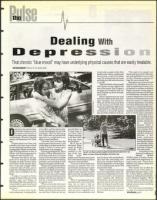
pressed at the Top Left: Lori Blume comforts daughter Hannah after she wakes from a nap.
National Institutes of
age of 26, he's Above: Lori takes a break with daughters and friend in tow.
Mental Health
made much
progress over the past seven years port for clients with mental illness, (NIMH) about 18 million Ameri-
but understands that his illness says that she continually con- cans suffer from depressive ill-
fronts the mistaken belief that a nesses each year. Yet of those
requires continued effort.
"I went to a doctor back then client's depression was brought afflicted, only about a third ever
because my parents were con- on by something the patient did seek treatment.
"The shame of it is that de-
cerned about me because I wasn't and it's their fault.
"Often a particular traumatic pression is one of the most un-
doing very well," he says. "What
made it worse was that I couldn't event can exacerbate major de- dertreated diseases today," says
figure out what was happening to pression, but depression is an ill- Dr. J. Barry Rubin, chief of psy-
me, and why I had all these symp- ness and needs to be treated as chiatry at Oakland General Hos-
such," explains Ms. Richman. pital, Madison Heights. "What
toms.
"When I was diagnosed as be- "Sometimes a bout of intense de- makes it worse is that the treat-
ing depressed I had mixed feel- pression may be short-lived but ment for depression has one of the
ings, but at least I had an often it is long-term and for many highest success rates, something
explanation for the way I felt. To- it is a chronic illness just like dia- like 80 percent.
`The notion that mental illness
day, I'm able to live by myself and betes or hypertension and must
work part-time. I regularly see a be controlled during a person's is a sign of weakness and other
therapist, I'm on medication, and lifetime.
DEPRESSION page 66
I work with a social worker from
Kadima who visits my apartment
three times a week and makes
sure I'm maintaining my home
and helps provide some structure
to my life.
"I feel a lot better about myself,
and I fmally can see a light at the
end of the tunnel. But it's been a
struggle and I probably will con-
tinue to battle my illness through-
out my life."
Serious depressions are total
disorders, affecting the body, feel-
ings, thoughts and behaviors.
They are not the temporary blues
or the passing sad moods that
everyone experiences after a loss.
Gita Richman, clinical director
of Kadima, a non-profit agency
that provides residence•and sup-
D
epression has always been
a familiar background for
the stories and sounds of
novelists, poets, composers
and librettists. Winston Churchill
used to call depression his "black
dog."
At some point in our lives, and
probably more than once, most of
us have described ourselves as be-
ing depressed. Maybe we had feel-
ings of disappointment or loss, of
failure and discouragement or
maybe we were injured or ill.
Whatever the reason, the ma-
jority of us manage to muddle
through our daily routines when
we're down in the dumps. For a
few, it may take a bigger effort,
a heavier dose of tears, and a
longer time of feeling sorry for our-
selves, but we still get over the
blues.
"I make it a point to find a
change of scenery when I'm in the
dumps," says Lori Blume of
Bloomfield Hills who cares for two
young children, ages 3 and 6, and
operates a graphics business from
her home.
"Th_ere are times when. I'm lit-
erally exhausted, working all day
at my office, and then being moth-
er and housekeeper for my kids
and family. After the kids are in
bed, I often start my second shift
around 9 p.m. and get back to my
office to meet deadlines.
"I do what I can, but when the
routine gets to be too much, I call
a babysitter and play tennis for a
couple of hours, or have lunch
with friends, or go shopping."
Clinical psychologist Dr. Alicia
Tisdale of West Bloomfield be-
lieves that each of us is in more
control of our lives than we think
and that if we work at thinking
positively, we're less likely to have
negative thoughts and feel sad.
"People who accept themselves
and have a healthy love for them-
selves aren't likely to become de-
pressed," says Dr. Tisdale. "That
doesn't mean there aren't times
when it's normal to feel sad when
dealing with the loss of family or
friends, or being disturbed by a
traumatic event.
"When events like that start
getting to me, I make it a point to
think how lucky I am that I have
family and friends who care about
me, and then I either go visit my
•