

Watching The Exodus
For Kathleen Straus, July 23, 1967, was just a quiet Sun-
day at home in northwest Detroit.
With local media initially suppressing news of the ri-
ots for fear of provoking further unrest, Straus was un-
aware of the violence and looting going on miles away
until a friend called from Toronto to find out if she was
okay.
Meanwhile, Straus' son Peter, visiting school friends
in a mainly black neighborhood, found himself in the
middle of the looting and rushed home to tell the fami-
ly.
That evening, Peter drove Kathleen — then a meth-
ber of the city community relations commission — to a
meeting downtown.
"We felt like we were the only people on the express-
way. Smoke was billowing up. It was eerie," she recalled.
For the Straus family, the riots heralded the failure of
their vision of racial harmony. Committed to staying in
JULIE WIENER STAFF WRITER
the city, they watched the majority of the
city's Jews and whites leave Detroit — grad-
ually in the years before the riots; more
abruptly after.
"The riots really hastened the exodus,"
said Straus, who still lives in Detroit and is
now president of the Michigan Board of Ed-
ucation. "Within a year there were only two
white families left on my street."
They witnessed changes in the schools
as well as on the streets. "Throughout my time at Mum-
ford [High School], each succeeding year, the number
of white kids dropped substantially," said Peter. "It was
always interesting to come back in September and see
how many of my friends from elementary school were
still enrolled."
When Peter graduated high school in 1968, Mumford
was 16 percent white. One year later, the white popu-
lation had dropped to five percent.
"People were afraid," said Kathleen Straus. "We
worked hard for years before the riots trying to keep
Mumford a good school and trying to keep whites from
leaving. But the riots destroyed a lot. White people were
very upset, and they just wanted to get away."
. Peter agreed. "There was definitely a siege mentality,
a palpable sense of fear among many white people."
Because he was close friends with many of his black
classmates, Peter managed to avoid the fear plaguing
other white students. While the ri-
ots angered him at the time, he says
he now understands the frustrations
stemming from a situation he com-
pares to the post-Rodney King verdict
Los Angeles.
"I can't excuse or condone [the ri-
ots], but I can understand it," he said.
Mother and son felt frustrated by
what they perceived to be a lack of
Jewish concern for Detroit.
"It was shortly after the Six Day War," said Kathleen.
"I remember being very upset because I was on the board
of the women's division of the Jewish Federation. I kept
saying we had to do something about the city and they
couldn't care less, they were just interested in Israel."
Peter said, "I had a certain amount of resentment to-
ward the whole white flight. I did feel a certain amount
of abandonment, but I also felt proud of our stance, that
our family was not going to flee in fear."
Now a businessman living in California, Peter looks
back on the riots as a sort of end of innocence.
"When you've stood on your own front lawn where
you've lived all your life and watched helicopters fly over-
head and tanksroll down the streets, you don't forget
something like that," he said. "I felt like my whole way
of life had been violated somehow. It was a hell of a time
to be growing up."
❑
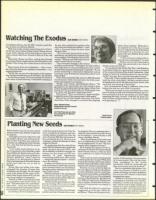
Above: Kathleen Straus:
Disappointed in the lack of Jewish
concern for the city.
Left: Peter Straus was one of few
Jews graduating from Mumford
after the riots.
Planting New Seeds
Robert Brown was only 12 years old the
summer of the riots, and they caught him
by surprise.
Although he lived in Oak Park with
his mother, Brown was visiting his fa-
ther in New York that July, and every-
one there was talking about the Newark,
N.J., riots that had started the preced-
ing month.
"I can vividly recall sitting in my fa-
ther's apartment that Saturday night
(hours before the Detroit riots) and some-
body asked me about race relations in
Detroit," said Brown. "I said, 'I don't see
the kind of civil disturbance in Detroit
[that was happening in Newark] because
people have jobs, it's not as bad as
Newark."
Brown, like most whites, had under-
estimated the decades of anger that
would boil over that night. He now places
much of the blame for the anger on De-
troit's then brutal police force and the
city's long tradition of segregation.
"Detroit in 1967 was every bit as bad
as Los Angeles under Darryl Gates," he
said. "The police force was overwhelm-
ingly white ... and it was well known in
the community that harassment of blacks
was standard operating procedure."
An attorney, Brown recently became
Robert Brown:
Tackling neglect.
JULIE WIENER STAFF WRITER
a full-time project director for New De-
troit, a coalition of business and com-
munity leaders founded just after the
riots. From his 29th floor downtown of-
fice overlooking the city, Brown is now
working to remedy the decades of urban
neglect in Detroit.
He emphasizes that the riots did not
cause Detroit's deterioration; instead the
stage was set by the early 1950's, with
the availability of federal mortgage as-
sistance for new homes and the con-
struction of local expressways
encouraging middle-class white people
— along with jobs and capital — to move
out to the suburbs.
In order to revitalize the city, New De-
troit is focusing on achieving economic
parity between whites and minorities in
the region and is working to improve De-
troit's public schools.
With the economy on the upswing and
Mayor Dennis Archer inspiring confi-
dence in many investors, Brown feels now
is a critical period for Detroit.
"Detroit has the opportunity now. Peo-
ple are investing. But we have to make
sure the economic and educational in-
frastructure is in place."
As a Jewish Community Council board
member and chair of its task force on pub-
lic education, Brown is optimistic that —
while the vast majority have left the city
for the suburbs — Jews will play a vital
role in rebuilding Detroit.
"Most Jewish people in the metro area
have a relationship with Detroit, with
the old neighborhood," he said. 'The com-
munity hasn't forgotten its roots."
He is hopeful that greater Jewish in-
volvement in Detroit will help to rebuild
black-Jewish relations, which he feels
have suffered as a result of suburban
sprawl.
`There's not as much common ground tention. Unfortunately, they get exploit-
as there used to be," he said. "With Jews ed by some people. They are also some-
living in the suburbs, there's less contact times overplayed in the Jewish
between Jews and blacks, which creates community a little bit, and people use
barriers and reinforces stereotypes."
them as an excuse not to be involved."
However, to some extent he believes
Brown emphasizes that greater sub-
the civil rights-era black-Jewish alliance urban involvement in Detroit is not a
has been idealized, and the similarities matter of helping out poorer neighbors,
between the communities oversimplified. but is in the self- interest of the entire
"Blacks and Jews are often compared metropolitan region.
because of discrimination, but they had
"If Detroit's not doing well, this region
very different experiences. Blacks came is not going to continue to do well eco-
here in chains, whereas the Jewish e:-.:- nomically, socially and culturally," he
perience [of oppression] was largely in said. "And the way to make a better com-
Europe."
munity is to get everybody involved in
And while the alliance is sometimes making it livable, with a population that
exaggerated, so is the post- 1960's rift, has disposable income and are working,
said Brown. 'There are still points of con- contributing members of society."
❑