

LLIdd11 13INVO a 010Hd
Sam Offen's story is one of return and
exile.
In 1969, two years after scofflaws
looted their fiu- shop, Offen and his late
partner, Saul Ceresnie, finally picked
up stakes and moved their business
out of Detroit. Their last location in the
city was on the tony "Avenue of Fash-
ion" on Livernois, the site of many Jew-
ish-owned shops in Detroit.
It wasn't simmering racial hostili-
ties or the riots of July 1967 that sent
them across Eight Mile. They were
simply following a trend. In 1962 or
`63, Offen and Ceresnie opened their
second store in Birmingham. They
were following their customers, many
of them Jewish, who had left the city
for Oak Park and Southfield in the late
`50s and early '60s.
A few years later, they closed the
Birmingham store because of the chal-
lenges of maintaining a high level of
personal service in two locations.
That left them with the one store,
which employed several African-
Americans. Business was good, despite
the departure to the suburbs of many
of their customers. Until 1967.
While Offen was fishing in the mid-
dle of a lake near his summer cottage
that July, he saw his wife and kids ges-
turing for him to come back to shore.
Ceresnie was on the phone with bad
news: the alarm company had called
him to tell him that Ceresnie & Offen
SENIOR WRITER AND
JULIE WIENER STAFF WRITER
had been looted, along with other busi-
nesses on Livernois. Vandals had bro-
ken into their store and snatched fur
coats, supplies, linings and work
records, but did not reach a safe that
was in the basement.
"At that point, we weren't looking
for another location, but after the ri-
ots, the exodus speeded up a little bit,"
Offen said. He and Ceresnie settled
into their current Woodward Avenue
location in Birmingham two years lat-
er.
Even if they left Detroit with heavy
hearts, Offen said, they knew they
couldn't make it any more in the city.
They sensed that whites, and Jews
along with them, were no longer want-
ed.
"I don't know if I could blame the po-
lice or political officials for the riot. I
think it was a plain racial riot, regret-
tably so. There was deep-seated re-
sentment against Jews, because I
think most stores that were looted
were owned by Jews. Haven't we al-
ways been the scapegoats for centuries,
for millenia?" he said. "I don't say
I felt [the resentment] personally,
but I saw it on TV. I had black cus-
tomers then and I do now. We have
some of the same customers."
Offen, a Holocaust survivor, said
that now, 28 years after moving his
family and business out of Detroit, he
harbors no ill feelings toward blacks
about the riots. The same sense
of polite distance, however, re-
mains.
"I don't have personal friends
who are black. We have em-
ployees here in our store and we
are extremely friendly, but we
are friendly from 9 to 6. We have
store parties on occasion, fami-
lies come and we have a good
time. Personally, I do support
black causes; I send money to
various black organizations, col-
leges."
Like Offen, Stanley Winkel-
man's department store, Winkel-
man's, was looted during the
riots. In fact, he witnessed the
looting at his store at Harper
and Van Dyke on the city's east
side.
"[The looting] was not black, but
black and white,"! he recalled. "They
had broken windows and were going
into the store in an orderly way, one at
a time, taking merchandise.. I was in
no danger. My first conclusion was that
this wasn't a race riot. Rather, it was
a disturbance generated by dissatis-
fied people, and it had gotten out of
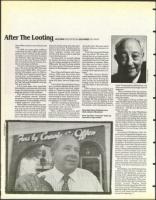
Above Right: Stanley Winkelman was a
charter member of New Detroit.
Below: Sam Offen: A sense that "whites and
Jews were no longer wanted."
PHOTO BY DAN IEL LIPPITT
After The Looting JULIE EDGAR
hand." Fortunately for Winkelman, the
store was insured and damage was not
extensive.
Then a member of the city commis-
sion on human relations, Winkelman
feels the riots were greatly exaggerat-
ed in the media.
`That night, I took my mother and
wife and drove them all the way down-
town. I wanted to prove that the city
wasn't burning down. It's true there
were fires ... but the city did not burn
down," he said.
Shortly after the riots, Winkelman
became a charter member of New De-
troit, a coalition of business and com-
munity leaders (including labor leaders
and political radicals), founded at the
request of then Governor George Rom-
ney and Mayor Jerome Cavanagh.
New Detroit was assigned to identify
and address the root cause of the dis-
turbance.
According to Winkelman, New De-
troit enjoyed substantial progress ear-
ly on, but its effectiveness dissipated
over the years as business involvement
declined and its mission was diluted.
In addition, Winkelman points out that
while there have been improvements
since 1967 — most notably the ascen-
dancy of black political leaders and the
growth of a black middle class, many
social problems like chronic unem-
ployment, crime and the public edu-
cation system have grown worse.
He also believes that black-Jewish
relations have worsened over the
years, primarily due to the movement
of Jews and their institutions out of
the city.
Nonetheless, new professional lead-
ership at New Detroit, notably its
president, Bill Beckham, and a nar-
rowing of the organization's agenda,
has brought "a new spark of life" to
the city, says Winkelman. That, com-
bined with the fact that Jewish Corn-
munity Council Director David
Gad-Harf recently joined the New De-
troit board, gives Winkelman some
hope that after 30 years, perhaps both
Detroit and black-Jewish relations
are on the upswing.
❑