
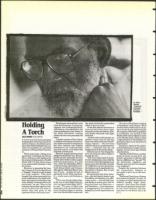

Dr. Arthur
Johnson:
"You do not
find blacks
running to
Farrakhan."
Holding
A Torch
JULIE WIENER STAFF WRITER
It is the sound of sirens and glass
breaking that will always haunt Dr.
Arthur Johnson, the former presi-
dent of the Detroit NAACP and a re-
tired vice-president for university
relations at Wayne State Universi-
ty.
Thirty years later, sitting in his
apartment overlooking the Detroit
River, Johnson is still saddened by
the memory of driving down Twelfth
Street with U.S. Rep. John Conyers
in an unsuccessful attempt to stop
the rioters.
However, in assessing the long-
term impact of what he describes as
a "tragedy," Johnson is able to point
out a few positives. "[The riots]
brought [the white community] to a
great awakening to the depth of de-
spair and anger and alienation that
many African- Americans felt in the
community," he said. "Many in the
business community began to real-
ize for the first time how little at-
tention they had given to the
oppressed black community here."
That despair stemmed from years
of job discrimination, housing seg-
regation and underemployment,
said Johnson, who added that in the
years preceding the riots, blacks of-
ten found themselves training
whites who then were promoted over
them.
A charter member of New Detroit,
a coalition of business and commu-
nity leaders founded in response to
the riots, Johnson was initially
heartened to see "ordinary black
men and women" at the table with
corporate powerhouses.
However, despite spurring initial
pledges to rebuild the city, Johnson
points out that ultimately the riots
simply led to further urban neglect
and racial polarization. It is only
now, under the leadership of May-
or Dennis Archer, that Detroit is ac-
tually being rebuilt, said Johnson,
although he added that Mayor Cole-
man Young — despite his lack of
popularity in the white communi-
ty — made some contributions as
well.
"What was already taking place
in the way of white flight from De-
troit was exacerbated [after 1967],"
he said. "The pace of flight was
quickened, and a peculiar kind of
racial thinking began to develop
here: that Detroit didn't matter and
[the white community] could indeed
afford to throw it away."
As the first African-Americans to
move into the Green Acres neigh-
borhood in northwest Detroit, John-
son's family witnessed white flight
firsthand.
"As days and months passed, my
children would come in and say,
`One more white family has moved."'
Today, Johnson — who now lives
with his wife in an apartment down-
town — estimates that the old
neighborhood is 85 percent black.
Johnson says he was disappoint-
ed to see Jews join other whites in
leaving the city.
"The most costly insult to black-
Jewish relations has come with the
movement of Jewish populations en
masse away from the city," he said.
"It is difficult to see how black-Jew-
ish relations can be significantly im-
proved from a distance. But we can't
afford to give up."
He recognizes that other obsta-
cles —like anti-Semitic leader Louis
Farrakhan and disputes over affir-
mative action — have divided Jews
and blacks in recent years. But he
feels that black anti-Semitism —
and Farrakhan — have been great-
ly exaggerated by the media and,
perhaps, by Jewish organizations as
well.
"You do not find blacks running
to Farrakhan," said Johnson. "He is
not the chosen leader and is not go-
ing to be the chosen leader because
the majority of the black population
is not Muslim, not moving to the
Muslim faith and not likely to move
to the Muslim faith. [There is also]
a regimentation in Farrakhan's or-
ganization that is not attractive to
most blacks."
Johnson is critical of the nation-
al Anti-Defamation League's inves-
tigation several years ago of black
anti-Semitism.
"Had the NAACP done a similar
study of racism among Jews, the
Jewish community would have felt
that in a different way," he said. "We
are historically neighbors and
friends, and you don't investigate
your neighbors."
Despite the tensions between
the communities, Johnson is
not ready to give up on the rela-
tionship.
"Blacks and Jews have a history
that cannot be denied," he said. "It
is a history in which each group has
suffered terribly tragic conse-
quences. I don't know how blacks
and Jews are going to become clos-
er, but I know we must. And I be-
lieve that we will find a way to do
it." ID