

The Scene
Be-Dekked Out
Reform and Conservative couples
are bringing old traditions into modern weddings.
LYNNE MEREDITH COHN STAFF WRITER
W
To brides and grooms, smash-
ing a glass symbolizes "the mo-
ment when the deal was sealed,
the moment when you felt mar-
ried," Rabbi Yedwab says.
He also credits Anita Diamant,
author of The New Jewish Wed-
ding, for a hand in the return to
tradition. The book suggests wed-
ding innovations (and old tradi-
tions); Diamant says you have to
understand traditions to execute
them.
Most Conservative weddings
FENBY
STEIN
Entertainment
• Agency •
JERRY FENBY
HOT ICE
TEEN ANGELS
THE CONTOURS
SIMONE VITALE
QUIET STORM
PERSUASION
SUN MESSENGERS
SUNSET
BOULEVARD
TIM HEWITT
LOVING CUP
BILL- MEYER
RENNIE KAUFFMAN
FENBY-CARR
ERIC HARRIS-DJ
1HE DETRO
PLEASE CALL FOR A FREE
VIDEO APPOINTMENT
44
810-553-9966
From bedekken (veiling cere-
mony) and circling to fasting and
taking a few moments to be alone
after the ceremony, bridal couples
are returning to their Jewish roots
to add spiritual spunk to their
weddings.
Rabbi David Nelson, of the Con-
servative Congregation Beth
Shalom in Oak Park, is seeing "a
re-emphasis on very traditional
aspects -7- although the Conserv-
ative wedding ceremony was al-
ways traditional. Couples are
seriously studying the ceremony,
so they know what to ask for."
Rabbi Paul Yedwab, of the Re-
form Temple Israel in West
Bloomfield, concurs.
"In Reform ceremonies, differ-
ent couples choose different
things," he says.
The biggies among Reform
weddings, says Rabbi Yedwab, are
bridal couples reciting the sheva
brachot (seven blessings) instead
of a rabbi or cantor. and yihud (a
few moments alone immediately
after the ceremony).
In days of old, yihud was the
first opportunity for bride and
groom to be alone; "it was sym-
bolic of their family status. I talk
about it as a symbol — at a wed-
ding, bride and
groom are first unto
each other, say `I love
you, we did it,' then
greet their guests.
The ideal of a Jewish
wedding is couples
first," Rabbi Yedwab
says.
Why the return to
tradition? "Some of it
is erasing mistakes,"
Rabbi Yedwab sug-
gests. "Reform Ju-
daism has come to
the realization of the importance
of physical symbols. Some is new
ideas.
"The early Reformers had it
wrong on some of the issues," Rab-
bi Yedwab says. For example, one
rabbi opposed breaking a glass un-
der foot. `Tor him it was obvious
that the breaking of the glass was
a symbol of the breaking of the Ny-
man, and it was vulgar," he ex-
plains. "His proof was that after
the breaking of glass, everyone
yells `Mazel toy!' If it symbolized
the destruction of the Temple,
why would we say 'rri azel
Well, [we say it] because the wed-
ding is over."
itself is very public."
The word "bedekken" comes
from the Yiddish verb "to veil." Co-
incidentally, it sounds like a He-
brew word which means "to
check." Some people mistake the
tradition for checking to make
sure it's the right bride, stemming
from the mix-up between Jacob,
Rachel and Leah (a biblical case
of the groom marrying the wrong
bride).
At a traditional bedekken, the
bride sits on a throne in one room;
PHOTOS BY GORBACK STU DIOS
at's old is new and
what's new is old in Jew-
ish weddings these days.
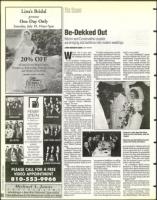
Dressed in a kittel, Noam Raz stands
beside his bride, Beth Bodzin, under the
chuppah.
Noam Raz signs the ketubah among his
closest male friends and relatives.
incorporate a bedekken, or veiling
ceremony, according to the Con-
servative Rabbi Elliot Pachter of
Congregation B'nai Moshe in
West Bloomfield.
"At more traditional weddings,
the bedekken is done very pub-
licly; more typically it's done with
just the immediate family and
bridal party," he says.
The practice of bedekken dates
back to the Bible. "Rebecca veiled
herself when she realized she was
going to marry Isaac," Rabbi
Pachter says. The veiling is "a sign
,1- Le private nature of the rela-
tionship between husband and
wife, even though the ceremony
-
surrounded by bridesmaids and
female relatives, and guests greet
and congratulate her. In anoth-
er room, the groom is surrounded
by men who sing and celebrate as
he signs the ketubah (marriage
contract). Then the men dance
into the women's room, and the
groom veils his bride.
At a bedekken, Rabbi Aaron
Bergman of West Bloomfield's
Conservative Beth Abraham Hil-
lel Moses, emphasizes that this is
the "last moment before they get
married. It's more emotional in
a lot of ways than being under the
chuppah itself."
More and more couples are con-
sidering how they can make their
ceremony very personal and very
spiritual.
Some grooms are embracing
the tradition cf donning a \vhiee
robe. or kittel, under the chum:eh,
says Rabbi Nelson. The robe is an