
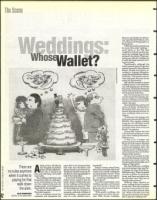

ILLUSTRATI ON BY SCOT RITC HIE
There are
no rules anymore
when it comes to
paying for that
walk down
the aisle.
JULIE WEINGARDEN
SPECIAL TO THE JEWISH NEWS
d rink of wine. He lifts the
veil. The glass is smashed.
A kiss. It's done. Mazel tov.
ow onto a whoop-it-up
hora and mile-long, circus-like
sweet table.
The wedding celebration calls
for guests to smile, cry, clink glass-
es, do a line dance or two, rave
over the radiant bride and ulti-
mately ponder, who's forking over
the dough for the shindig?
The answer used to be a given:
The bride's parents.
But as weddings turned into
weekends and receptions into
galas akin to an inaugural ball,
cost came into discussion and
things started to get divvied up.
The groom's family would pay for
the flowers, band, photographs or
half of the entire affair
In her book Wediquette, Yetta
Fisher Gruen explains that the
bride's family traditionally paid
for the wedding, and the groom's
family paid some expenses. "After
all, the bridegroom of yesteryear,
no matter what his education or
prospects, undertook a lifetime of
responsibilities — the support and
care of a wife, children and a
household."
Today's woman, notes Gruen,
often enters marriage with an ed-
ucation and a career, making her
an equal partner. So now, "more
and more families share expens-
es ... everything, including the re-
hearsal dinner."
It's unfair to generalize, since
wedding agendas and finances
vary from family to family. But
there are some common trends in
the Detroit area.
"With gentile weddings, the
couple pays,more than the par-
ents. With Jewish weddings,
Mommy and Daddy are still pay-
ing," says Harriet Friedman, own-
er of Diamond Photography in
Birmingham.
"Often the bride's parents pay
for most of the entire wedding —
you'd think in the '90s they
wouldn't be. Not only are they pay-
ing for the weddings, they are also
paying for the photos. These pay-
ments come after the wedding, yet
it's still the bride's parents writ-
ing the checks."
Traditionally, although the
bride's parents paid, the groom's
parents sprung for the rehearsal
dinner, flowers and liquor, ac-
cording to Solange Messelian,
owner of Lee's Specialty in Bloom-
field Hills. 'The groom's side al-
ways took part, but now we are
seeing full partnership."
She says the increase in shared
wedding costs is a new phenome-
non, only popping up over the last
four years. Among her clients, the
bride's side picks up the wedding
tab 75 percent of the time.
But "it's becoming more com-
mon for the bride's parents, giv-
ing the wedding, to acknowledge
the groom's parents on the invi-
tation," she says.
Haarold Bellcrest, a florist and
owner of House of Haarold in
Bloomfield Hills, also sees more
parents sharing costs because, he
says, weddings today are so ex-
pensive.
"In this area, the average wed-
ding [costs] between $25,000 and
$35,000. The regular wedding
across the U.S. is $18,000. Jewish
weddings are more elaborate —
the sweet table alone could cost
$2,000," he explains.
Among older couples, the trend
is for the bride and groom to take
care of the wedding themselves,
Bellcrest says.
"I find a lot of brides and
grooms getting married older, and
[they] are more mature. That has
a direct relationship with who
pays for the weddings. Now, a lot
of people pay for weddings them-
selves because they are further
along in their careers."
He sees more couples in their
30s and 40s getting married for
the first time, where in the '70s,
his clients got hitched right out of
college or high school.
Dee Dee Hoffman, a wedding
and event planner who runs Par-
ty Design out of her West Bloom-
field home, says, 'There are people
who like to follow the etiquette
books, and there are others who
do what they want. There are no
blanket rules anymore."
Hoffman helps organize as
many wedding duties as possible
for families. This role sometimes
puts her in the position of coun-
selor. The brides' parents often
ask, "What is the best way to tell
the groom's parents that they'd
like to split the wedding cost?"